Cupid Chastised
Bartolomeo Manfredi · 1613
Explore the painting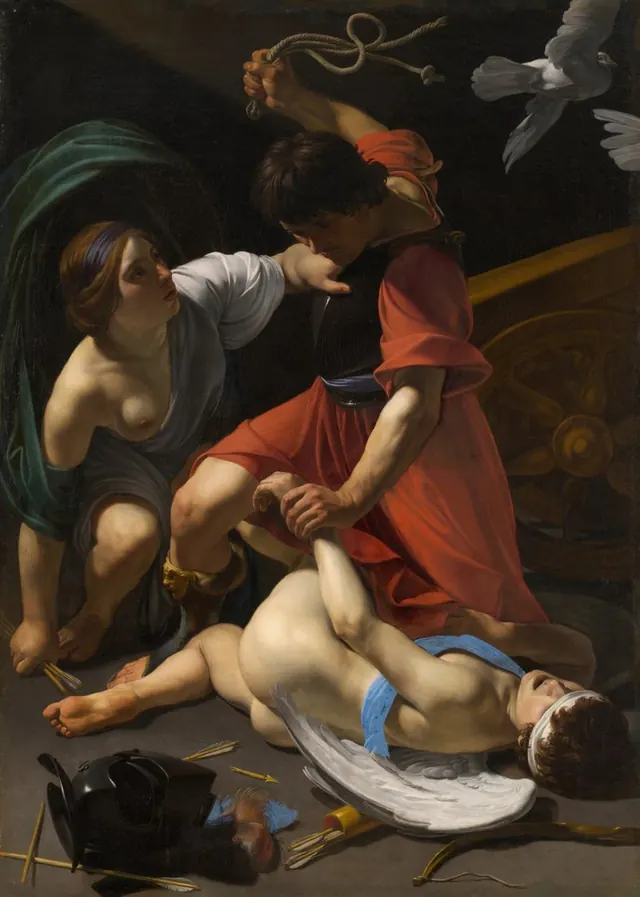
The painting’s story and details
Mars, god of war, raises a scourge above Cupid. Venus tries to stop him, while the boy already lies on the ground. The story makes this punishment for involving Mars in an affair with Cupid’s mother, Venus. Bartolomeo Manfredi painted the scene in 1613. Ancient deities take the bodies of ordinary people, turning myth into a crowded and physically tangible struggle.
Venus presses a hand against Mars’s chest and lifts her face towards him. Bending beside her son places her below the armed man. Her gesture connects all three figures while revealing their unequal power. The goddess of love acts as a mother trying to protect her child.
The raised hand grips a knotted cord. Its loops stand out against black, making the weapon visible before every spatial detail becomes clear. Light from the left sharply defines the arm. Action pauses before the blow. Figures occupy almost the entire canvas height, leaving little space around them.
Mars’s red clothing fills the centre. His knee presses beside Cupid’s body while the other hand restrains the boy’s wrist. Muscle and taut fabric emphasise effort. Following Caravaggio, Manfredi used recognisable human physicality in religious and mythological subjects. An elevated story became an event viewers could imagine through bodily experience.
Wings identify Cupid despite his helpless position and thrown-back head. Bright light exposes his naked body. Love’s weapons, bow and arrows, lie scattered nearby. The figure normally associated with control over other people’s feelings has become vulnerable himself. Authority over desire gives way to direct physical force.
A helmet lies among arrows along the lower edge. Military and amorous attributes occupy one heap, extending the figures’ conflict into their belongings. A large wheel emerges behind them. Objects give the myth a material setting, while the low viewpoint brings us close to the fallen body.
White birds fly at the upper right. Their wings echo Cupid’s pale wings below, connecting opposite corners. Darkness removes much of the surrounding world. Light concentrates attention on the action’s crucial points: raised weapon, restraining hand, faces and the boy’s body.
Manfredi began in Rome by copying Caravaggio. The museum proposes a connection with a lost painting by the older artist for Cardinal Francesco Maria del Monte. Strong light and shadow and figures studied from life became a language others could develop. The painting supports an allegory of love against war, while making that abstraction uncomfortably concrete. Behind competing forces stand a person striking, another protecting and another receiving the blow.
Period, style and subject
- Movement
- Baroque
- Genre
- Imagined worlds
- Medium
- Oil on canvas
- Collection
- Art Institute of Chicago
- Dimensions
- 175.3 × 130.6 cm
- Accession number
- 1947.58
Sources
Image provided under CC0. Image licence
Adapted and translated from Art Institute of Chicago materials. · Text licence