The Poet Lin Bu Wandering in the Moonlight
Du Jin · late 1400s
Explore the painting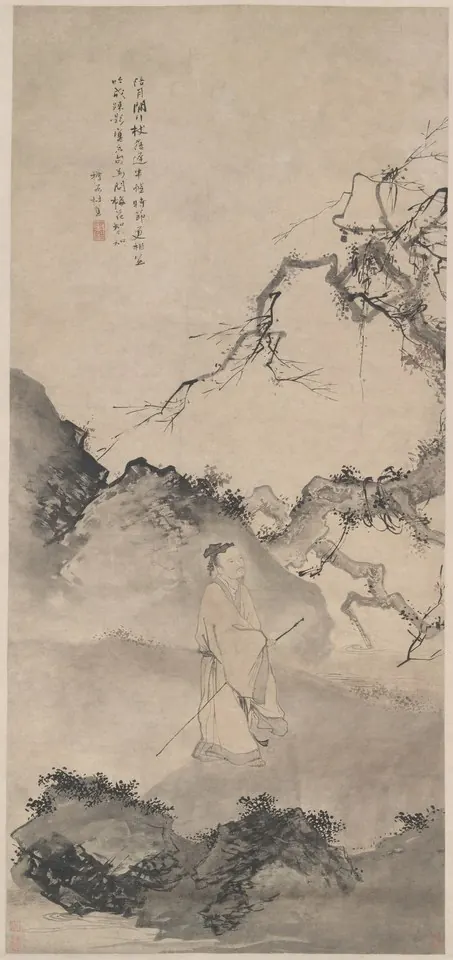
The painting’s story and details
The poet Lin Bu pauses beside a flowering plum. Du Jin painted him in the late fifteenth century, almost five centuries after his death. Lin Bu lived as a hermit beside Hangzhou’s West Lake rather than pursuing an official career. Poetry, plum trees and cranes shaped his memory. This painting returns to one such literary image: a night walk beside his beloved tree.
A man in a long robe lifts his head towards the branches. His staff crosses the figure diagonally, and the hem falls slightly away from his feet. The poet has paused during his walk to look at the blossoms. Du Jin places him in a setting familiar to readers of his poems about plum trees.
The plum extends a long branch across open space. Its angular trunk thickens and narrows, with fine offshoots spreading at varied angles. Traces of growth convey age. The branch occupies more room than the poet and becomes, convincingly, the principal object of his attention.
Small blossoms and dark dots scatter along the wood’s bends. Distinguishing them requires approaching the painting. The landscape thus echoes the effort of looking at night, as pale flowers gradually emerge. A familiar subject offers new details when given enough time.
Broad wet touches form foreground stones beneath darker strokes. They appear heavier than the airy branch. Du Jin varies his brushwork with the subject. That range conveys grounded weight and light blossoms within a restrained palette.
The inscription at the upper left connects the walk with poetry and preserves Du Jin’s signature. Few signed works by the painter survive. Writing identifies both an earlier subject and the artist who brought him back to a viewer. Centuries separate them, yet their presence meets on paper.
It was said that plum trees were Lin Bu’s wife and cranes his children. This image of chosen solitude became part of cultural memory. The painting sustains it by concentrating on the poet and tree. Withdrawal from public career itself became a source of lasting fame: he was remembered for preferring another way of life.
Featured in tours
Chinese landscape. The scholar’s life
Public service, retirement, gardens, poetry and the memory of earlier masters.
More paintings to compare
Period, style and subject
- Movement
- Chinese painting
- Genre
- Literary subjects
- Medium
- Hanging scroll; ink and color on paper
- Collection
- Cleveland Museum of Art
- Dimensions
- Image, 156.4 × 72.4 cm
- Accession number
- 1954.582
Sources
Image provided under CC0. Image licence