Herbaceous Peony
Yun Shouping · 1685
Explore the painting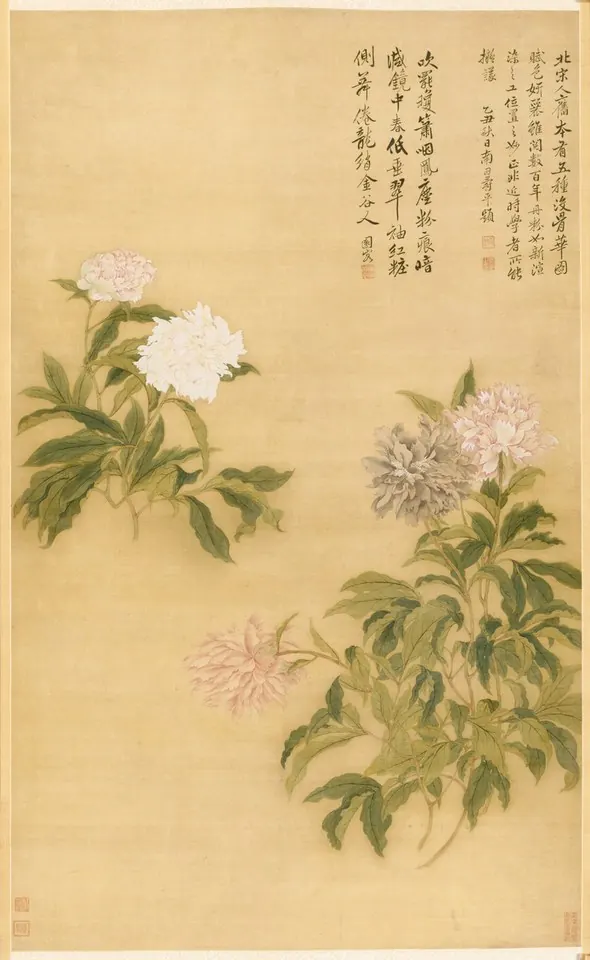
The painting’s story and details
Yun Shouping painted these peonies in 1685. Flowers were his principal subject, and his native Changzhou was known for paintings of plants and insects. No garden or vase surrounds the flowering stems; they are offered to close examination. Beside them, the painter recalls a Northern Song painting whose colours, he writes, retained their beauty over several centuries.
The white flower at the left opens more widely than the others. Barely perceptible tonal shifts distinguish its petals. This approach was called boneless, building form mainly through colour without a firm dark framework. Petal edges consequently appear thin and soft although each turn is carefully managed.
A smaller pinkish flower sits above it. Petals gather more closely around the centre, and the colour is slightly stronger. Neighbouring blossoms allow comparison of openness and hue. The painter preserves differences within a familiar motif, showing flowers at different stages of opening.
At the right, a greyish blossom neighbours a pale pink one. Drooping petals and heavy leaves give the group fragility. Peonies traditionally carried associations of prosperity, yet these plants do not look invulnerable. Their beauty includes weariness and a flowering season’s brevity.
Thin stems descend and break off, leaving the plants without roots. Reddish lines appear among the green. The Cleveland museum suggests a possible political allusion in the pale flowers and damaged branches. Yun lived through the Ming collapse, participated in resistance to the Manchus and lost relatives. That biography adds weight to fading blossom.
The inscription praises an earlier master’s colours, composition and skill, difficult to equal among contemporaries. It is a specific judgment about art. Admiration for a distant past may also suggest dissatisfaction with the present. The text leaves both possibilities together without assigning a separate cipher to every flower.
The peonies join different times. A real flower quickly loses freshness; the old painting Yun describes keeps its colours for centuries; his new work returns those qualities to another generation. Loss is therefore accompanied by continuation. An artist who survived the destruction of an earlier world can still transmit knowledge of its painting through close depiction of his own.
More paintings to compare
Period, style and subject
- Movement
- Chinese painting
- Genre
- Still life
- Medium
- Hanging scroll; ink and color on silk
- Collection
- Cleveland Museum of Art
- Dimensions
- Painting, 118.7 × 71.8 cm
- Accession number
- 1967.192
Sources
Image provided under CC0. Image licence