Repose
John White Alexander · 1895
Explore the painting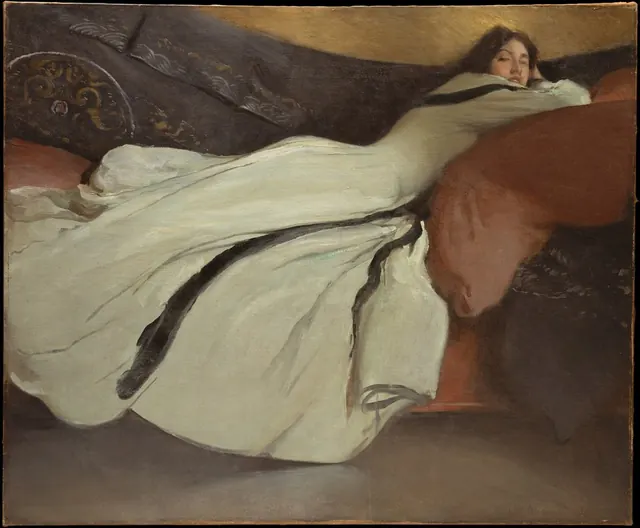
The painting’s story and details
John White Alexander painted Repose in 1895 while working in Paris. His images of women in interiors enjoyed international success. Here a pale dress occupies much of the canvas, while the face is placed near the upper right corner. The museum connects its flowing contours with Art Nouveau. The human figure belongs to a continuous arrangement of curves joining fabric, cushions and furniture.
The woman’s head lies close to the upper edge. Light picks out cheek, forehead and neck, leaving part of the face in shadow. She looks towards us. The turn of her head completes the long diagonal of her body across the canvas.
Pale fabric extends from the shoulder across the canvas towards the lower left edge. Large folds form broad arcs, with smaller details following their direction. At closer range, cream, grey and yellowish passages become distinct. Clothing gives the painter an extensive surface on which to explore colour. It makes the figure legible from a distance, before individual features can be distinguished.
A black ribbon crosses the pale dress. Its narrow curve is especially clear against the broad folds. The same organising principle operates on different scales: the figure’s large contour finds an echo in a small detail of costume. This helps Alexander hold the image together. The ribbon remains part of the clothing while guiding the eye through the fabric’s arrangement over the body.
A reddish cushion on the right supports the upper part of the figure. Its rich colour differs from the pale dress, while its rounded volume continues the shapes of arm and shoulder. The body consequently appears settled into the furniture. Comfort is only part of the effect. The large cushion also fills the right side of the canvas, balancing the long stretch of light fabric on the left.
Curving ornament is visible on the dark upholstery. Beside the dress, it remains subdued, keeping the background from breaking into overly assertive patches. A relationship between painting and decorative art becomes directly apparent. The contours of objects and the human figure echo the pattern. This coordination of lines helps explain the picture’s affinity with Art Nouveau.
Alexander began his career in American publishing. He became an illustrator at Harper’s Weekly in 1875, then studied in Munich and worked with Frank Duveneck in Italy. Strong silhouettes and a clear distribution of light and dark were useful to a magazine artist too. This experience provides context for his mature style. In the same year, 1895, Alexander received a mural commission for the Library of Congress. His career connected magazine illustration, easel painting and the decoration of public buildings. Repose belongs to an intimate genre, but the figure is organised across a substantial surface. The painting shows how a scene of private leisure could also become an exploration of line, silhouette and the decorative arrangement of space.
Period, style and subject
- Movement
- Art Nouveau
- Genre
- Everyday life
- Medium
- Oil on canvas
- Collection
- The Metropolitan Museum of Art
- Dimensions
- 132.7 × 161.6 cm
- Accession number
- 1980.224
Sources
Image provided under CC0. Image licence