Autumn Oaks
George Inness · ca. 1878
Explore the painting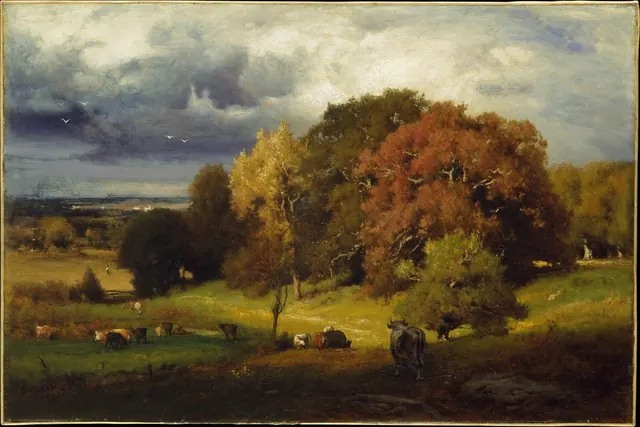
The painting’s story and details
Around 1878 Inness painted an autumn grove with grazing cattle. By then he had worked extensively in Italy and France and encountered European painting. His landscapes were becoming freer in brushwork and less minutely descriptive. In Autumn Oaks the trees remain recognisable, but their crowns merge into a large mass caught by changing light.
Russet foliage fills the middle of the grove. Pale branches emerge between its patches, while dark recesses convey the crown’s thickness. Small touches of the brush sometimes broaden into rubbed patches. The tree’s surface feels varied, dense within and loose where leaves meet the air.
The yellow tree to the left of the oaks advances through its light colour. Almost black foliage lies behind it, with slender trunks and grass below. Inness uses contrasts within a single grove without separating it into equally distinct trees. The overall impression depends on connections between areas and on differences in how they are painted.
The nearest cow presents its hindquarters to us. Light catches its spine, horns and the edges of its legs, leaving the body dark. It is a heavy, distinct silhouette before loosely painted vegetation. Its size measures the meadow’s depth: farther across the slope, the animals shrink into a few patches of colour.
The herd stretches across the lower meadow. Some animals stand and others lie down; white flanks emerge into light or disappear into shade. Pasture, path and distant fields reveal an inhabited rural landscape. Such an everyday tract of land supplied Inness with material for an ambitious landscape without mountain peaks or a famous landmark.
White birds stand out against a dark band of clouds. A few brief strokes describe them, but their scattered chain opens the distance on the left. Pale land at the horizon picks up the same colour. Small white marks connect the broad sky with the narrow strip of fields, bringing both into the same illumination.
The pale clouds above the grove are painted with broad movements. Grey and blue passages remain within them, while their edges almost disappear in places. Moving air is handled differently from the solidity of a cow’s silhouette or a branch. Varying paint density lets sky, foliage and earth retain distinct qualities within a shared space.
Inness followed Emanuel Swedenborg’s teaching, which connected the visible and spiritual worlds. He wrote about colour’s significance and regarded landscape as a means of expressing that relationship. Observation of weather therefore accompanied a religious search. Here that belief can be read through the unity of light and space, with oaks and pasture forming part of a broader conception of nature.
More paintings to compare
Period, style and subject
- Movement
- Symbolism
- Genre
- Landscape
- Medium
- Oil on canvas
- Collection
- The Metropolitan Museum of Art
- Dimensions
- 54.3 × 76.5 cm
- Accession number
- 87.8.8
Sources
Image provided under CC0. Image licence