The Toilette of Venus
François Boucher · 1751
Explore the painting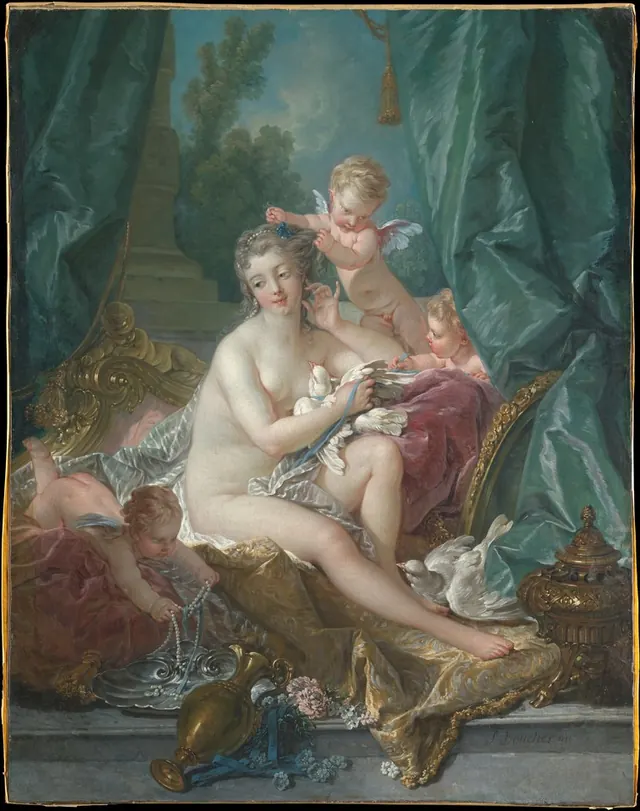
The painting’s story and details
In 1751 Madame de Pompadour commissioned this painting from Boucher for Bellevue, her residence near Paris. It hung above the door to the dressing room in the bathing pavilion, paired with The Bath of Venus. An ancient goddess accompanied the owner’s daily routines, while the painting extended the carving, fabrics and gilding of the actual interior.
Venus sits among cushions, with one leg extended diagonally. A white dove rests in her lap and another beside her foot. Doves are a traditional attribute of the goddess of love. Pale skin stands out against cool green fabric and warm pink velvet. Her turn brings these broad areas of colour together around her hands and knees.
The winged child above the goddess arranges her hair. Ornaments are already woven into it, and Venus touches her ear. The mythological scene retains recognisable actions of a morning toilette. At the French court, dressing and grooming formed an elaborate ritual; Boucher turns it into a light performance with small divine attendants.
Another cupid peers out from behind the pink fabric on the right and holds a blue ribbon running towards the bird in Venus’s lap. Almost everything is connected by touch: hands attend to hair, ribbon and jewellery. Separate actions gather around one figure, giving the goddess the concentrated care of a household retinue translated into mythology.
At the lower left, a child handles strings of pearls above a silvery shell. Flowers and an overturned golden vessel lie nearby. The shell recalls Venus’s marine origins while also resembling precious household ware. Mythological attributes enter an array of luxuries that could interest the patron and the craftspeople furnishing her home.
Large green curtains part to reveal a column and distant trees. The space cannot be reduced to an ordinary enclosed room: luxurious furniture stands before a park view. The drapery works almost like a theatre curtain. Such artifice belongs to Rococo decoration, where interiors, gardens and imagined action could combine within a single ensemble.
Furniture scrolls recur in the shell’s edge, fabric folds and the vessel’s curved handles. Boucher changes material while retaining related shapes. He also designed for theatre, tapestries, book illustration and porcelain. This painting belongs to a world of collaboration across crafts, in which wall decoration coordinated with the room as a whole.
Pompadour was Louis XV’s official mistress and an influential patron of Boucher. Commissioning such ensembles made her an active participant in court artistic patronage. Venus lent a private space the prestige of classical culture, while costly materials emphasised its owner’s position.
More paintings to compare
Period, style and subject
- Movement
- Rococo
- Genre
- Myths & allegories
- Medium
- Oil on canvas
- Collection
- The Metropolitan Museum of Art
- Dimensions
- 108.3 × 85.1 cm
- Accession number
- 20.155.9
Sources
Image provided under CC0. Image licence