Portrait of a Young Man
Bronzino · 1530s
Explore the painting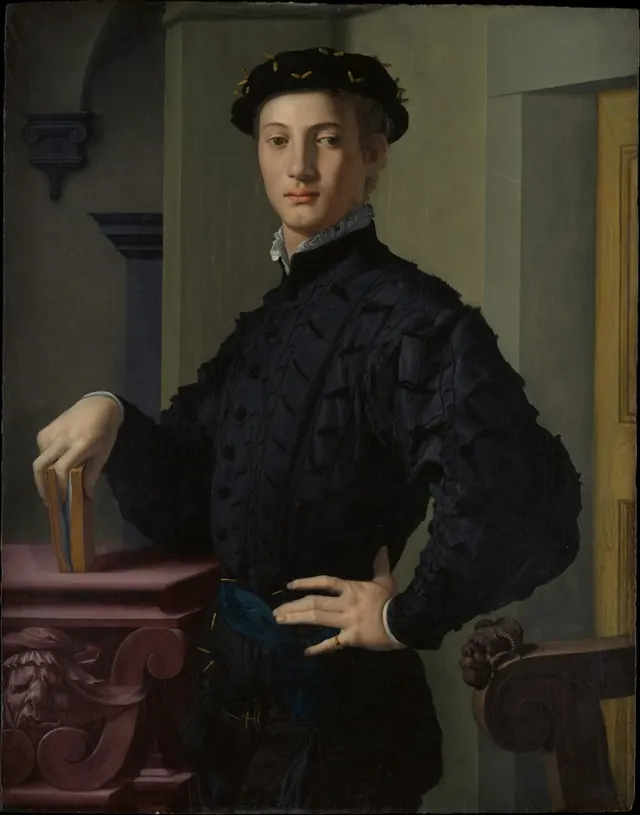
The painting’s story and details
A young man stands beside a table, holding a book. His identity is unknown. The Metropolitan Museum associates him with Bronzino’s literary circle and suggests that the volume contains poetry. Painted in Florence in the 1530s, the portrait presents learning together with carefully arranged dress and posture, while strange faces on the furniture complicate its outward seriousness.
The face turns almost toward the viewer, but the eyes shift sideways. Smooth skin and precise contours contain the features. The lower lip projects slightly and the eyebrows are finely drawn. This finish produces a restrained expression. No emphatic gesture or incident supplies a single explanation of the sitter’s character.
The book rests on its edge, with fingers marking a place between pages. The young man is not reading at this moment, yet the volume participates in his self-presentation, associating leisure with literature. Bronzino himself wrote poetry, including comic verse, and the portrait could address a circle that valued verbal invention.
Dark clothing consists of numerous slashes, folds, and projections. Light shifts from near black to cool blue. Golden fastenings and a white collar supply small accents. Restrained color conceals the garment’s complexity of manufacture. An expensive appearance can be established without large areas of bright color.
The hand at the hip spreads its fingers, with the elbow projecting outward. This gesture claims space and stabilizes the figure. Long fingers receive the same precision as details of clothing. The pose appears prepared for representation, conveying social assurance without a name or official title.
A grotesque face appears on the table support, with another decorating the chair at the right. Their distorted features coexist with the meticulously finished human face. The museum connects these masks to literary play involving appearance and self-presentation. The elegant portrait admits irony about its own persuasiveness.
Book, clothing, and relaxed posture construct a person with access to education and leisure. The masks introduce doubt about that image’s transparency. They can evoke the artifice of public self-presentation without exposing a secret or discrediting the sitter. The portrait offers both a persuasive human presence and an inventive play on what appearance can communicate.
Featured in tours
Florence and Rome. Patrons of the Renaissance
Merchants, monasteries, the Medici and the papal court. The changing work of artists from the thirteenth to the sixteenth century.
More paintings to compare

Period, style and subject
- Movement
- Mannerism
- Genre
- Portrait
- Medium
- Oil on wood
- Collection
- The Metropolitan Museum of Art
- Dimensions
- 95.6 × 74.9 cm
- Accession number
- 29.100.16
Sources
Image provided under CC0. Image licence