"Bahram Gur Sees a Herd of Deer Mesmerized by Dilaram' s Music", Folio from a Khamsa (Quintet) of Amir Khusrau Dihlavi
Attributed to Miskin · 1597–98
Explore the painting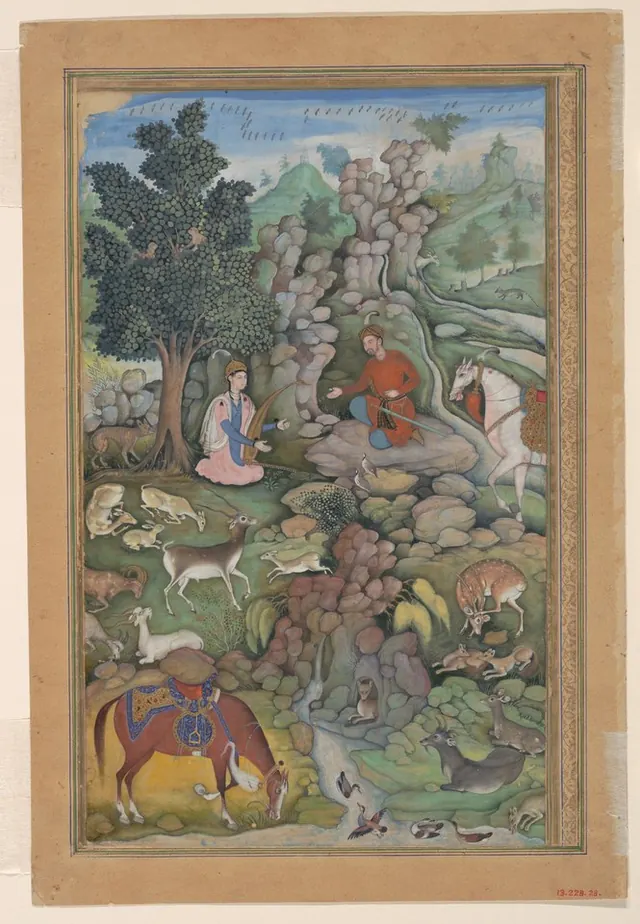
The painting’s story and details
Dilaram plays before King Bahram Gur while animals gather around. In Amir Khusrau’s story, her music can put animals to sleep and wake them. This miniature of 1597–98 is attributed to Miskin. It belonged to a copy of the Khamsa made for Emperor Akbar. In a book about rulers, a woman held in enslavement temporarily possesses exceptional power.
Dilaram sits with a harp, her hands engaged with the instrument and her body turned toward the king. The miraculous action originates in human skill. She needs neither a weapon nor a command to captivate animals. The story gives musical performance a power that courtly audiences could appreciate.
Bahram Gur listens at the right, extending a hand. His position differs from that of a royal hunter pursuing prey. Here animals approach another person’s music. A ruler’s military and hunting power encounters an art he does not himself produce in this scene.
Deer have approached the performers closely. Some stand while others settle on the ground. Their different states make music’s effect visible without representing sound. Their bodies continue Dilaram’s performance visually, and their stillness acquires a narrative purpose.
A monkey appears in the tree, above and away from the main group. Animal life extends across the page. The painter leaves small discoveries around the central marvel. These creatures give the story of music’s influence a varied, inhabited setting.
Angular rocks rise among the animals, connecting this Mughal miniature to Persian manuscript painting. Amir Khusrau’s text itself continues Nizami’s poetic tradition while retelling it in his own way. At Akbar’s court, older stories acquired new images and entered an imperial library.
Dilaram possesses an art that stills surrounding life, but her gift does not abolish her dependent status. That makes the scene more complex than a tribute to beautiful music. A ruler may admire another person’s talent while remaining her master. The miniature preserves the performer’s supremacy at the moment when her playing governs attention and animal behavior.
Featured in tours
Love, marriage and encounters
Gods, lovers, spouses and people whose relationships remain unknown.
The courtly book. Iran and India
Poets, scribes, painters and rulers make an illustrated manuscript.
More paintings to compare
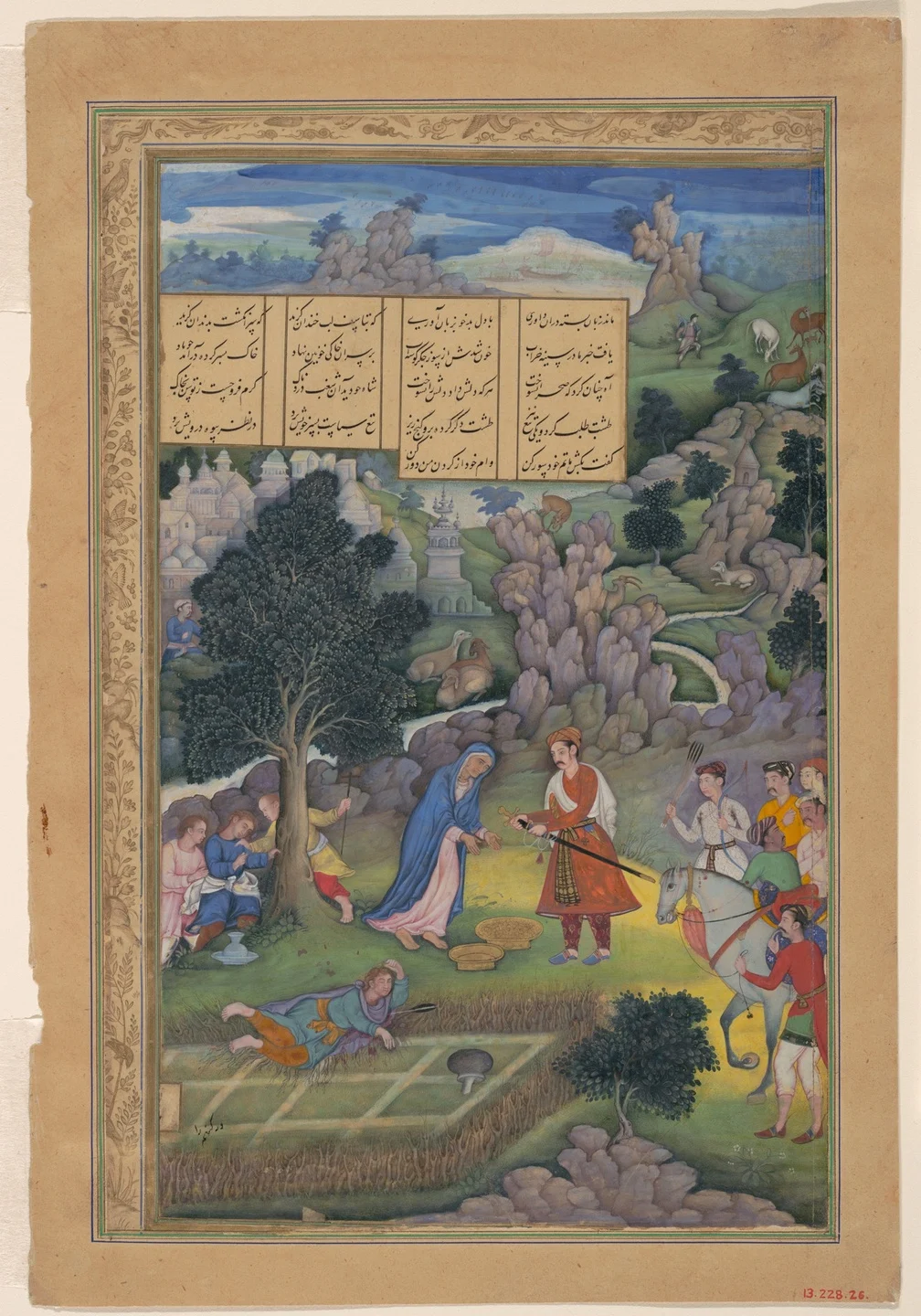 Attributed to Miskin
"A King Offers to Make Amends to a Bereaved Mother", Folio from a Khamsa (Quintet) of Amir Khusrau Dihlavi
1597–98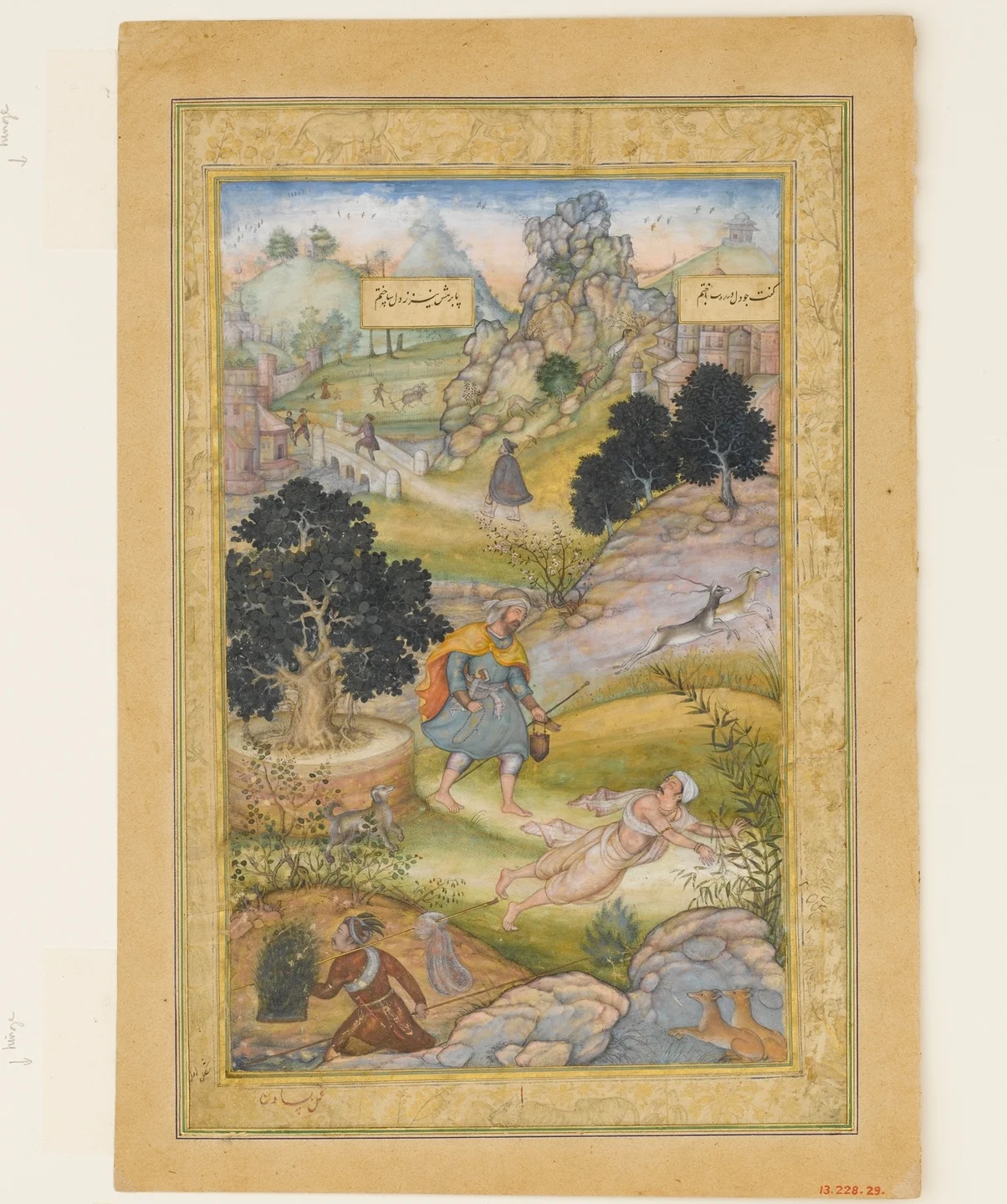 Basawan
"A Muslim Pilgrim Learns a Lesson in Piety from a Brahman", Folio from a Khamsa (Quintet) of Amir Khusrau Dihlavi
1597–98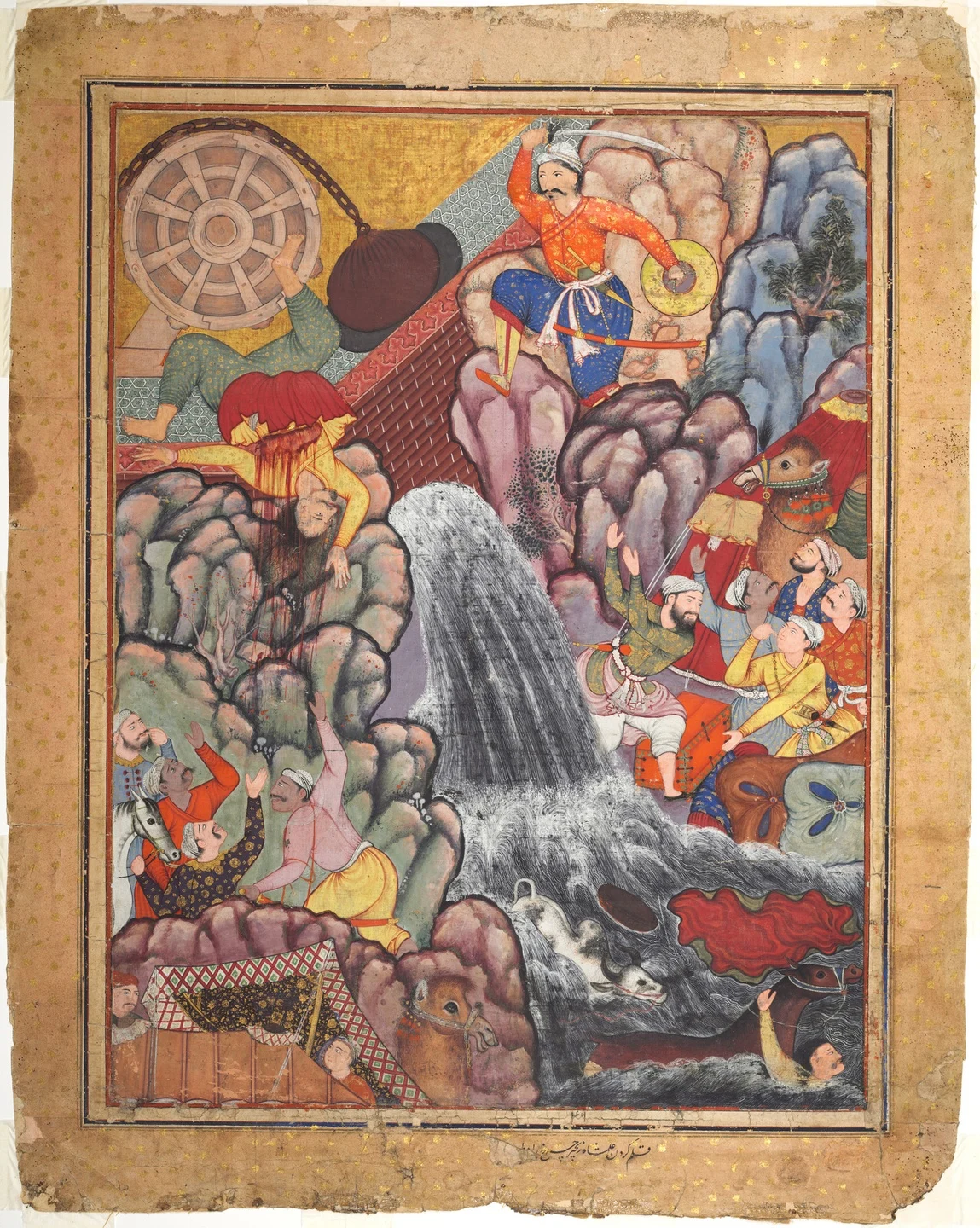 Unidentified painter of Akbar's workshop
Alamshah cleaving asunder the chain of the wheel, from volume 11 of a Hamza-nama (Adventures of Hamza)
c. 1560s–70sPeriod, style and subject
- Movement
- Mughal painting
- Genre
- Literary subjects
- Medium
- Main support: ink, opaque watercolor, and gold on paper Margins: gold on dyed paper
- Collection
- The Metropolitan Museum of Art
- Dimensions
- 24.5 × 15.1 cm
- Accession number
- 13.228.28
Sources
Image provided under CC0. Image licence