"Krishna Holds Up Mount Govardhan to Shelter the Villagers of Braj", Folio from a Harivamsa (The Legend of Hari (Krishna))
Unidentified Mughal painter · ca. 1590–95
Explore the painting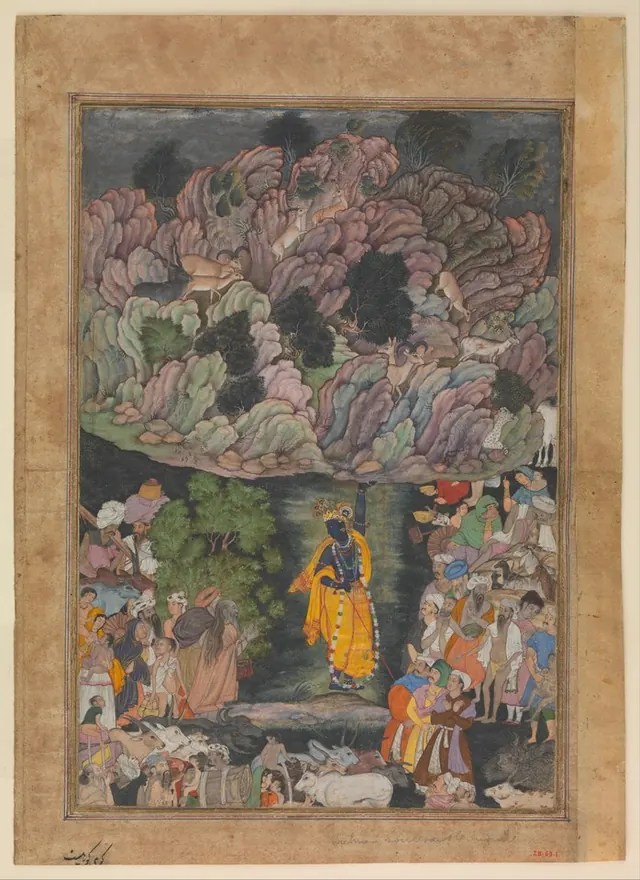
The painting’s story and details
An entire mountain hangs above the crowd. Krishna supports it with one raised hand, sheltering the people of Braj from a downpour sent by the god Indra. The painter makes the miracle legible through a simple spatial relationship: an immense mass of rock rests on a small human figure. Beneath it a whole community fits together with its domestic animals.
The leaf was made around 1590–1595 in a Mughal court workshop, probably in Lahore. Under Emperor Akbar, Hindu texts were translated into Persian and illustrated. This episode comes from the Harivamsa, an account of Krishna’s genealogy and deeds. For a Persian-language book, painters had to develop new compositions around material unfamiliar to that manuscript tradition.
Krishna stands out through his dark blue body, yellow clothing, and the open space surrounding him. His arm reaches towards the mountain’s lower edge. Feet and hand create a vertical axis around which the image is organised. The crowds on either side make this central interval more conspicuous.
The mountain consists of folded pink, green, and lilac rocks. It has no single smooth silhouette: the surface divides into many closely packed forms, holding the eye for a long time. Its scale and abundance of projecting rocks make the mountain’s extraordinary weight tangible.
Animals remain among the rocks and trees above. Some stand on ledges; one rises onto its hind legs. Their small movements, familiar from observing nature, enter the miraculous event. The mountain retains its own inhabited world even after becoming a shelter for the people below.
At the right, faces gather in several close rows. One person raises a hand, another joins the palms, and others look upwards. Different gestures respond to the same event: Krishna and the mountain above. The crowd nevertheless avoids becoming a repetition of identical figures through varied headwear, ages, and bodily positions.
In the left group, people appear in profile and from behind. Overlapping bodies show that they stand beyond the first row. The clear space around Krishna survives despite the crowding. This calculated distribution of space makes the central action easy to locate among numerous faces and brightly coloured clothes.
Cattle and other domestic animals fill the lower edge, their heads interspersed with human figures. Protection extends to the whole village community, including the animals on which its daily life depends. This detail gives the gods’ cosmic conflict an understandable human scale.
Court translation can be understood as interest in another religious tradition. It also brought that tradition’s texts into an imperial library and patronage system. The painting does not require only one explanation. It shows cultural exchange taking place within relationships of power and commission.
The painter of this leaf has not been identified. The work preserves another important fact: a Hindu narrative entered a luxurious book for the court of a Muslim emperor. Translation changed its readership, while illustration conveyed the story through faces, gestures, and spatial arrangement. Book art thus participated in the cultural life of a diverse empire.
More paintings to compare
Period, style and subject
- Movement
- Persian painting
- Genre
- Religious art
- Medium
- Ink, opaque watercolor, and gold on paper
- Collection
- The Metropolitan Museum of Art
- Dimensions
- 28.9 × 20 cm
- Accession number
- 28.63.1
Sources
Image provided under CC0. Image licence