Bamboo in the Wind
Yi Jeong, known as Taneun · early 17th century
Explore the painting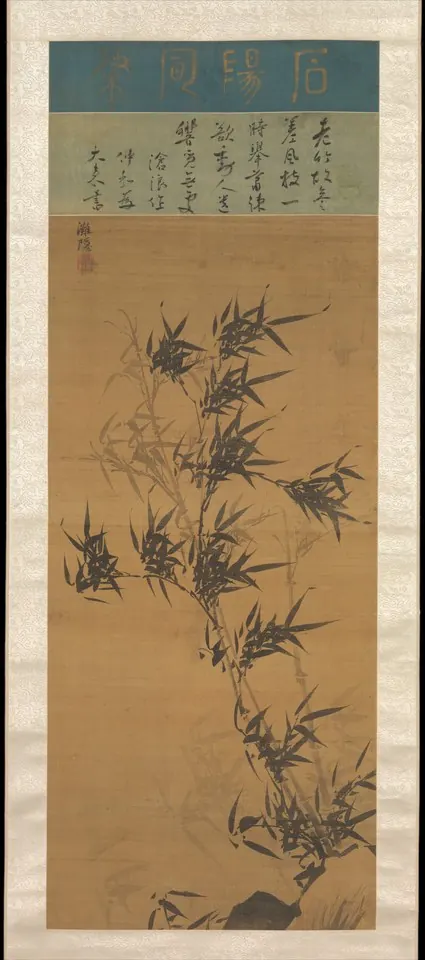
The painting’s story and details
Yi Jeong, known as Taneun, belonged to the royal family and was a great-great-grandson of King Sejong. He practised poetry, calligraphy, and ink painting. These arts meet in this early-seventeenth-century scroll: bamboo appears beneath a poetic inscription, and the leaves are formed through movements related to a calligrapher’s brushwork.
Stems bend while long leaves point in different directions. Wind is conveyed through the plant’s position. No separate sign depicts a current of air, yet the eye can follow where branches bend more strongly and where they remain nearly straight.
A dark leaf begins broadly and ends in a sharp tip. A short brush movement produces a complete form. Leaves differ in length, angle, and width although they share a technique. Repetition requires control: a small change of pressure changes the mark.
Paler bamboo appears behind the dark leaves. The nearer plant overlaps its stems and branches in places. Diluted ink creates another plane without a different colour. Light and dark emerge from one material, with the silk support visible between them.
A shoot at the left carries a cluster of leaves away from the main vertical. The composition therefore avoids becoming an even column. The plant has a principal direction of growth, but individual branches depart from it, producing a living, branching form.
The inscription concerns aged bamboo and branches lifted by the breeze. East Asian scholar culture associated the plant with moral integrity and dignity. Its flexible stem offered an observable basis for that comparison. A botanical subject could thus prompt reflection on how a person responds to pressure.
The rock below is a compact dark form. Finer, more mobile stems rise above it. Most of the remaining surface omits details of location, concentrating attention on the plant and the quality of the brush marks rather than on the precise arrangement of a garden or bank.
The traditional moral reading of bamboo does not automatically reveal Yi Jeong’s personal convictions. The scroll can be understood both as a statement within scholar culture and as a demonstration of brush skill. These approaches complement one another, while the particular occasion for its creation remains an open question.
More paintings to compare
Period, style and subject
- Movement
- Korean painting
- Genre
- Still life
- Medium
- Hanging scroll; ink on silk with gold on colophon
- Collection
- The Metropolitan Museum of Art
- Dimensions
- Image, 115.6 × 53.3 cm
- Accession number
- 2015.300.299
Sources
Image provided under CC0. Image licence