Portrait of the Boy Eutyches
Unidentified painters of Roman Egypt · 100–150 CE
Explore the painting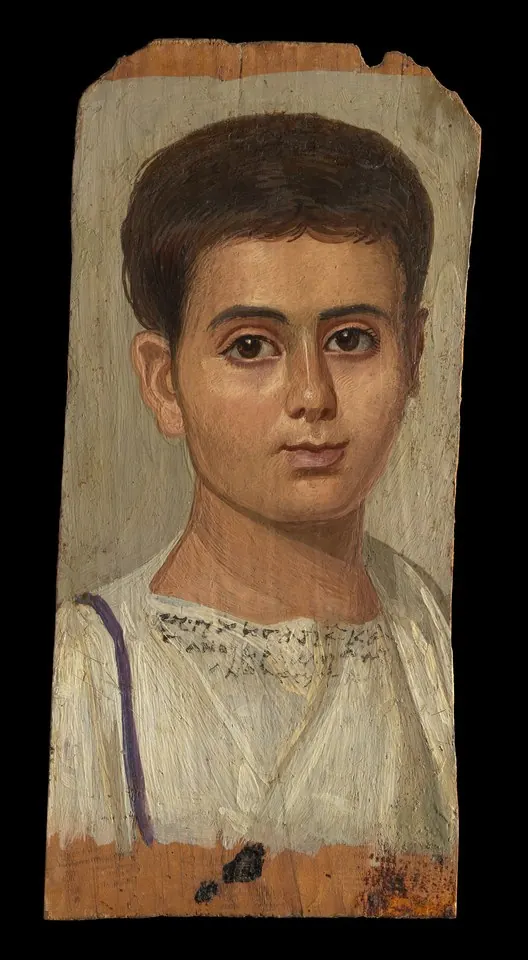
The painting’s story and details
This is Eutyches, an adolescent who lived in Egypt in the second century CE. His face feels immediate through the slight turn of his head, the light on his skin, and his clear eyes. Yet the portrait served a funerary purpose. A wooden panel like this was placed over a mummy’s face and held by its wrappings, preserving the deceased person’s recognisable appearance.
A Greek inscription survives on the tunic. Scholars securely read Eutyches’ name and identify him as a freedman of Kasanios, meaning that he had previously been enslaved. The remaining words allow different readings. They may include an artist’s signature, but that cannot be stated with certainty. Even this short inscription leaves important questions about his life unanswered.
The head turns slightly, so one cheek appears broader than the other. A soft shadow separates the nose from the face, and the lips have volume. The painter creates a likeness through small differences. The restrained expression does not tell us the boy’s character or his feelings while posing; it shows the appearance chosen for the portrait.
Small bright points appear in the dark eyes, with broader pale strokes along the lower eyelids. Marks of different sizes suggest a moist eye and illuminated skin. Close looking reveals how tiny areas of the painted surface sustain the impression of a living face.
The hair forms a dense dark mass but separates into locks over the forehead. On the skin the strokes run differently and almost merge. The painter used a wax-based medium, encaustic. Its surface retains the marks of working, and differences among those marks distinguish hair, cloth, and skin.
A narrow purple stripe marks the white tunic at the boy’s right shoulder, on our left. Long pale strokes describe the cloth and spread along its folds below the neckline. Roman clothing appears alongside Greek writing. Together with the Egyptian form of burial, they show different cultural traditions meeting in one person’s life.
The lower part of the board is unpainted and its edges are irregular. The portrait formed part of a funerary object. Freed from its wrappings, it now looks like an independent painting. Originally, the image was connected to the body and preparations for existence after death.
A Greek name and Roman clothing do not securely establish Eutyches’ ethnicity. The freedman inscription records legal status rather than an entire life. A recognisable face makes the person feel close while leaving questions that appearance cannot answer.
Images of this kind are often called Faiyum portraits, although they were found beyond the Faiyum oasis as well. Eutyches belongs to Roman Egypt, where language, clothing, legal status, and funerary belief could draw on different traditions. His portrait makes that coexistence visible through specific things: an inscription, a tunic, wax-based paint, and a wooden support.
Featured in tours
Cave, tomb and Roman home
Where images belonged before the familiar museum painting.
More paintings to compare
Period, style and subject
- Movement
- Roman Egyptian painting
- Genre
- Portrait
- Medium
- Encaustic on wood
- Collection
- The Metropolitan Museum of Art
- Dimensions
- 38 × 19 cm
- Accession number
- 18.9.2
Sources
Image provided under CC0. The surviving portrait panel. Image licence