Diver — painted lid from the Tomb of the Diver
Unidentified painter of Poseidonia · 480–470 BCE
Explore the painting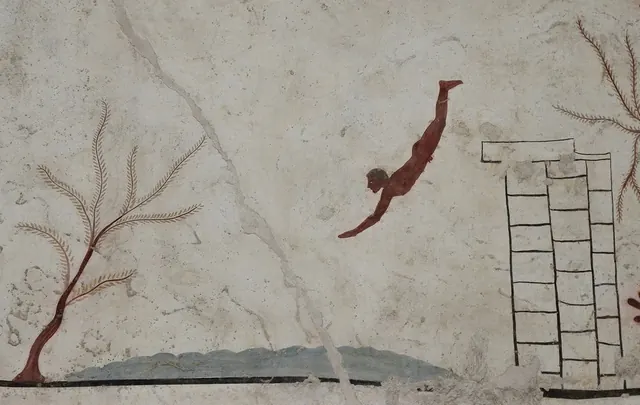
The painting’s story and details
A young man dives into water, but his image was made for a sealed tomb. It was discovered in 1968 near ancient Poseidonia, now Paestum in southern Italy. Dating from the early fifth century BCE, it covers the inside of a stone lid. After burial it was meant to remain in darkness. That original condition changes our understanding of the apparently simple athletic movement.
The body extends through open space between a structure and the water. A thin dark contour separates its reddish silhouette from the pale ground. Shading contributes little to the muscles. The dive is recognizable through the torso’s angle, raised legs and outstretched arms. Those features establish a particular phase of movement that we can mentally continue.
The arms point towards the water, followed by the head. A large empty field remains between the hands and the surface. It gives the instant a felt duration although the lid presents only one pose. Empty space performs a task that neighbouring actions might perform in a crowded scene. We see the start and the expected end of the dive at once.
The structure on the right consists of outlined rectangular blocks. It establishes the height from which the movement began. Its schematic form makes a precise location or real platform difficult to identify. In a funerary setting, the dive is often read as passage beyond life. The tomb’s purpose supports that reading, but no inscription fixes it conclusively.
A slender tree occupies the left side. Its branching trunk and short leaves suggest an outdoor setting without a detailed landscape. Part of another plant appears at the right edge. They contain the scene laterally while leaving the youth in an open centre. With so few elements, each relationship becomes especially noticeable.
A low blue-grey band marks the water. It occupies little of the surface but determines the entire action. We can readily imagine a splash and the continuation of the dive. Yet the archaeological object cannot decide whether this recalls an activity of the deceased or presents a symbolic image. What is depicted and why it was placed in a tomb remain separate questions.
The tomb’s four side slabs depict a symposium, or drinking party. The dive originally stood above another world of images involving communal food, wine and music. An isolated reproduction leaves only one part of the ensemble. It helps us examine the drawing but weakens its connection with burial ritual. Understanding the diver requires bringing those unseen side walls back into the account.
The archaeological park emphasizes that the scene has no single agreed explanation. The lid belonged to the deceased and those conducting the burial; the museum presents it to many modern viewers. These audiences have different expectations. We can value the clarity of the contour while recognizing limits to our knowledge of its ancient purpose, leaving room for several grounded readings.
Featured in tours
Cave, tomb and Roman home
Where images belonged before the familiar museum painting.
More paintings to compare
Period, style and subject
- Movement
- Ancient painting
- Genre
- Religious art
- Medium
- Painting on plaster over limestone
- Collection
- National Archaeological Museum of Paestum
Sources
Image licensed under CC BY-SA 2.0. The source photograph was cropped by Surajr7. Gallery previews and zoom tiles are resized derivatives, without further cropping or retouching. Image licence