Still Life with Flowers
Odilon Redon · 1905
Explore the painting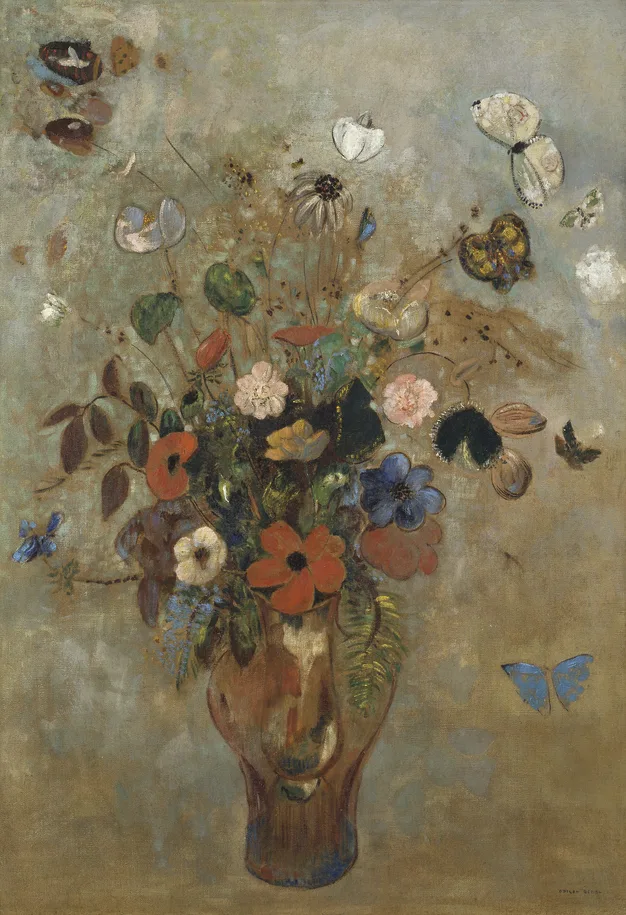
In 1905 Odilon Redon was sixty-five. He had established his reputation through black-and-white drawings and lithographs of fantastic creatures, but in his later years he increasingly painted flowers. A familiar domestic subject allowed him to continue exploring the imagination. Individual plants remain recognisable here, yet their scale, arrangement and surroundings form a composition that is difficult to mistake for an ordinary arrangement in a room.
The dark vase extends through almost a third of the canvas. Its solid brown silhouette anchors the scattered flowers near the bottom. Yet the edge of the table is barely discernible, and there is no familiar wall behind the bouquet. Redon retains enough domestic evidence for us to recognise a still life while removing details that would establish its precise position in space.
The orange-red flower sits in front of dark foliage. Small pale touches loosen its centre, while its petals spread unevenly. Here colour visibly constructs form. Cool blue and greenish patches surround the dense red, making even this small part of the bouquet feel richly varied.
The pale flowers at the top are separated by wide intervals. Their thin stems almost disappear into the background. As a young man Redon knew the botanist Armand Clavaud, who introduced him to plants and scientific observation. This interest survived in his fantastic works. Precision in an individual petal could coexist with an invented setting.
A small blue butterfly appears beside the vase on the right. Its colour recurs in the flowers above, and its wings are similar in size to petals. It introduces movement into a motionless arrangement. Assigning it an unequivocal meaning such as the soul or resurrection would be premature. The painting reveals affinities between living forms without supplying a fixed dictionary of symbols.
The background consists of grey, pink, ochre and greenish patches. Some areas seem dense; others almost dissolve. They describe no particular object, yet determine how bright each flower appears. This freedom of colour connects late Redon with early twentieth-century painters for whom a recognisable subject was gradually becoming less essential.
Redon’s still life can be explored without decoding a secret message. It offers a more open experience. We recognise a vase, flowers and a butterfly, then notice how unusually they have been combined. Its Symbolism lies in allowing the viewer’s imagination to extend the image. Recognition begins the act of looking, and each juxtaposition of colours can invite a personal association.
- Medium
- Oil on canvas
- Collection
- Art Institute of Chicago
- Accession number
- 1988.141.22
Sources
Wikimedia Commons reproduction. Public domain. Image licence