Cabin in the Cotton
Horace Pippin · c. 1931–37
Explore the painting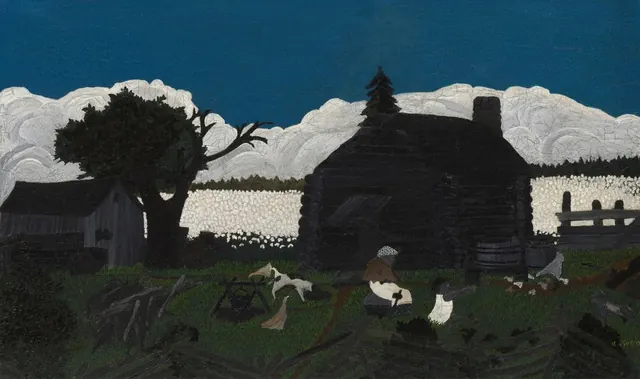
The painting’s story and details
A small house stands before a white cotton field. An older woman and a child share its yard with domestic animals. Horace Pippin painted the scene in the 1930s while living in Pennsylvania. Born in the northern United States, he encountered the South during military training in South Carolina in 1917. The picture joins memory of another place to his later experience.
The dark log cabin nearly merges with its roof. Its large, simple shape anchors bands of earth, cotton and sky. Everyday African American life became one of Pippin’s subjects. Here housing and a yard take the place of a celebrated person or grand event.
The roof crosses the white cloud bank. Clear silhouettes and broad colour areas organise space. Pippin had no academic art training. He taught himself, discovering the forms he needed through drawing.
Cotton stretches behind the house in a dense band. White dots form an almost continuous wall. The crop sustained the South’s agricultural economy and demanded arduous manual labour. Its proximity makes the domestic world physically surrounded by a source of work.
A tree and fence continue the yard’s boundary on the right. Human space seems small beside the field. The picture can suggest rooted domestic life, while house and cotton also raise questions about dependence on agricultural labour. The precise terms of ownership of this dwelling are unknown.
Grass, earth and leaning rails fill the foreground. Pippin keeps individual objects legible. A First World War wound restricted movement in his right arm. Painting became important in his postwar life, although this subject extends well beyond the personal history of injury.
The woman sits with a pale animal close to her lap. Her small figure stands out against the dark wall. Age and posture establish everyday presence. She occupies a domestic world to which the artist gives sustained attention.
The child appears to her right. Light clothing links the figure with animals and the white field. Different generations share one yard. Their presence invites thought about maintaining domestic life where labour, land and household routine are closely intertwined.
Beyond the fence, cotton continues to the edge. Harvesting itself remains unseen. Pippin chose time spent at home, leaving its economic surroundings in the landscape. The quiet yard and a labour-intensive crop share the painted surface.
In 1937 the painting was displayed in a shoe-repair shop near Philadelphia, where it drew attention to Pippin. An artist without academic training found recognition through a place people visited to have shoes repaired. That history changes how we might judge the painting’s simple forms. Pippin had developed his way of painting long before museums took notice.
Featured in tours
How painting changed in the early twentieth century
Colour, the human figure and early experiments in abstraction.
Period, style and subject
- Movement
- Naive art
- Genre
- Everyday life
- Medium
- Oil on cotton, mounted on Masonite
- Collection
- Art Institute of Chicago
- Dimensions
- 51 × 85 cm
- Accession number
- 1990.417
Sources
Image provided under CC0. Image licence
Adapted and translated from Art Institute of Chicago materials. · Text licence