Les Andelys, Côte d'Aval
Paul Signac · 1886
Explore the painting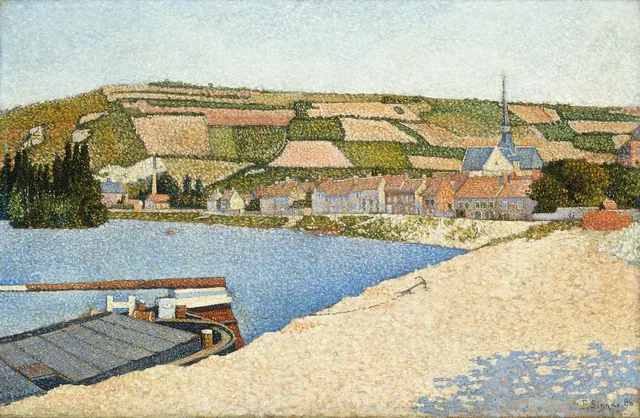
The painting’s story and details
Paul Signac worked at Les Andelys on the Seine in the summer of 1886. He made ten landscapes there, testing his recently adopted method of constructing an image with separate coloured marks. Works in the new manner had appeared at the final Impressionist exhibition that spring. The small river town became a setting for sustained investigations of colour.
A church spire rises above the houses on the right. Its narrow silhouette makes the settlement immediately readable, although small strokes construct the building. Signac retains recognizable landmarks. His new technique changes the painted surface while preserving the place’s structure.
A boat at the lower edge appears close to us. Its dark hull cuts across pale water and extends partly beyond the frame. This cropped object locates the viewer near the bank. The river landscape incorporates the moorings and transport necessary to the town’s life.
Water occupies a large triangle between the banks. Blue, green and pale marks remain distinguishable while combining into a sunlit surface. Signac developed the method through his association with Georges Seurat. The museum notes alternating dots and short strokes that animate the disciplined composition.
A band of houses runs across the painting. Divided colour does not mean treating every object identically. Short rectangular marks suggest walls, while reflections require broken movements. The scale and direction of strokes preserve differences between solid buildings and water.
Fields on the hillside become trapezoids and strips. Their geometry begins with land already divided through human cultivation. Signac strengthens it, connecting the worked plots with the river’s triangle. The view appears organized before we begin separating individual colours.
Blue and violet describe the shadow at the lower right. Colour relationships continue into shaded areas. In 1886, the critic Félix Fénéon named the new movement Neo-Impressionism. The term connected the Impressionists’ inheritance with a more systematic investigation of neighbouring colours and their effects upon one another.
Trees on the left raise verticals above the horizontal river. Their crowns and the bank use the same divided handling, but repeated trunks establish a larger rhythm. Signac coordinates substantial forms while working through small variations of colour within them.
Seen closely, the painting separates into numerous brushmarks; from farther away, a clear river view reappears. Viewers choose how fully the image comes together. Our position before the canvas becomes mobile, while its boats, houses and banks stay in place.
Featured in tours
After Impressionism. Four different answers
Seurat, Cézanne, Van Gogh and Gauguin changed painting for different reasons.
More paintings to compare
Period, style and subject
- Movement
- Neo-Impressionism
- Genre
- Landscape
- Medium
- Oil on canvas
- Collection
- Art Institute of Chicago
- Dimensions
- 60 × 92 cm
- Accession number
- 1993.208
Sources
Image provided under CC0. Image licence
Adapted and translated from Art Institute of Chicago materials. · Text licence