Beach at Cabasson (Baigne-Cul)
Henri Edmond Cross · 1891–92
Explore the painting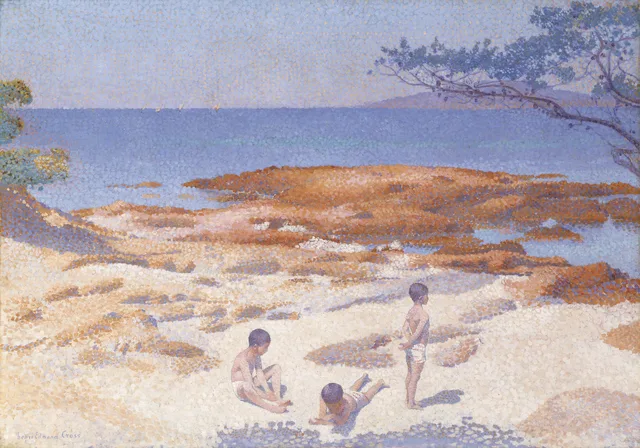
Henri Edmond Cross moved to the Côte d’Azur in 1891 because of rheumatoid arthritis, settling in Cabasson, a small village in southern France. A change of place also brought a change in painting. He began systematically separating colour into small strokes and dots, following Neo-Impressionist experiments. This beach, painted soon after the move, shows an early stage of that method. The warm shore consists of numerous touches of colour that combine into a coherent view at a distance.
Three small human figures occupy the sand. Their bodies are made with the same divided touches as the shore, without sharply outlined contours. One reclines while others sit and stand. Their differing poses create gentle movement within an otherwise still landscape. Their scale conveys openness, while their proximity to the lower edge keeps us near the beach. This is a place accessible to the body, imaginable through warm sand and the search for a comfortable position.
Pale sand consists of pinkish, yellow and bluish dots. Cross depends on adjacent colours interacting in the viewer’s perception. The technique requires time and consistency, although the leisure depicted seems carefree. The difference between subject and process becomes particularly clear. A moment on the beach has been methodically constructed. The later reputation of pointillist painting as a cold experiment hardly accounts for the sensuous warmth and light that such calculation can produce.
Reddish rocky projections form several horizontal bands. Water remains between them, making the shore more complex than a simple boundary between land and sea. These bands organise distance without a receding road or architectural perspective. Cross uses the geography itself as the basis of his composition. The relationship of coloured areas lets the eye move gradually into depth while retaining awareness of the broad, almost flat canvas surface.
The sea forms a calm blue band below the horizon. It contains fewer strong contrasts than the rocky shore, gradually slowing the eye. Dots remain visible here too, but merge into an even field from a distance. This demonstrates one possibility of Neo-Impressionism. The same basic element, an individual brush touch, can participate in depicting flesh, stone, sand or water. Differences between materials emerge through its colour, density and relationship with neighbouring marks.
A branch enters from the upper right and partly covers the sky. It gives the open view a near boundary, as though we stood beside vegetation at the beach’s edge. Dark leaves supply a contrast with pale sand. They do not turn the landscape into an enclosed stage, however. A free horizon remains beyond them, and the coast continues outside the frame. The composition combines a sheltered viewpoint with space that cannot be possessed in a single glance.
Cross’s move was connected with his health, yet the painting offers an image of bodily freedom and ease. Knowing that circumstance changes the impression of a southern idyll. A favourable environment could be a necessity for the painter and an attractive artistic image for a buyer at the same time. Both aspects matter. This sunny beach emerged from a particular life and a considered method before becoming an easily recognisable image of Mediterranean leisure.
- Medium
- Oil on canvas
- Collection
- Art Institute of Chicago
- Accession number
- 1983.513
Sources
Wikimedia Commons reproduction. Public domain. Image licence