Triptych
Unidentified Ethiopian painter · Late 17th century
Explore the painting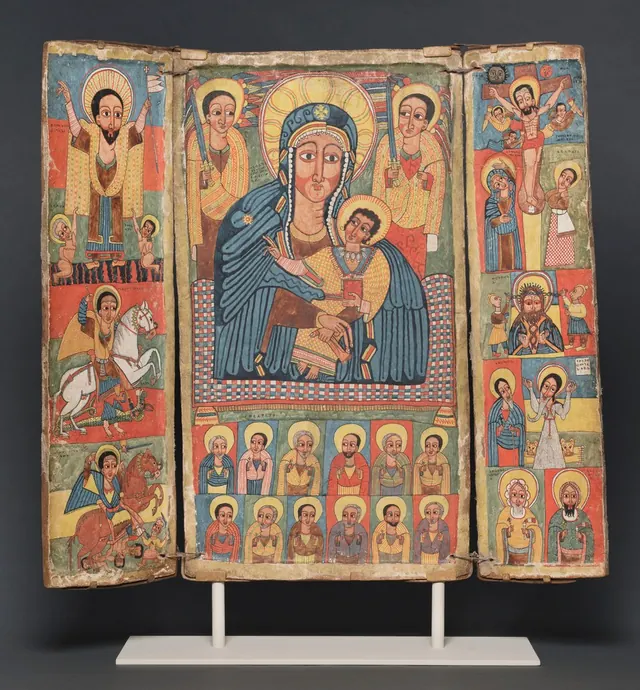
The painting’s story and details
Christianity has been practised in Ethiopia since the fourth century. This triptych dates from the late seventeenth century, a flourishing period for court painting at Gondar. Three wooden sections open to reveal a large assembly of sacred images. Mary holds Christ at the centre, surrounded by archangels and other revered figures. The original viewer encountered a devotional object rooted in a long local tradition.
Mary's face occupies the most prominent area of the central panel. Large eyes, a long nose and a firm contour remain expressive without elaborate shading. Her gaze addresses the devotee. A broad halo and central position correspond to the importance of Marian devotion in Ethiopian worship, emphasised by the museum's interpretation.
Christ sits in her arms, holding a book and raising his other hand. Like the adult sacred figures, he wears patterned clothing. His smaller size does more than convey childhood. The figure retains the conventions of a religious image communicating Christ's identity and teaching.
The archangels Michael and Gabriel stand beside Mary. Their faces turn inward and coloured wings fill the upper space. A large central figure and smaller companions establish a clear hierarchy. Clothing colours distinguish them while retaining the unity of the frontal assembly.
The Crucifixion appears at the top of the right wing. The cross, Christ's outstretched arms and the figures beside him identify the event immediately. Mother and child coexist with Christ's suffering within one object. The triptych moves between devotional presence and episodes of sacred history without requiring a different object of contemplation.
On the left wing a rider on a white horse spears a dragon, the recognisable subject of Saint George. The bent neck, raised legs and downward spear compress the action into a narrow panel. Other saints appear nearby, but a single visual attribute is not sufficient to name every one without reading the inscriptions.
Two rows of haloed figures stand beneath Mary. Equal-height registers organise a large number of participants, while faces, hair and clothes preserve individual differences. Red, green and blue fields alternate like compartments. The arrangement helps viewers remember and recognise the sacred assembly.
At the upper left a saint raises his hands. His elongated figure fills a separate field. Each area has its own completeness while remaining part of the triptych. Borders establish the devotional image's order within an object that could be closed and reopened.
Tempera is applied to linen mounted on wood, with the sections bound by cord. The museum identifies the First Gondarine style, which flourished under King Iyasu I, who ruled from 1682 to 1706. Rich patterns and clearly defined figures connect the work with this courtly culture. Its exact painter and patron remain unknown. We might ask what is lost when such an object is judged solely against European painting. Conventional scale, repetition and large eyes serve recognition and devotional address. These features deserve to be understood within Ethiopian religious culture before comparison with other expectations of portrait likeness.
Featured in tours
Christian images. From mosaic to Caravaggio
Icons, manuscripts, domestic devotional pictures and church altarpieces.
Period, style and subject
- Movement
- Ethiopian painting
- Genre
- Religious art
- Medium
- Tempera on linen, mounted on wood and bound with cord
- Collection
- Art Institute of Chicago
- Dimensions
- 67 × 74 cm
- Accession number
- 2006.11
Sources
Image provided under CC0. Image licence
Adapted and translated from Art Institute of Chicago materials. · Text licence