Christian images. From mosaic to Caravaggio
Icons, manuscripts, domestic devotional pictures and church altarpieces.
Open the tour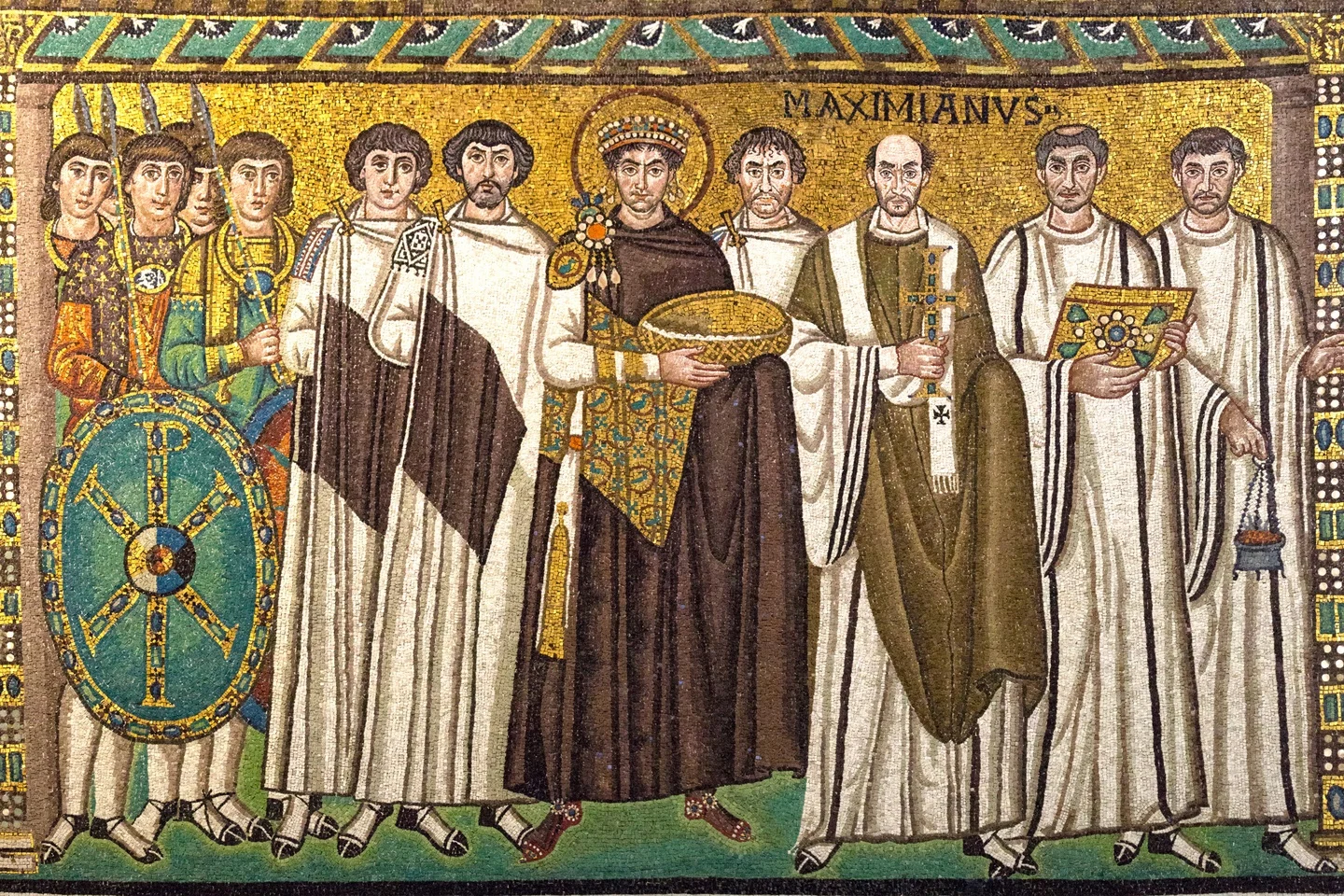 Unknown mosaic artists
Justinian and his retinue
About 547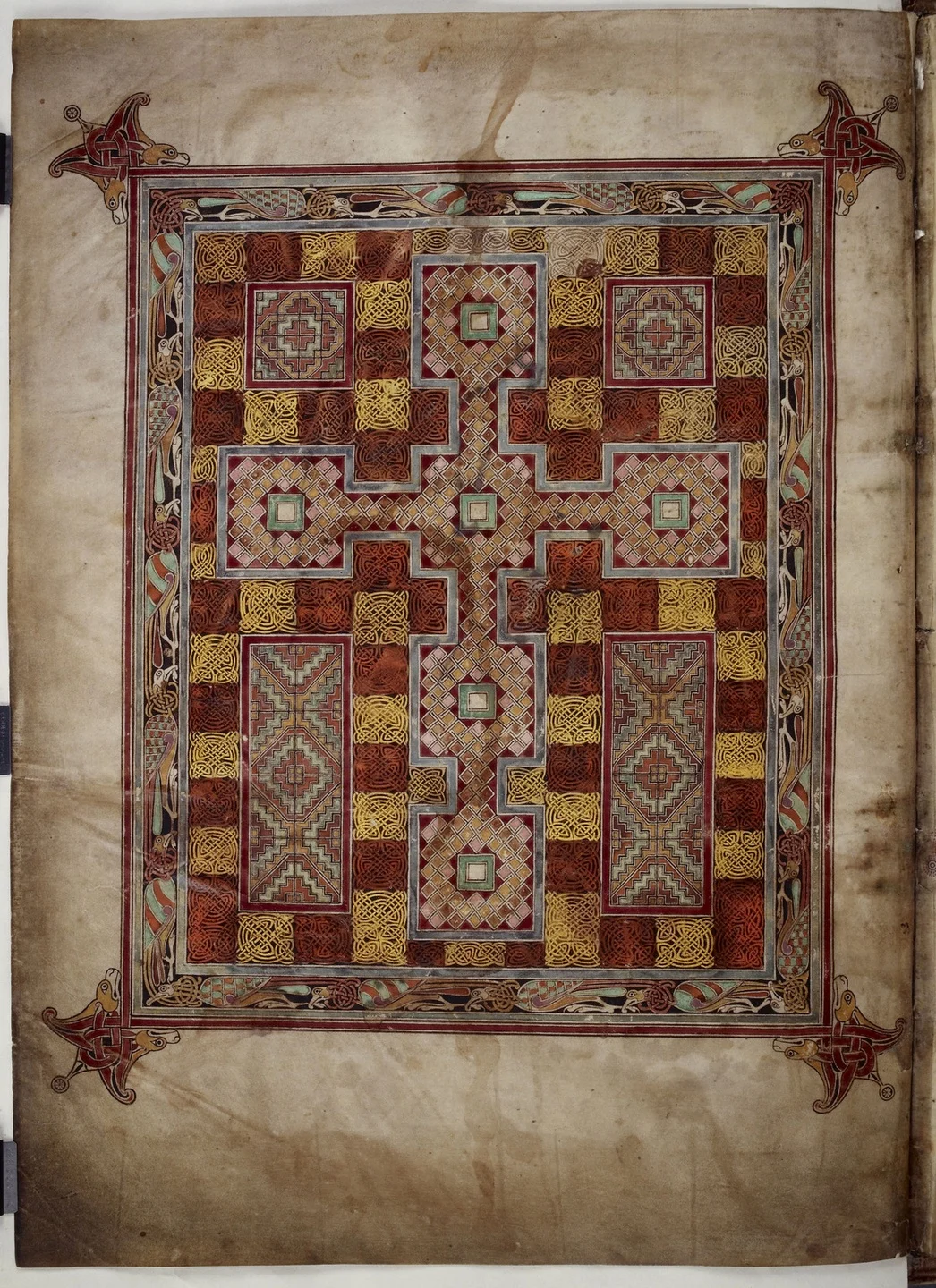 Attributed to Eadfrith
Lindisfarne Gospels: carpet page
About 700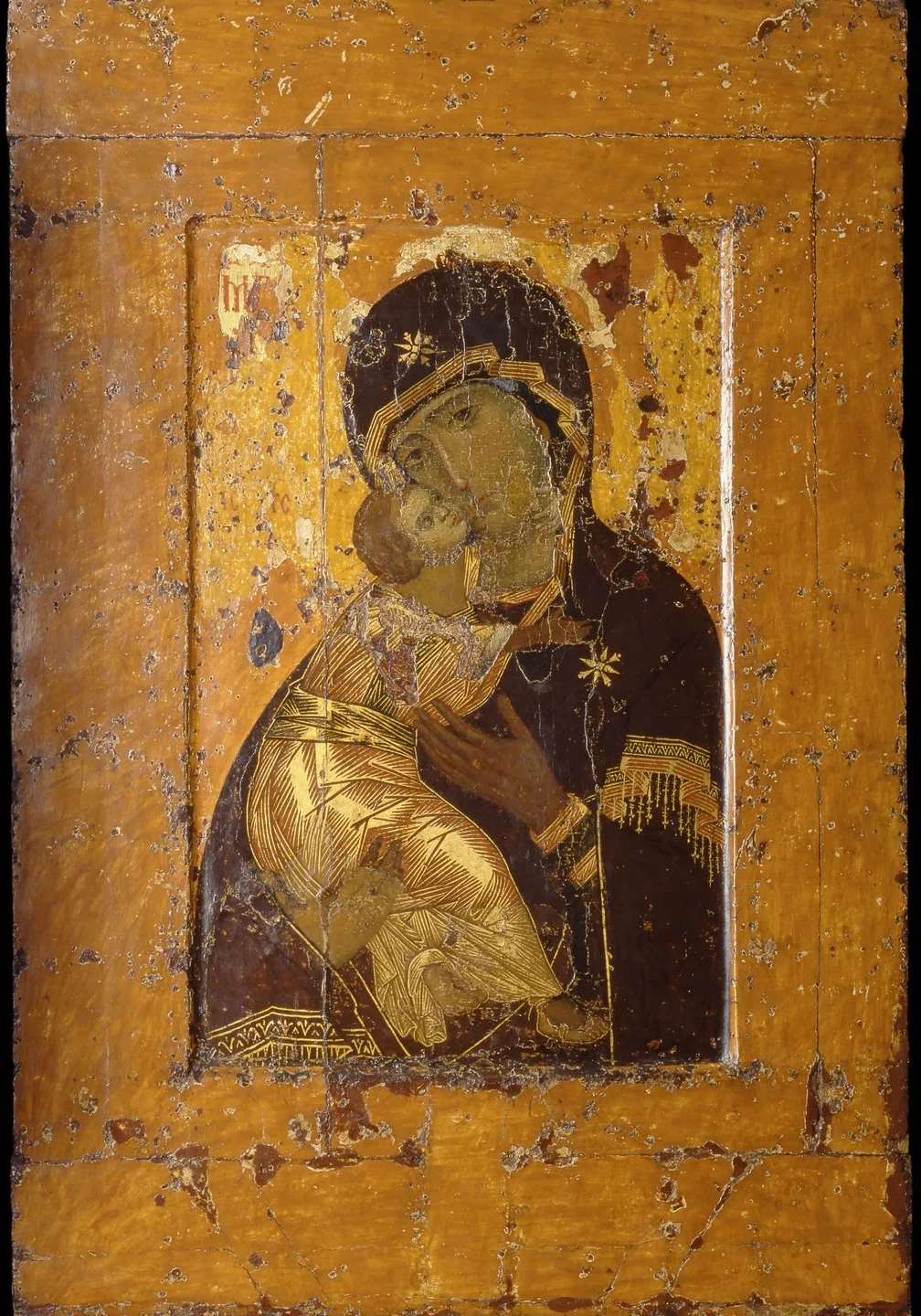 Unknown Byzantine icon painter
The Vladimir Mother of God
First third of the 12th century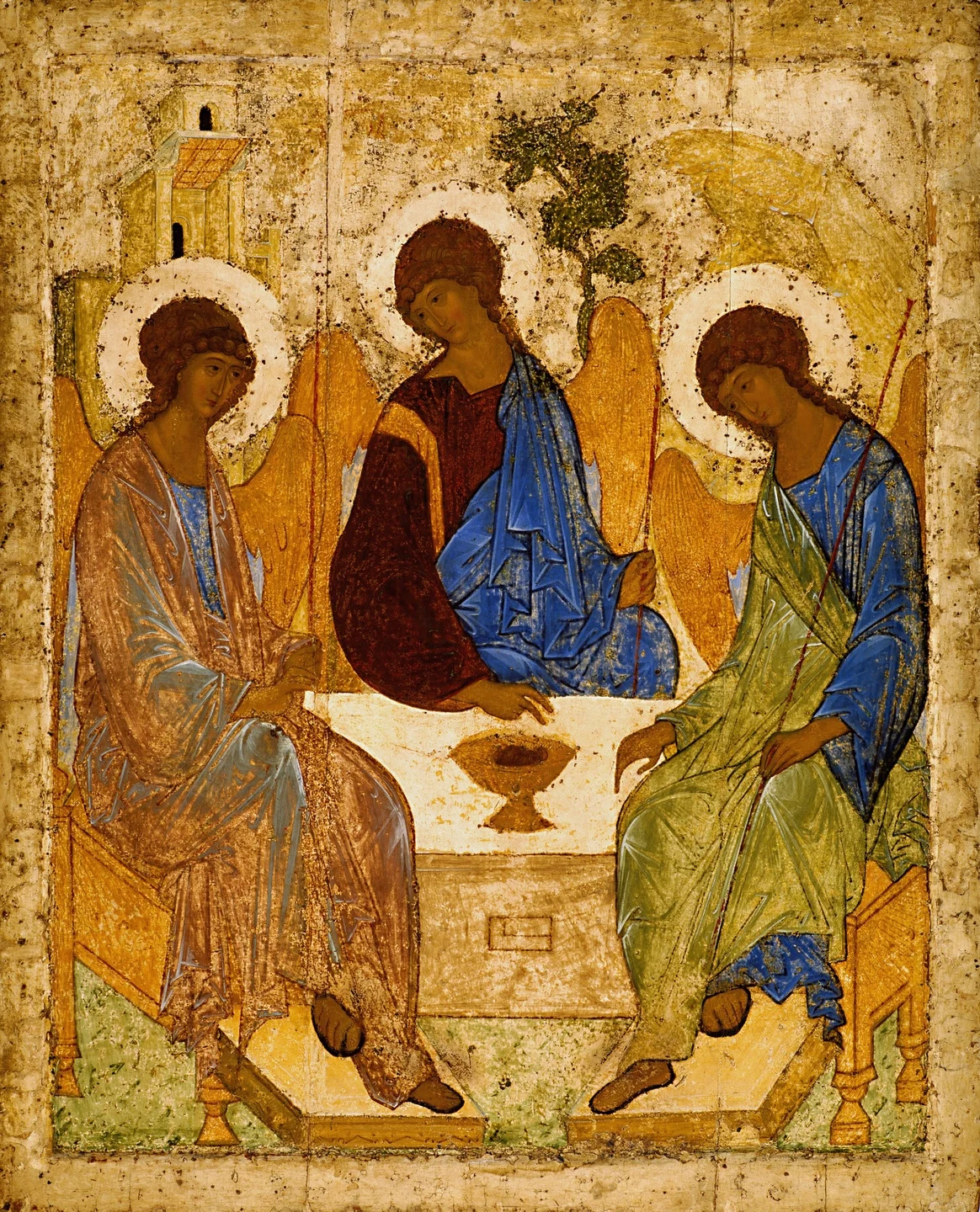 Andrei Rublev
The Trinity
Probably 1422–1427Icons, manuscripts, domestic devotional pictures and church altarpieces.
Medieval artists worked for churches, monasteries and private patrons. Their works accompanied prayer and worship, preserved memory and affirmed authority. We follow these purposes from Ravenna and the Lindisfarne manuscript to the Italian Renaissance. Russian and Ethiopian icons show independent Eastern Christian traditions.
The early Middle Ages and Eastern churches
Precious materials, repeated images and ornament supported different approaches to the sacred.
Justinian and his retinue
Unknown mosaic artists · About 547
Emperor Justinian never visited Ravenna, yet he takes part in a ceremony on the wall of San Vitale. The basilica was consecrated in 547. Soldiers and clergy stand beside the ruler, representing imperial authority in the city.
Lindisfarne Gospels: carpet page
Attributed to Eadfrith · About 700
The Lindisfarne Gospels were made around 700. This page precedes the Novum opus preface. Its dense ornament gives it the name carpet page. The attribution to Bishop Eadfrith comes from a note added to the manuscript in the tenth century.
The Vladimir Mother of God
Unknown Byzantine icon painter · First third of the 12th century
Painted in Byzantium in the first third of the twelfth century, the icon was brought from Constantinople to Rus around 1130. It was repeatedly repainted over the centuries. Its present surface combines early painting with later alterations.
The Trinity
Andrei Rublev · Probably 1422–1427
Three angels sit at a table with a single cup. Rublev painted the icon for the Trinity Cathedral of the Trinity–Sergius monastery, probably in 1422–27. Abraham’s three visitors form the basis of this Orthodox image of the Trinity.
Triptych
Unidentified Ethiopian painter · Late 17th century
The Virgin and Child occupy the centre with archangels Gabriel and Michael beside them. The triptych follows the courtly First Gonderine style developed under King Iyyasu I. Large figures and rich ornament belong to a local tradition, recalling Ethiopia’s long independent history of Christian painting.
The altar panel becomes a space
In thirteenth- to fifteenth-century Italy, artists studied bodily weight and relationships between figures within devotional images.
Virgin and Child with Saints
Berlinghiero · c. 1230s
Three hinged panels could be folded for storage and transport as a small domestic altarpiece. Berlinghiero led a workshop in Lucca, an important Tuscan center before Siena and Florence rose to prominence. Long lines defining garments and hands continue a Byzantine tradition. He is among the earliest Italian painters known by name.
Madonna and Child
Duccio di Buoninsegna · ca. 1290–1300
The infant moves Mary’s veil while her sorrow is understood in relation to the future Crucifixion. Candle burns survive on the original frame. They record close devotional use long before the image entered a museum.
Saint Andrew
Simone Martini · ca. 1326
Saint Andrew was one of five figures in a portable altarpiece. Its original rectangular frame survives. The government of Siena may have commissioned the altar. Its small panels could be folded for transport and opened for prayer.
Lamentation
Giotto di Bondone · 1303–1305
Giotto told the life of Christ through a sequence of frescoes in the Scrovegni Chapel. Painted in 1303–05, the Lamentation shows the body on the ground, surrounded by mourners. Each has a different gesture, giving the shared event individual human responses.
The Adoration of the Magi
Giotto di Bondone · possibly ca. 1320
This panel belonged to a seven-scene Life of Christ. A kneeling king lifts the infant while Mary watches closely. Physical care gives the sacred event unusual human immediacy. The museum’s dating remains qualified, possibly around 1320.
Coronation of the Virgin
Fra Angelico · 1420s
This small panel is considered an early work by the Florentine friar and painter. Its original use is uncertain. The dimensions would suit the base of an altarpiece, but this subject was unusual there. Its minute detail also suggests private devotion. Gold unites garments, hangings, and the light around the central figures.
The Tribute Money
Masaccio · 1423–1427 (initial Brancacci Chapel cycle)
The fresco belongs to the story of Saint Peter in the Brancacci Chapel. Merchant Felice Brancacci commissioned the cycle after returning from Egypt in 1423. Masaccio places several moments of the tribute episode within one landscape. Peter appears repeatedly, allowing the narrative to move through time without dividing the wall into separate scenes.
Annunciation at San Marco
Fra Angelico · About 1440–1450
The friars of San Marco encountered this fresco beside the stairs to their living quarters. Fra Angelico painted it around 1440–50, after the monastery’s rebuilding under Cosimo de’ Medici’s patronage. Gabriel announces Christ’s birth to Mary.
Prayer at home and in the monastery
Close viewing allowed small gestures and domestic objects to enter the picture. Details could support reflection on a familiar story.
The Adoration of the Shepherds
Andrea Mantegna · shortly after 1450
Shepherds approach the infant in worn working clothes after the angelic announcement still visible in the distance. The museum connects Mantegna’s detailed manner with Netherlandish painting admired at Ferrara. A commission from Borso d’Este remains a possibility.
Madonna and Child
Giovanni Bellini · late 1480s
Bellini places Mary and Christ before a landscape passing from dormancy to growth. The museum relates this transition to death and resurrection. The figures stand close to the viewer, while a stone parapet preserves the boundary between their sacred space and ours.
Virgin and Child with an Angel
Sandro Botticelli · 1475–85
Mary brings her cheek close to the child, who wraps an arm around her neck. Botticelli combines a devotional image with recognisable maternal affection. Human contact brings the sacred subject close to the viewer. The smaller angel preserves the religious setting without disrupting the close embrace.
The Last Communion of Saint Jerome
Sandro Botticelli · early 1490s
Jerome receives his final communion in his cell at Bethlehem. Monks support his frail body. The painting was commissioned by the Florentine merchant Francesco del Pugliese, a supporter of Savonarola. Its small scale suited close viewing and private religious devotion.
The Meditation on the Passion
Vittore Carpaccio · ca. 1490
The dead Christ appears with Job and Saint Jerome in a landscape arranged for reflection on death and resurrection. Barren rock and fertile land occupy opposite areas. This is a gathering of religious figures across different periods rather than a single Gospel episode.
Virgin and Child with the Young Saint John the Baptist
Antonio da Correggio · c. 1515
The young Correggio absorbed several artistic traditions. His pyramidal grouping recalls Raphael; soft contours suggest Leonardo, while the landscape reflects Northern European models. Working in Parma, away from Italy’s largest artistic centres, he developed his own manner. Soft light and close relationships between figures already anticipate his mature frescoes.
The Alba Madonna
Raphael · c. 1510
Mary sits on the ground in the Madonna of Humility tradition. Jesus accepts a reed cross from John, anticipating the Crucifixion. Raphael coordinates inclinations and gazes with the circular panel. Such formats were related to round painted trays presented in wealthy Florentine homes after childbirth.
Large figures before the viewer
Sixteenth- and seventeenth-century altarpieces increasingly addressed viewers’ positions inside churches. Movement and light distinguished participants in the scene.
The Sistine Madonna
Raphael · 1512–1513
Raphael made the altarpiece for San Sisto in Piacenza, almost certainly on a commission from Julius II. Saints Sixtus and Barbara, venerated there, accompany Mary. The two familiar angels below were added late in the painting process. In 1754 Augustus III acquired the work for Dresden after two years of negotiations.
The Last Supper
Leonardo da Vinci · 1495–1498
Leonardo painted the dining hall of Santa Maria delle Grazie in Milan. He worked on dry plaster, allowing him to revise the composition and develop gradual tonal changes. The fragile technique soon began to fail. The apostles respond to Christ's announcement that one of them will betray him, above the room where the monks took their meals.
The Coronation of the Virgin
Annibale Carracci · after 1595
Cardinal Pietro Aldobrandini commissioned this painting after Carracci arrived in Rome in 1595. Northern Italian colour and light meet an ordered composition informed by Raphael. The pose of God the Father derives from an ancient statue of Jupiter.
The Crucifixion of Saint Andrew
Caravaggio · 1606–7
According to tradition, Andrew continued preaching from the cross, and a later attempt to release him was miraculously prevented. Caravaggio brings a small number of participants into a confined space close to the viewer. Strong light reveals bodies against darkness, making the martyrdom tangible through physical effort.
The church was a major patron of art
The church was a major patron of art. Its needs supported workshops and demanded new solutions throughout the Middle Ages and Renaissance.
Images changed with their settings and viewers. A small icon was seen close up, a fresco read among neighbouring scenes, and a large altarpiece viewed from across a church. These conditions explain much about figure size, gestures and lighting.
Artists in the tour
- Antonio da Correggio
- Sandro Botticelli
- Unidentified Ethiopian painter
- Giovanni Bellini
- Caravaggio
- Vittore Carpaccio
- Annibale Carracci
- Giotto di Bondone
- Andrea Mantegna
- Simone Martini
- Duccio di Buoninsegna
- Fra Angelico
- Berlinghiero
- Leonardo da Vinci
- Raphael
- Masaccio
- Andrei Rublev
- Eadfrith of Lindisfarne
- Mosaicists of San Vitale
- Painter of the Vladimir icon
Sources
- Unknown mosaic artists — Justinian and his retinue
- Attributed to Eadfrith — Lindisfarne Gospels: carpet page
- Unknown Byzantine icon painter — The Vladimir Mother of God
- Andrei Rublev — The Trinity
- Unidentified Ethiopian painter — Triptych
- Berlinghiero — Virgin and Child with Saints
- Duccio di Buoninsegna — Madonna and Child
- Simone Martini — Saint Andrew
- Giotto di Bondone — Lamentation
- Giotto di Bondone — The Adoration of the Magi
- Fra Angelico — Coronation of the Virgin
- Masaccio — The Tribute Money
- Fra Angelico — Annunciation at San Marco
- Andrea Mantegna — The Adoration of the Shepherds
- Giovanni Bellini — Madonna and Child
- Sandro Botticelli — Virgin and Child with an Angel
- Sandro Botticelli — The Last Communion of Saint Jerome
- Vittore Carpaccio — The Meditation on the Passion
- Antonio da Correggio — Virgin and Child with the Young Saint John the Baptist
- Raphael — The Alba Madonna
- Raphael — The Sistine Madonna
- Leonardo da Vinci — The Last Supper
- Annibale Carracci — The Coronation of the Virgin
- Caravaggio — The Crucifixion of Saint Andrew