Virgin and Child with the Young Saint John the Baptist
Antonio da Correggio · c. 1515
Explore the painting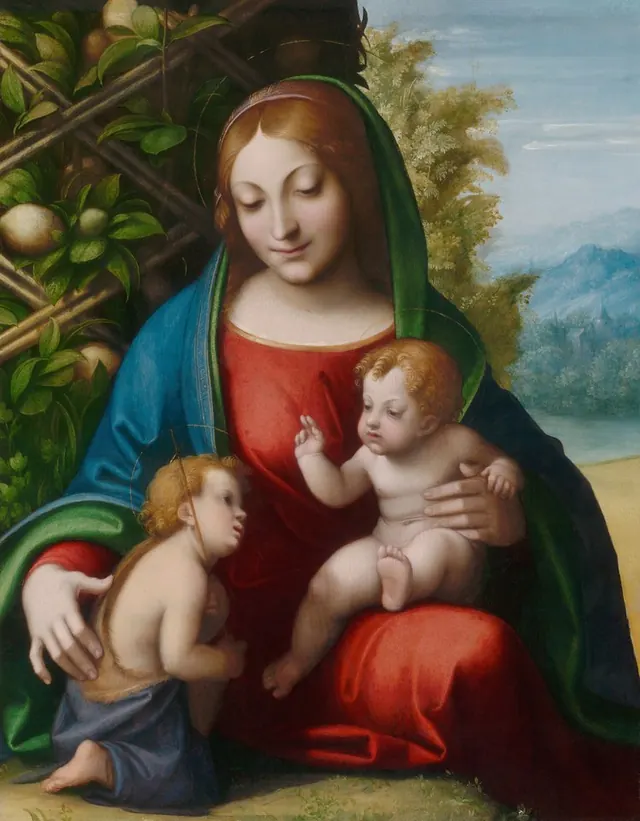
The painting’s story and details
Around 1515 the young Correggio painted Mary with two children for close devotional viewing. Christ sits on her lap while the young John the Baptist kneels beside them. Touch connects a compact group. Lessons from Raphael, Leonardo and Northern European landscape contribute to Correggio’s own image of tenderness. The children’s future religious history appears through recognisable maternal closeness.
Mary lowers her face with a slight smile. Gradual transitions between light and shadow soften eyes and mouth. This recalls Leonardo’s painting and gives the face a living flexibility. The group nevertheless retains a stable pyramidal shape associated with Raphael.
Christ raises a hand towards John while Mary supports his side. Blessing enters the movement of a child. Religious meaning emerges within a small circuit of touch and gaze. Close figures and intimate scale could make a worshipper’s approach feel personal.
John kneels at the left, looking towards Christ. A slender cross and animal-skin garment identify the future preacher. Their childhood meeting connects the lives ahead of them. Infant bodies coexist with attributes of later service, giving family tenderness a further dimension in time.
Mary rests a hand on John’s back. The gesture closes the group and includes him within her care. Soft transitions connect fingers, shoulder and green fabric. Bodily contact carries weight alongside identifying religious objects.
Red cloth crosses Mary’s knees. Light swelling forms and deep folds give it a velvety texture. Similar soft shading constructs the children’s bodies. Shared handling unites skin and fabric in a calm, substantial presence.
Fruit and leaves mingle with wooden supports on the left. Detailed vegetation makes a nearby shelter against the open distance on the right. The image accommodates close attention to small natural forms and a broad view beyond its figures.
Blue mountains recede behind Mary’s right shoulder. The museum relates this landscape to Northern European examples. Crisp nearby leaves and dissolving distance offer different kinds of attention, gathered around the human group.
Correggio later made vast frescoes in Parma, including its cathedral dome in 1526–30. Here his exploration remains concentrated on a small panel and intimate relationships. Working away from Rome, Florence and Venice, he transformed major centres’ achievements. Artistic independence becomes visible through the combination of borrowed devices—pyramidal grouping, softened faces and distant landscape—into a personal devotional whole.
Featured in tours
Christian images. From mosaic to Caravaggio
Icons, manuscripts, domestic devotional pictures and church altarpieces.
More paintings to compare




Period, style and subject
- Movement
- Renaissance
- Genre
- Religious art
- Medium
- Oil on panel
- Collection
- Art Institute of Chicago
- Dimensions
- 64.2 × 50.2 cm
- Accession number
- 1965.688
Sources
Image provided under CC0. Image licence
Adapted and translated from Art Institute of Chicago materials. · Text licence