Street Scenes in Times of Peace 太平風會圖
Zhu Yu · Yuan dynasty (1279–1368), 14th century 元朝
Explore the painting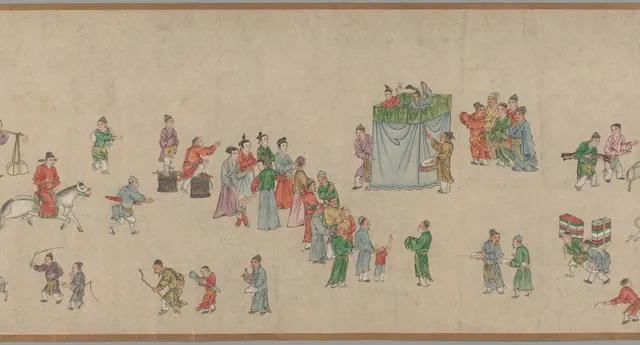
The painting’s story and details
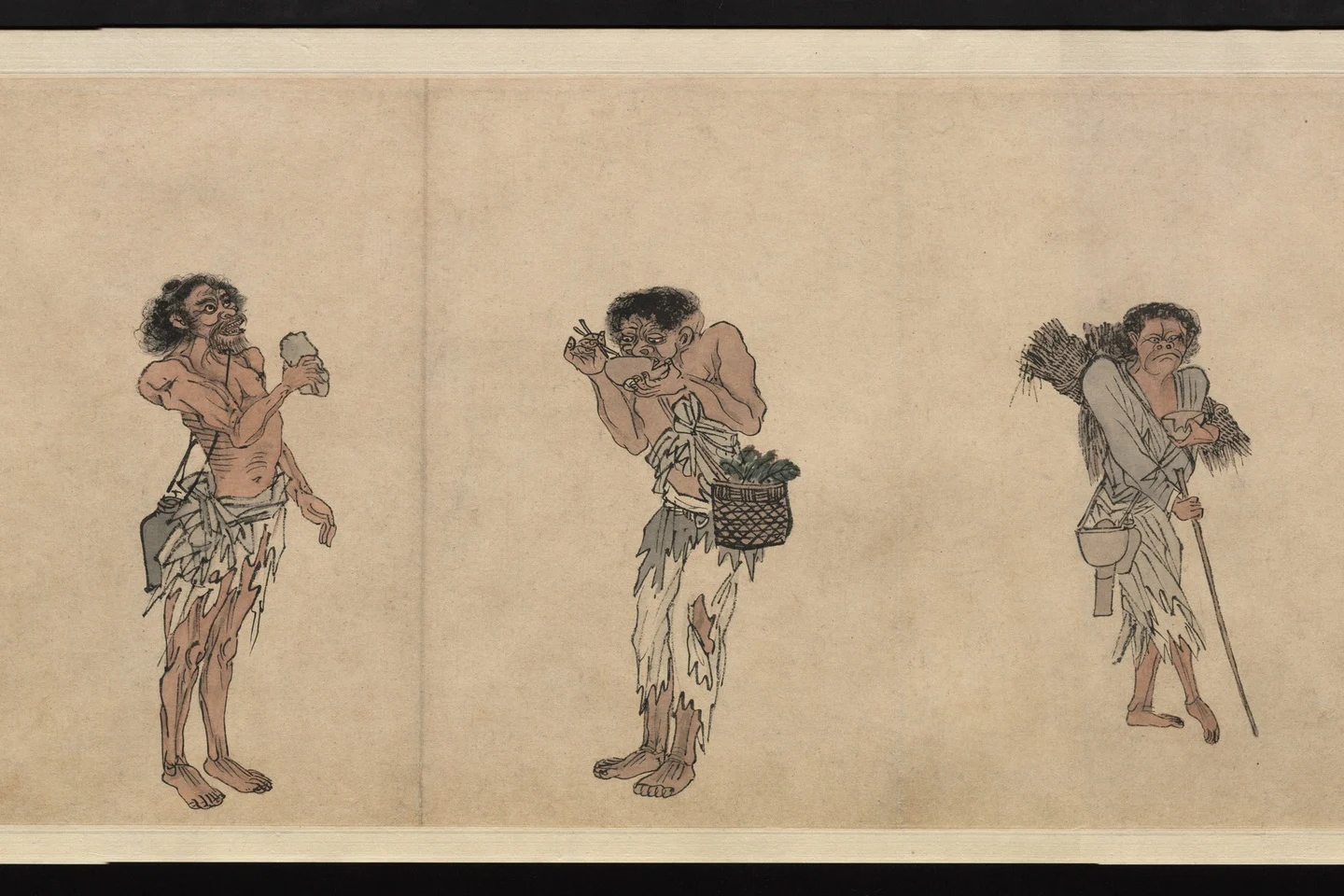
The complete Street Life in Times of Peace scroll contains more than four hundred people. We see one section of its long succession of activities and encounters. It belongs to a tradition of Chinese urban genre imagery that developed during the Song period. The scroll's frontispiece describes a collection of customs in peaceful times. Those words already evaluate the pictured world and deserve comparison with its figures.
A rider in red moves beside pedestrians at the left, standing out against the pale horse. Differences in clothing, transport and companions reveal a varied society. Through these small groups the scroll gradually assembles a broad population whose everyday lives meet on one street.
Adults and children form the central group. Turning heads, raised hands and intervals connect them in small episodes. Without detailed urban scenery, people create the street. Their interactions organise the composition more effectively than a continuous row of buildings would.
A small puppet theatre rises above the crowd. A curtain conceals the performers' work, figures appear above it, and a drummer stands nearby. Entertainment belongs to the urban economy. The image preserves an occupation dependent on attracting passers-by and gathering an audience.
Spectators crowd together to the theatre’s right, their postures and gazes varying. A performance temporarily turns passers-by into an audience that will disperse again. Such episodes make street life changeable even without a continuous setting of houses and road.
Two carriers bear tall striped loads. Weight makes them bend and changes their silhouettes. Transport labour occupies the same world as recreation and walking. A title celebrating peace does not remove the effort and inequality visible in different occupations.
A child in red participates in the adults' activity. Small size and a raised hand distinguish the figure among long garments. Elsewhere the complete scroll includes women, beggars, scholars with servants and street incidents. This excerpt reveals only part of its society.
A green-clad figure below turns towards neighbours. Extensive blank paper makes gestures individually legible. This arrangement recalls a painter's collection of figure models. Spatial relationships nevertheless turn an inventory into a succession of possible encounters.
Some hats and garments belong to the Mongol Yuan period. The museum allows a later Ming date, when the customs shown might already have belonged to the past. Peaceful times would then become an image of memory too. The scroll supports readings as observation of urban life and as a constructed picture of prosperous order. How similarly would a carrier, theatre spectator and beggar experience that order? Varied occupations make the question tangible within the painting.
More paintings to compare
Period, style and subject
- Movement
- Chinese painting
- Genre
- Everyday life
- Medium
- Handscroll; ink and colors on paper
- Collection
- Art Institute of Chicago
- Dimensions
- 28 × 1092.2 cm
- Accession number
- 1952.8
Sources
Image provided under CC0. A detail of the scroll is shown. Dimensions refer to the work catalogued by the museum. Image licence
Adapted and translated from Art Institute of Chicago materials. · Text licence