Coronation of the Virgin
Fra Angelico · 1420s
Explore the painting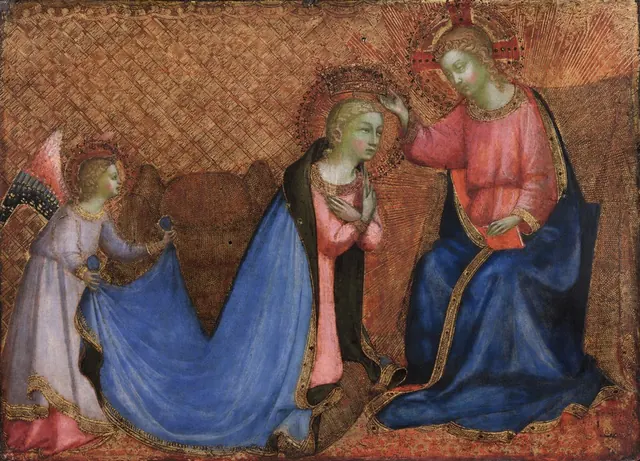
The painting’s story and details
Christ places a crown on Mary’s head. Fra Angelico painted this small scene in the 1420s, early in his career. A Dominican friar and painter, he combined work within Florence’s artistic world with religious life. He presents the Virgin’s heavenly glorification through an action familiar to earthly viewers: the ceremonial bestowal of a sign of authority.
Mary bows before Christ with her hands held against her chest. Her pink garment forms a soft silhouette at the centre. Submission and elevation happen together. A Christian conception of humility takes visible form: the highest honour comes to a figure receiving it with her head lowered.
Christ holds the crown above Mary with his right hand while his left rests on a book. Fine intervals separate his fingers, the golden circlet and her bowed head. The event concentrates here. The painting’s small size invites a viewing distance close enough to notice a movement that can dissolve into the general golden radiance from farther away.
At the left, an angel supports the blue edge of Mary’s garment. This attendant makes the coronation a ceremony involving service and assistance. The pale figure balances larger masses of colour at the right. A small gesture of care connects heavenly order with behaviour familiar from courtly and church life.
Christ’s blue mantle falls in large folds beside Mary’s pink garment. Contours are clear and colour transitions restrained. Fra Angelico preserves the ceremony’s ordered solemnity while giving the clothing weight. The eye can follow a fold and sense the body beneath it.
Fine patterns and radiant haloes articulate the gold surface. As illumination changes, real metal reflects light differently from paint. Heaven acquires a material presence. Gold distinguishes the devotional image among everyday objects while also revealing the care and expense of its production.
The painting’s original purpose remains unresolved. Its horizontal format could suit an altarpiece’s lower register, although coronations rarely occupied that position. Rich miniature detail also suggests private devotion. In either setting, a close viewer encountered humility expressed through luxury. That relationship invites reflection on how a precious object helps make spiritual value imaginable.
Featured in tours
Florence and Rome. Patrons of the Renaissance
Merchants, monasteries, the Medici and the papal court. The changing work of artists from the thirteenth to the sixteenth century.
Christian images. From mosaic to Caravaggio
Icons, manuscripts, domestic devotional pictures and church altarpieces.
More paintings to compare

Period, style and subject
- Movement
- Early Renaissance
- Genre
- Religious art
- Medium
- tempera and gold on wood panel
- Collection
- Cleveland Museum of Art
- Dimensions
- Unframed, 27 × 37.2 cm
- Accession number
- 1944.79
Sources
Image provided under CC0. Image licence