Reading
Berthe Morisot · 1873
Explore the painting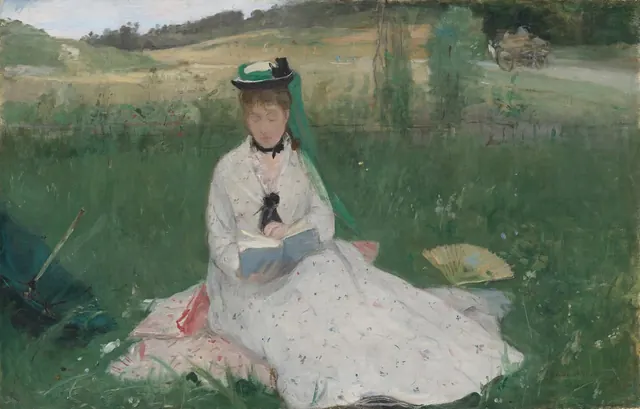
The painting’s story and details
Edma Morisot reads in a meadow, seated on her spread-out shawl. Her younger sister Berthe painted her in 1873. Both had studied art from youth, worked with Corot and exhibited at the Salon from 1864. After marrying in 1869, Edma gave up her professional career. Berthe continued painting, often asking her sister to pose. The sisters had begun together, but by the time of this portrait their professional paths had diverged.
Edma’s eyes are lowered to the book. X-rays revealed that she originally looked directly at the viewer. Berthe revised this area, changing the observer’s relationship to the sitter. Our gaze is no longer returned; we see someone absorbed in reading. The impression of a chance glimpse resulted from deliberate alteration. The painting retains the lightness of a rapid study even though the position of the head had to be reconsidered.
The blue-covered book is open on Edma’s lap, her fingers resting on its pale pages. Its title is illegible. Berthe gives us the activity and its outward rhythm: inclined head, lowered hands and a still seated figure. The direction of her gaze separates her attention from ours. The book occupies Edma while the open meadow remains before the viewer’s eyes. The scene contains an activity that continues independently of being watched.
The white dress fills the foreground. Grey and pinkish shadows cross it, while tiny coloured flowers echo those scattered in the grass. A figure outdoors was an important pictorial problem for Morisot. Light changes the fabric’s colours, yet the figure remains coherent and recognizable. Here the pale fabric unites many separate strokes. Up close, individual touches are visible; from farther away, they gather into a broad skirt spread on the ground.
An open fan lies in the grass on the right, with a parasol on the left. Along with the shawl, they show a place on a walk temporarily adapted for rest. Their colours help structure the picture: the dark parasol anchors the left edge, and the yellow fan stands out on the right. Accessories of fashionable dress enter the landscape alongside flowers. An affluent woman’s life and an experiment with colour are intertwined because this everyday setting supplied the material for painting.
A cart appears on the road in the upper right. Its figures and wheels take only a few strokes, while individual blades of grass can be distinguished in the foreground. The difference in detail establishes distance. Life continues beyond the reader’s pause. Morisot does not fill every interval equally densely. Pale green between the scattered touches gives the meadow a sense of openness.
A year after Reading, Morisot took part in the first independent Impressionist exhibition. She chose it against Manet’s advice; he preferred the official Salon. Family and accessible places of leisure supplied her subjects, but she made her own artistic decisions. Edma’s revised gaze makes that especially clear. Her sister has an activity of her own within the painting, while Berthe determines how closely the viewer may approach it.
Featured in tours
Early Impressionism. Paris 1860–1879
The Salon, the first independent exhibition, railway stations, studios and leisure on the Seine.
Women painters. Learning and working
Family workshops, academies, private commissions and independent exhibitions.
More paintings to compare


Period, style and subject
- Movement
- Impressionism
- Genre
- Everyday life
- Medium
- oil on canvas
- Collection
- Cleveland Museum of Art
- Dimensions
- Unframed, 46 × 71.8 cm
- Accession number
- 1950.89
Sources
Image provided under CC0. Image licence