Summer’s Day
Berthe Morisot · About 1879
Explore the painting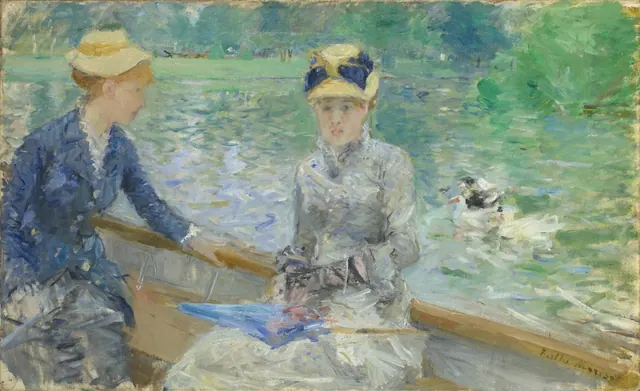
The painting’s story and details
Berthe Morisot painted these two women in a boat around 1879. They are visiting the Bois de Boulogne on the western edge of Paris. Water fills almost all the space behind them, with the shore reduced to a narrow strip at the top. An ordinary outing becomes a subject in its own right. For the Impressionists, contemporary life in and around the city offered subjects as compelling as historical events and literature.
The Bois de Boulogne was a carefully designed place of recreation. In the 1850s Napoleon III and landscape architect Adolphe Alphand transformed the park into apparently natural woodland with winding paths and lakes. Planning and labour lay behind its appearance of unrestricted nature. A boating trip can therefore be understood as part of urban culture. Parisians came here for an experience of country life prepared for them close to the city.
The side of the boat crosses the painting diagonally. The left edge cuts through the figure in blue, while the bottom edge crops her companion’s pale skirt. From this close viewpoint neither end of the boat is fully visible. It feels as though there is room for us aboard. The women are beside us and the lake recedes behind their shoulders. The effect depends on the precise boundaries Morisot chose for the image.
The woman on the left turns towards her companion, who sits almost facing us with her hands in her lap. Their gazes point in different directions and each retains her own pose. No single gesture between them explains the entire episode. Our attention moves from one figure to the other, then towards the water. Looking around during an outing works much the same way, without everyone continually taking part in a shared action.
Short pale strokes cross darker ones on the blue sleeve. Each is easy to distinguish. Pull back a little and those angular marks resolve into a shoulder, an elbow and folds of fabric. Morisot relies on our eyes to complete the process. Her brush supplies enough clues for a shape to become recognisable, while the viewer connects the small gaps. Magnification changes the way we look at the painting.
Greys, blues and greenish colours recur in the pale dress and the lake. Along the sleeve it is difficult to trace an unbroken boundary between fabric and reflections. The dark gloves in the woman’s lap, however, are immediately distinct. Morisot varies the degree of definition. Some passages hold our attention; others allow it to move freely from the figure into the surrounding light.
The birds on the right consist of a few light and dark patches, with orange marks for their bills. We recognise them before we have time to separate the strokes. Nearby, similar pale marks read as reflections. What a patch of paint represents depends on the marks around it. This becomes particularly clear in a small detail where Morisot defines almost nothing with a fine outline.
By this time Morisot had helped establish the Impressionist movement. In 1874 she exhibited alongside Monet, Degas and Renoir. She had studied landscape painting with Corot and shown work at the Paris Salon before joining the independent exhibitions. Years of professional training lay behind her loose handling. Critics often discussed her paintings through assumptions about femininity, although her participation in artistic life extended far beyond an amateur’s role.
Summer’s Day was probably shown at the Impressionist exhibition in 1880. Contemporaries accused Morisot of leaving work unfinished. Today her visible brushwork helps us consider how much an artist chooses to leave for the viewer to complete. Even the impression of an instant observed outdoors could require returning to a canvas in the studio. The National Gallery considers that this picture was probably painted at least partly there. Ease of looking and ease of making are different things.
Featured in tours
Early Impressionism. Paris 1860–1879
The Salon, the first independent exhibition, railway stations, studios and leisure on the Seine.
Women painters. Learning and working
Family workshops, academies, private commissions and independent exhibitions.
More paintings to compare


Period, style and subject
- Movement
- Impressionism
- Genre
- Everyday life
- Medium
- Oil on canvas
- Collection
- National Gallery, London; in partnership with Hugh Lane Gallery, Dublin
- Accession number
- NG3264
Sources
Public Domain. Resized previews and tiles prepared for display; no retouching or upscaling. Image licence