The Beach at Sumiyoshi from the Tales of Ise
Tawaraya Sōtatsu · c. 1634
Explore the painting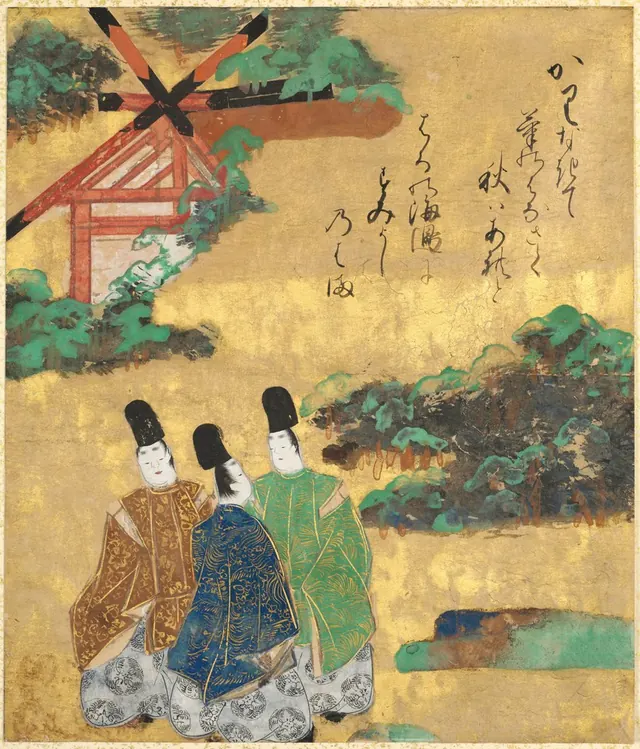
The painting’s story and details
Three courtiers pause at Sumiyoshi’s shore. Tawaraya Sotatsu painted this small picture around 1634 after The Tales of Ise, a tenth-century literary work. A poem beside them praises the place in spring. Several centuries separate the text from its illustration. Colour, pattern and a recognizable poetic scene return an older courtly world to readers of the artist’s time.
Columns of writing descend freely across the gold ground. The poem sets autumn geese and flowering chrysanthemums beside the pleasure of dwelling by the sea at Sumiyoshi in spring. Words connect seasons the painter need not show simultaneously. They give the image a memory of another season, turning a shore view into a personal judgment of beauty.
The courtiers form a close group. Their white faces are sparingly described, while blue, green and brown robes carry detailed gold patterns. The courtiers turn their heads towards one another. A few poses and contrasting coloured silhouettes make the human encounter clear.
The red-and-white structure above is Sumiyoshi’s Grand Shrine. It identifies the setting although only part of the building appears. Black beam ends and red diagonals contrast sharply with rounded foliage. The architectural detail works like a familiar place-name in a poem, evoking wider associations with the locality.
Trees form dense green islands. Their colour spreads in places and merges with dark passages of earth. Broad gold intervals remain between them. A few expressive shapes establish space, replacing a detailed coastal route with a rhythm of visual pauses: people, trees, shrine and writing.
A low patch of land at the right appears in blue, brown and green. The poem’s sea receives little detailed representation of its own. Gold surface leaves viewers room to complete the setting through words and a familiar story. Literary knowledge becomes part of looking itself.
Sotatsu headed Kyoto’s Tawaraya workshop, which sold fans, decorated paper and small paintings. Ancient court literature continued through objects reaching a new urban audience. This sheet’s refinement draws on aristocratic heritage, while its circulation also depended on workshops, trade and collectors. Familiarity with old poetry became a new way to participate in cultural life.
Featured in tours
Japanese painting. Scrolls and screens
Literature, temples, the arrangement of rooms and everyday life.
Period, style and subject
- Movement
- Rinpa school
- Genre
- Literary subjects
- Medium
- Poetry sheet mounted as an album leaf; ink, color, and gold on paper
- Collection
- Cleveland Museum of Art
- Dimensions
- Image, 24.5 × 20.9 cm
- Accession number
- 1951.398
Sources
Image provided under CC0. Image licence