Bamboo and Rocks in Clearing Skies
Ike Taiga · mid-1700s
Explore the painting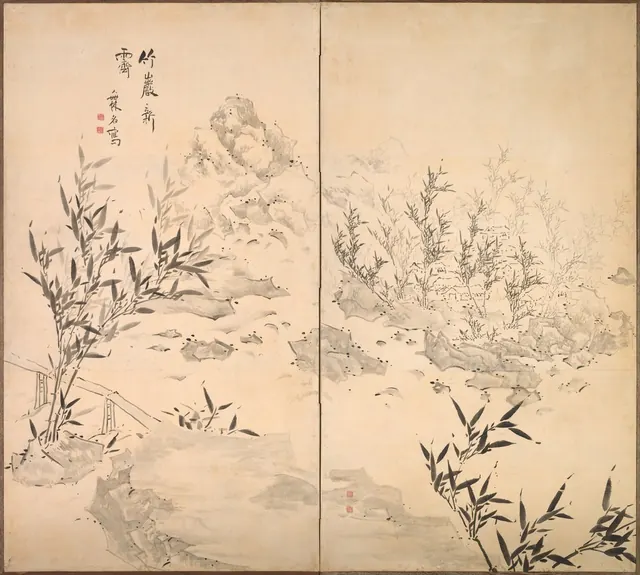
The painting’s story and details
After rain, bamboo rises among pale rocks as water runs down from the mountains. Ike Taiga painted this two-panel screen in the mid-eighteenth century. Its inscription connects refreshed scenery with renewed spirits. That freshness nevertheless emerges through visible decisions: translucent ink, open paper and dark leaves standing especially clearly against a light ground.
The large bamboo at the left consists of separate elongated strokes. Pressure increases at each leaf’s base before the brush lifts into a fine tip. Every mark remains an independent hand movement, joined by branches into a living plant. The close relationship between painting and calligraphy becomes especially clear: form emerges from a sequence of precise touches.
Diluted ink describes the mountain behind the bamboo. Some edges nearly disappear, while small dark dots hold its rocky surface together. Differences in density create air between nearby leaves and distant stone. Depth requires only variations within one material. Water, ink and brush movement supply distinctions that multiple colours might otherwise provide.
At the right, much smaller bamboo surrounds tiny buildings. Differences of scale turn a large botanical motif into an entire landscape. Human dwellings occupy the distance, although no people are visible. Nature after rain becomes a lived environment. The distant village connects freshness with its inhabitants’ imaginable daily experience.
A broad flat rock occupies the foreground. Its pale surface is largely open, with a few broken lines describing its edge. It resembles a platform from which to look at the stream. The screen’s size brings this imagined stone close to the room’s scale. The landscape offers its owner a place within the image while remaining part of a domestic interior.
The title at the upper left matches a design in Taiga’s Brush Methods. The artist himself learned partly from Chinese printed manuals. They carried techniques and compositions across borders, making them available far from original paintings. The inscription recalls how an impression of free engagement with nature rested on sustained study of a visual language.
Taiga began by selling painted fans in Kyoto and transformed his study of Chinese models into an individual manner. This screen joins knowledge from books, professional skill and a wish to experience nature indoors. Its freedom developed through learned methods. Familiar bamboo becomes personal through variation within a shared language: leaf density, mountain translucency and the distances between them.
Featured in tours
Japanese painting. Scrolls and screens
Literature, temples, the arrangement of rooms and everyday life.
More paintings to compare
Period, style and subject
- Movement
- Japanese painting
- Genre
- Landscape
- Medium
- Two-panel folding screen; ink on paper
- Collection
- Cleveland Museum of Art
- Dimensions
- Image, 163.2 × 182.6 cm
- Accession number
- 1958.337
Sources
Image provided under CC0. Image licence