Hunting near Hartenfels Castle
Lucas Cranach the Elder · 1540
Explore the painting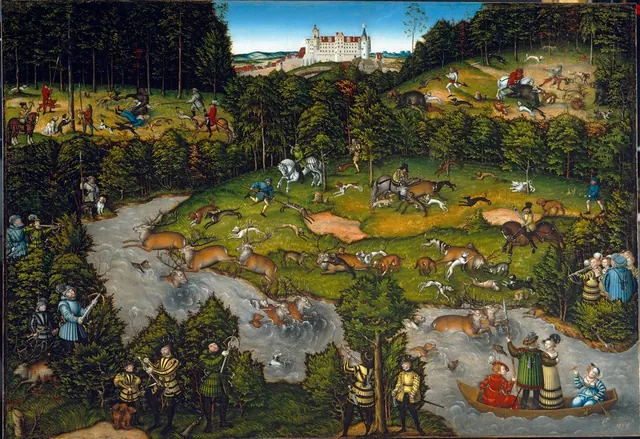
The painting’s story and details
Cranach painted this hunt in 1540 for the Saxon court. Hartenfels Castle rises above the forest as the ruler, his wife, courtiers and servants take part in an elaborate event. Hunting was an aristocratic privilege requiring the organization of people, dogs and terrain. The picture turns it into a detailed representation of authority over land. Viewers see both the hosts’ recreation and the work ensuring their successful shot.
The white castle stands in the distance above the hunt’s many episodes. Its towers and walls remain clear and still amid restless activity in the forest. It is the patrons’ residence and an anchor connecting different parts of the painting. Territorial possession receives a visible centre. The extensive landscape unfolds around the home of those directing events.
Dogs drive deer towards the river. Some animals are already swimming; others plunge into the water, raising foam. The bank becomes a useful boundary where hunters await their quarry. The painter’s distribution of movement reveals the hunt’s organization. Its success depends on prepared positions for animals and people, although individual episodes look rapid and accidental.
At the lower left, John Frederick the Magnanimous, dressed in dark green, spans his crossbow. Nearby figures help distinguish his action. The ruler participates personally, but an entire service surrounds him. Power appears as the capacity to organize other people’s efforts and occupy the right place at the decisive moment. That role belonged to the courtly image of a worthy sovereign.
At the right, among courtiers, Electress Sibylle raises her crossbow. She has the privilege of the ceremonial first shot. A female figure thus participates in the public distribution of honours. Her gesture helps establish the hunt as a court ritual too. The sequence of actions marked participants’ rank as clearly as their elaborate clothing.
Riders, beaters on foot and dogs operate in the forest. Their figures are smaller than the ceremonial participants in front, yet the hunt would stop without them. Different groups move along prepared routes; horn signals coordinated such work. Attention to these minor participants changes the story’s centre. A few aristocrats’ recreation becomes a large collective undertaking.
Cranach’s Saxon patrons supported the Reformation, and his workshop supplied both religious and courtly images. Here the estate’s arrangement itself persuades: a clear residence, abundant forest, numerous servants and a successful hunt. Modern attention may rest instead on driven animals and unequal exposure to risk. The painting shows how a court’s desirable image of order could depend on others’ vulnerability.
More paintings to compare
Period, style and subject
- Movement
- Northern Renaissance
- Genre
- Everyday life
- Medium
- oil, originally on wood, transferred to masonite
- Collection
- Cleveland Museum of Art
- Dimensions
- Unframed, 116.8 × 170.2 cm
- Accession number
- 1958.425
Sources
Image provided under CC0. Image licence