The Harvesters
Pieter Bruegel the Elder · 1565
Explore the painting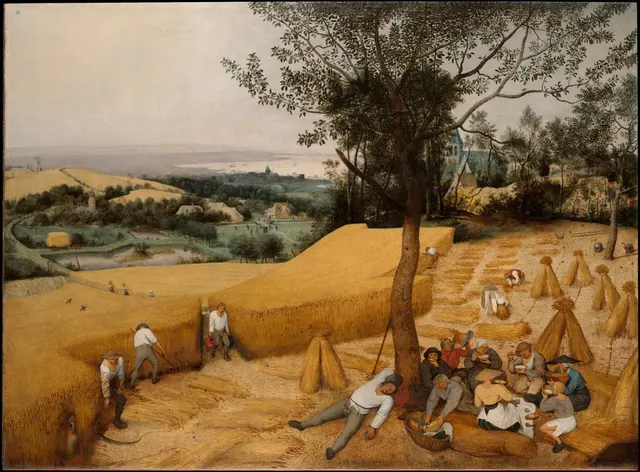
The painting’s story and details
Some peasants cut wheat while others eat and rest beneath a tree. Bruegel painted The Harvesters in 1565 for a six-part seasonal cycle commissioned by an Antwerp merchant for his country house’s dining room. Summer labor became a spectacle for people who could dine while contemplating others’ work to produce food.
A mower at the left enters dense wheat. His implement passes close to the ground, separating the cut area from standing stalks. The field’s boundary changes through work. Agriculture becomes a successive transformation of space, with one person’s movement gradually contributing to the harvest’s larger pattern.
A bent figure gathers stalks beside the mower. The back echoes the slope of nearby sheaves, while posture and clothing largely conceal the body. This proximity between worker and crop can suggest harmony with natural order, though the posture itself also conveys sustained physical effort.
A man lies beneath the tree with his legs stretched out, occupying conspicuous foreground space. Rest receives as much attention as work. Nearby mowing and gathering continue, so the pause belongs within a shared working day rather than marking the harvest’s end.
Seated figures eat in the shade, with dishes, bread, and varied hand movements visible. Food connects directly to the harvest and brings field workers together. In the patron’s house, another dining group could observe them over a meal. The depicted and actual diners occupied different positions in relation to the labor supplying the table.
Beyond the field lie a road, settlement, and distant water. Activities continue far beyond the nearest group. An elevated viewpoint brings labor, movement, and rest into the same view. The land appears inhabited and connected through numerous actions, even though each individual occupies very little space.
The painting treats peasants sympathetically, yet its abundance answers an affluent urban patron’s desires. The museum emphasizes this idealization of rural life. Heat and fatigue remain present without disrupting a beautiful, productive world. Bruegel offers attention to the working body alongside a landscape whose fruits are made available to a privileged viewer.
More paintings to compare
Period, style and subject
- Movement
- Northern Renaissance
- Genre
- Everyday life
- Medium
- Oil on oak
- Collection
- The Metropolitan Museum of Art
- Dimensions
- 119 × 162 cm
- Accession number
- 19.164
Sources
Image provided under CC0. Image licence