Hell Courtesan
Kawanabe Kyōsai · 1871–89
Explore the painting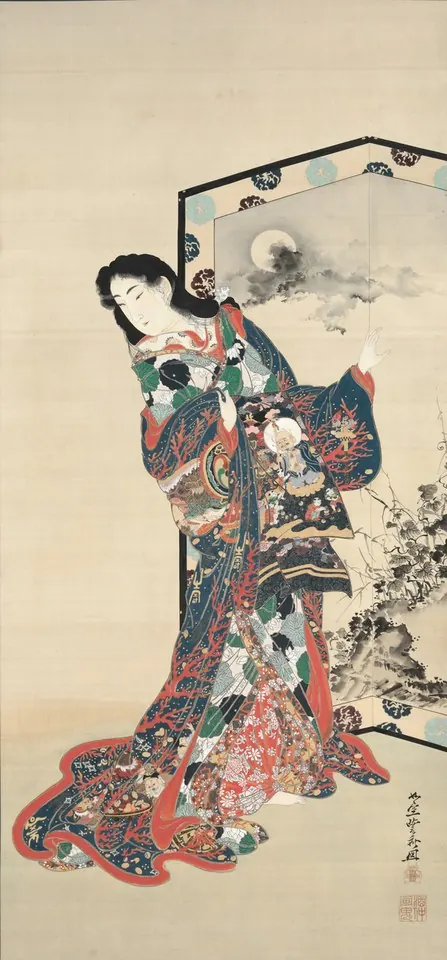
The painting’s story and details
Judgment of the dead unfolds across a courtesan’s luxurious clothing. Kawanabe Kyōsai returned to this figure several times; the Cleveland scroll dates from between 1871 and 1889. Its subject is known as the Hell Courtesan. According to legend, bandits abducted the fifteenth-century woman, who understood her suffering as retribution for deeds in a previous life. Scenes of hell on her clothing expressed that belief.
The woman turns her head over her shoulder. Dense hair surrounds a pale face, with long ornaments extending sideways. In this version, according to the museum, she takes the place of Benzaiten, one of the Seven Gods of Good Fortune. The legendary sinner thus acquires the attributes of a benevolent deity, altering a familiar religious story.
A raised hand touches the garment’s edge, letting its broad sleeve hang freely. The graceful gesture displays the fabric and guides attention towards its design. Layers of pattern almost conceal the body. Encountering the woman gradually becomes a reading of events that she carries on her clothing.
The other six Gods of Good Fortune appear on the outer robe. Among them is a scene with Enma, the King of Hell, recording judgments on the dead while one god reports their sins. Kyōsai mixes auspicious figures with formidable otherworldly bureaucracy. The museum identifies this substitution of characters as parody.
Blue fabric extends into a long train filled with gold and silver longevity characters. They wish for life to continue although the garment’s imagery recalls death. Different meanings coexist on one precious surface. Closer examination makes it increasingly difficult to reduce the woman to a single moral definition.
A screen bearing the moon and branches stands behind her. Its light, almost transparent drawing leaves the principal colour intensity to the clothing. The scroll itself uses silk, real gold and silver. Its material repeats the luxury it depicts, bringing the painter’s art close to the craft of decorating textiles.
The legend explains violence against a woman through her earlier sins. Such a story readily shifts responsibility from abductors to their victim. Kyōsai places gods of fortune and wishes for longevity alongside that inheritance. His version retains judgment and retribution while giving the woman a benevolent, almost divine appearance. The contradiction makes the painting richer than a single lesson about punishment.
Featured in tours
Japanese painting. Scrolls and screens
Literature, temples, the arrangement of rooms and everyday life.
More paintings to compare
Period, style and subject
- Movement
- Japanese painting
- Genre
- Literary subjects
- Medium
- Hanging scroll; ink, color, gold, and silver on silk
- Collection
- Cleveland Museum of Art
- Dimensions
- Image, 144.2 × 67.6 cm
- Accession number
- 1985.268
Sources
Image provided under CC0. Image licence