The Falls of Niagara
Edward Hicks · ca. 1825
Explore the painting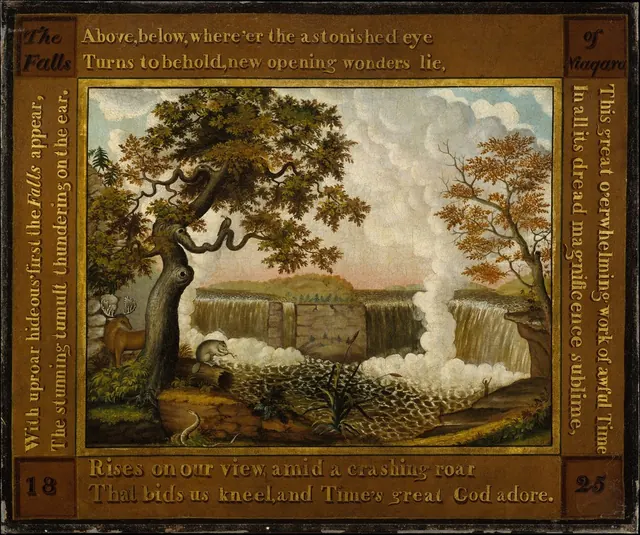
The painting’s story and details
Edward Hicks visited Niagara in 1819 while travelling as a Quaker preacher. For this painting, made around 1825, he nevertheless used an engraving from a map of North America. Personal experience met a printed model. Verse surrounding the falls supplies a religious explanation of nature’s power. The landscape was intended to be read as well as viewed.
The water drops over a broad curve. Its upper edge is almost level, and many pale vertical lines describe the falling streams. Hicks preserves a clear overall form where the current would break into countless movements. A low horizon and small trees remain behind the falls. This structure makes the event comprehensible, separating the lip, the cliff and the water below.
A tall plume of spray rises from the gorge. Rounded white masses connect the water with the clouds and occupy much of the sky. Below, foam divides into smaller pale curls. Water descends while spray rises, bringing two directions together in the centre.
A large tree bends over the view on the left. Its dark trunk stands out against the white spray, and its branches spread almost like an ornament. Hicks earned his living painting coaches and signs. This craft background helps explain his clear silhouettes, rhythmic patterns and careful lettering. The landscape retains decorative coherence despite its many small details.
A beaver sits beneath the tree; a moose appears farther left, a snake curves along the bottom, and an eagle occupies a branch. The museum identifies this group as familiar Euro-American emblems of the “New World.” Their presence in such a small area therefore has a larger purpose. They stand for an entire continent. The picture communicates an idea of its nature shaped partly through printed imagery.
The golden letters at the bottom conclude Alexander Wilson’s verse. In the poem, the waterfall’s grandeur leads to worship of God. The lettering belongs to the canvas itself and forms one work with the landscape. It narrows the interpretation by giving natural power a particular creator. Hicks the preacher makes a conviction accessible through a place capable of astonishing people with different beliefs.
Text continues up the sides and across the top, while the title and date occupy corner rectangles. Reading it all requires changes in direction. The painting asks for time with words, like a printed sheet or sign, while also offering a detailed view. Its verbal border is an integral part of the design. Removing it would alter what the artist intended to communicate about the falls.
From 1811, Hicks served as an itinerant preacher without receiving payment for that work. Painting remained alongside religious life, although Quakers could be suspicious of pictorial luxury. Here a natural spectacle acquires an instructive purpose.
Featured in tours
American landscape. Land and its inhabitants
Nature, territorial expansion, the Civil War and urban life in American painting.
Period, style and subject
- Movement
- Naive art
- Genre
- Landscape
- Medium
- Oil on canvas
- Collection
- The Metropolitan Museum of Art
- Dimensions
- 80 × 96.5 cm
- Accession number
- 62.256.3
Sources
Image provided under CC0. Image licence