Washington Crossing the Delaware
Emanuel Leutze · 1851
Explore the painting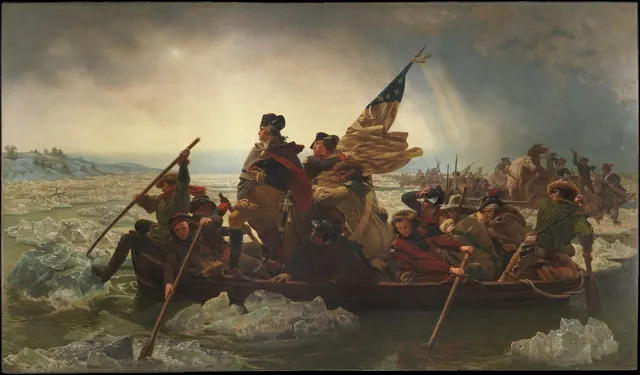
The painting’s story and details
On Christmas night in 1776, Washington’s army crossed the Delaware to launch a surprise attack on the Hessian garrison at Trenton. He needed a victory to restore morale and attract new recruits. In the painting, the decision has been made, but the far bank still lies ahead. Leutze chose a moment when success remained uncertain.
Washington stands above the others, his profile clear against the pale sky. Everyone around him is physically occupied while he looks toward the shore. The painter assigns distinct roles to commander and army. Even the red edge of his cloak draws attention to the upright figure among the angled bodies and oars.
Leutze painted the canvas in Germany in 1851. The American Revolution offered a precedent for Europeans seeking political change. Mount Vernon connects his project with hopes for German unification. The great flag behind Washington thus also belongs to the political language of the painter’s own time.
The ice must be negotiated and pushed aside. The historical crossing was genuinely difficult. Of three forces meant to cross at different points, only Washington’s made it over. In the painting, the rowers and the man with the long pole on the left keep the boat moving. Their exertion gives the ceremonial scene physical credibility.
Different hats and costumes share the boat. Leutze presents the army as a gathering of people from different backgrounds. The museum’s interpretation identifies a Black participant and a Native American at the stern. These are representative figures within the revolutionary story; the identities of everyone in Washington’s boat are not known.
The man at the stern wears a fur cap and a decorated pouch. Scholar Scott Manning Stevens associates its ornament with Indigenous traditions of the Northeast. This presence complicates the heroic narrative. In 1779 Washington ordered the devastation of Haudenosaunee communities allied with Britain. The promise of liberty did not bring security to everyone.
Behind the principal boat are other vessels, horses, and crowded soldiers. An entire force, including artillery, had to cross. Leutze compresses a complex operation into one recognizable image while retaining its scale in the background. Victory at Trenton required a commander and people capable of transporting an army across a winter river.
Featured in tours
History in painting. Events and memory
Who painted war, revolution and state power, and how long after the event.
More paintings to compare
Period, style and subject
- Movement
- American painting
- Genre
- History painting
- Medium
- Oil on canvas
- Collection
- The Metropolitan Museum of Art
- Dimensions
- 378.5 × 647.7 cm
- Accession number
- 97.34
Sources
Image provided under CC0. Image licence