Watson and the Shark
John Singleton Copley · ca. 1778
Explore the painting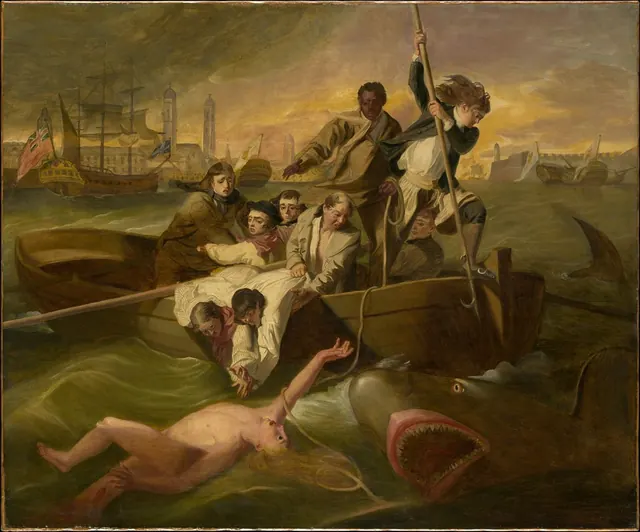
The painting’s story and details
In 1749 a shark attacked fourteen-year-old Brook Watson in Havana harbour. Sailors rescued him, but he lost part of his leg. Almost thirty years later, Watson commissioned Copley to paint his rescue. This small study was made after the first completed painting, in preparation for subsequent versions. It preserves the larger work’s central decision. Everyone is rushing to help, but no rescuing gesture has yet been completed.
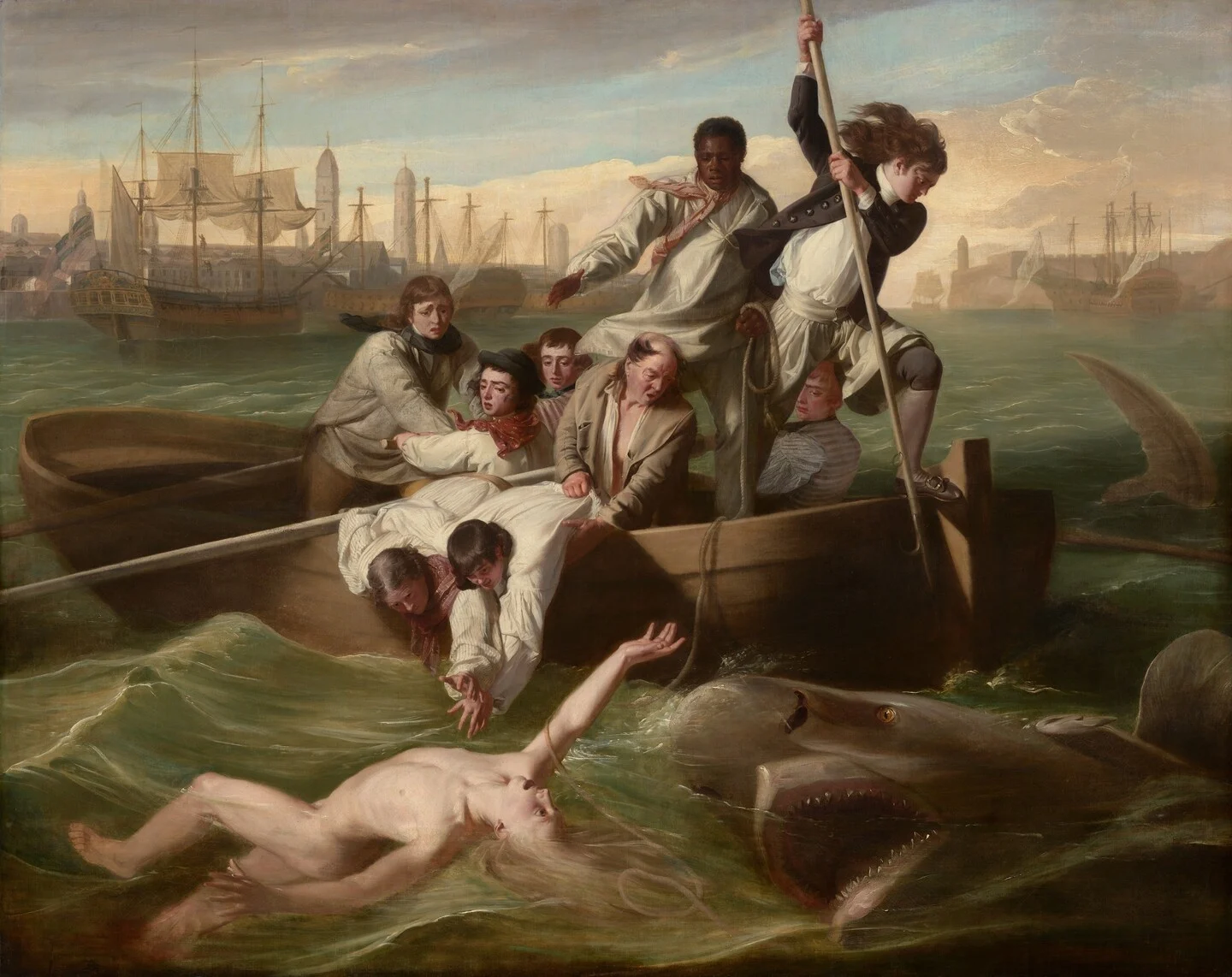
Watson lies on his back, his head almost touching the shark. Light picks out his naked body against dark water and clothed rescuers. His raised palm is open, but the men have yet to reach it. A small gap between hands separates him from safety. Even knowing the outcome, we watch that distance. Copley keeps us inside the second when a happy ending still cannot be taken for granted.
Two sailors lean so far over the side that they risk falling in themselves. A man behind them grips one sailor’s white shirt. Rescue consists of several simple actions, each dependent on someone else’s support. Oars and the boat’s edge lead our eyes towards the outstretched hands. In the large painting exhibited in London in 1778, ordinary sailors became the protagonists of history painting. The value of a human life gives their actions consequence.
The Black sailor stands high above the others, holding a rope. Silhouetted against the sky, he reaches towards the boy. Watson later became a wealthy merchant and politician who defended the slave trade. With that knowledge, this is difficult to see as an uncomplicated story of gratitude. A man dependent on a sailor’s help supported a system that deprived other people of freedom. The identity of the model for the Black rescuer remains unknown.
On the right, a sailor raises a long boat hook. Its shaft runs almost the full height of the picture, ending in a hook beside the gunwale. Below it, an enormous mouth opens to reveal rows of teeth. Its reddish rim stands out against the green water. Copley brings the threat so close that we register it before many of the human faces. The mouth’s size, the angle of the weapon and the distance to the boy work together to stage the danger.
Ships behind the boat bring harbour life into the account. Havana participated in Atlantic commerce, including the transport of enslaved people. We cannot identify the cargo of every painted vessel, but this setting changes the meaning of the foreground water. For Watson it became the site of one memorable disaster; for many others, the sea passage meant violence and loss of freedom. The rescue of one boy takes place within a much larger history.
Watson bequeathed the first large version to the charitable school Christ’s Hospital, hoping it would offer a useful lesson to the young. A private memory acquired a future audience and an educational purpose. The choice of protagonist already guided its interpretation. Today we can spend longer with the sailors whose actions made his story possible. They are numerous and work together, while the familiar title preserves only the rescued boy’s name. The painting allows us to redistribute our attention.
More paintings to compare
Period, style and subject
- Movement
- American painting
- Genre
- History painting
- Medium
- Oil on canvas
- Collection
- The Metropolitan Museum of Art
- Dimensions
- 63.2 × 76.5 cm
- Accession number
- 42.71.1
Sources
Image provided under CC0. Image licence