The Toilers of the Sea
Albert Pinkham Ryder · ca. 1880–85
Explore the painting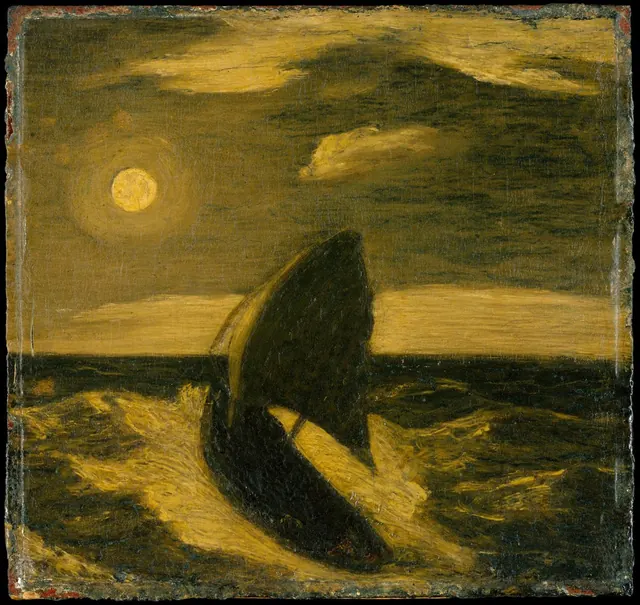
The painting’s story and details
A small boat and heavy waves almost fill this painting, which measures roughly thirty centimetres across. Albert Pinkham Ryder grew up in the whaling port of New Bedford and moved to New York in 1870. The sea remained a major subject for him. The title may connect the painting with Victor Hugo’s 1866 novel The Toilers of the Sea, although no particular episode can be securely identified.
The moon sits high on the left, some distance from the boat. Its small, bright disc stands out clearly among dense areas of darkness. A sea-captain friend recalled Ryder studying the moon over the Hudson. Such observations informed his marine paintings. Here, experience of night light becomes a tightly compressed composition in which almost every bright passage carries considerable weight.
The dark sail forms an irregular triangle against the lighter sky. Its edges are much clearer than the vessel’s smaller details. Ryder reduces the image to a few large shapes. On this small scale, the sail becomes the main landmark for locating the boat. Its angle suggests the vessel’s dependence on wind.
The curve of the hull takes a moment to separate from the water. Brown and nearly black paint bring the boat close in tone to the waves around it. The vessel consequently seems caught within the sea’s overall movement. The title invokes human labour, but Ryder supplies no sequence of tasks on board. The boat’s presence among these masses of water makes human effort palpable.
A light wave on the right rises above a dark trough. Its rounded edges flow into neighbouring forms, making it difficult to draw a firm boundary between individual crests. This produces a sense of continuous motion. The boat occupies a narrow area within a much more extensive and unstable space.
An elongated cloud near the top echoes the direction of the wave. Related golden tones connect sky and sea, bringing the upper and lower parts of the image together. Yet the present colour cannot be attributed entirely to Ryder’s original intentions. The paint has changed with age. Its material history matters particularly when discussing exact hues or the depth of the darkness.
Ryder painted this work in oil on wood. He returned to his pictures over long periods and sometimes added paint over layers that had not fully dried. This method left vulnerable surfaces; a network of cracks is visible here today. It places a limit on interpretation. We encounter a surviving object affected by ageing, and some of its present mystery may have developed after the artist finished working.
More paintings to compare
Period, style and subject
- Movement
- Symbolism
- Genre
- Marine painting
- Medium
- Oil on wood
- Collection
- The Metropolitan Museum of Art
- Dimensions
- 29.2 × 30.5 cm
- Accession number
- 15.32
Sources
Image provided under CC0. Image licence