A Lady Playing the Tanpura
Unidentified Kishangarh painter · ca. 1735
Explore the painting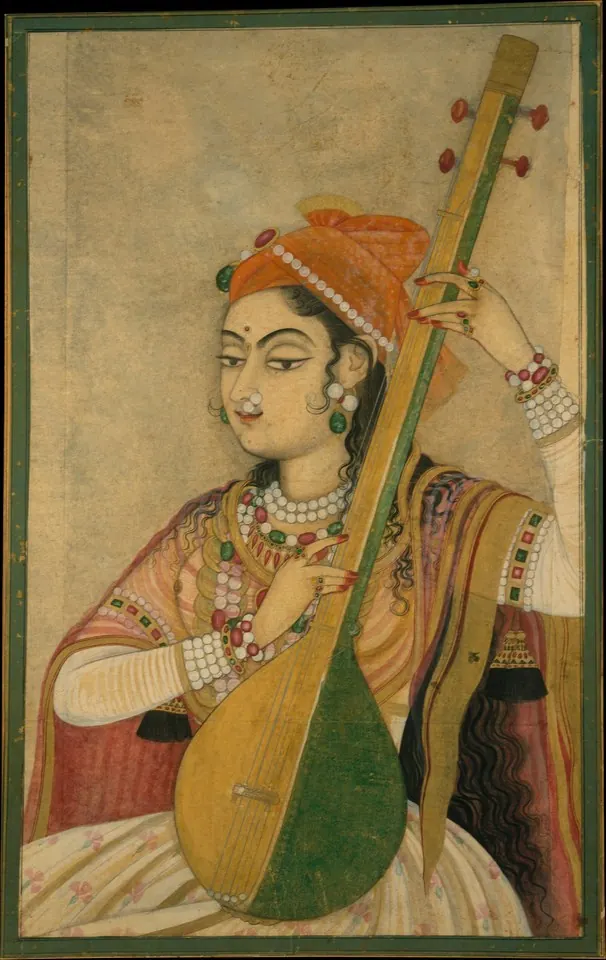
The painting’s story and details
A woman holds a tanpura and touches its strings. An unidentified painter made the image around 1735 in Kishangarh, a Rajput principality. The museum identifies her as a nayika, an ideal heroine of love and devotional poetry. She need not be a portrait of an identifiable musician; the image joins courtly beauty, music, and devotion.
Long eyes and arched brows accompany a nearly profile view of the nose. A smooth contour leads toward the chin. These features belong to an artistic ideal. A fine curl beside the cheek repeats the face’s curves, while pearls on the headdress form a contrasting row of small circles.
The tanpura crosses the figure diagonally. Its long neck joins the two hands, with a broad body in front of her. Four strings and tuning pegs are clearly distinguished. The instrument structures her pose and places her within a musical action rather than merely beside an emblem of accomplishment.
The raised hand holds the neck, its fingers covered with rings. Red fingertips and colored stones stand out against pale skin. The lower hand touches the strings. The two gestures organize the painting’s single action, remaining legible amid abundant jewelry.
Pearls, colored stones, and fine textiles establish a courtly setting. The museum connects these features to Kishangarh’s patronage. This ideal of beauty presumes costly materials and leisure, representing a social world unavailable to many women.
The arm remains visible through the pale sleeve, with fine folds in the fabric. Opaque and transparent paint are combined on paper. The red cloak is denser, while the lighter garment admits the body’s contours. Different handling makes the costume tangible against a nearly empty background.
The museum suggests an allusion to Radha, Krishna’s beloved, important to local patrons. Courtly splendor then becomes a language of devotional love. Music, fine cloth, and jewels join earthly beauty with spiritual intimacy. The boundary between a noble musician and a sacred heroine remains open.
Featured in tours
Indian painting. Recognising a story
Jain manuscripts, Hindu subjects and regional court life.
More paintings to compare
Period, style and subject
- Movement
- Indian painting
- Genre
- Everyday life
- Medium
- Ink, opaque and transparent watercolor, and gold on paper
- Collection
- The Metropolitan Museum of Art
- Dimensions
- 47 × 33.7 cm
- Accession number
- 1996.100.1
Sources
Image provided under CC0. Image licence