Indian painting. Recognising a story
Jain manuscripts, Hindu subjects and regional court life.
Open the tour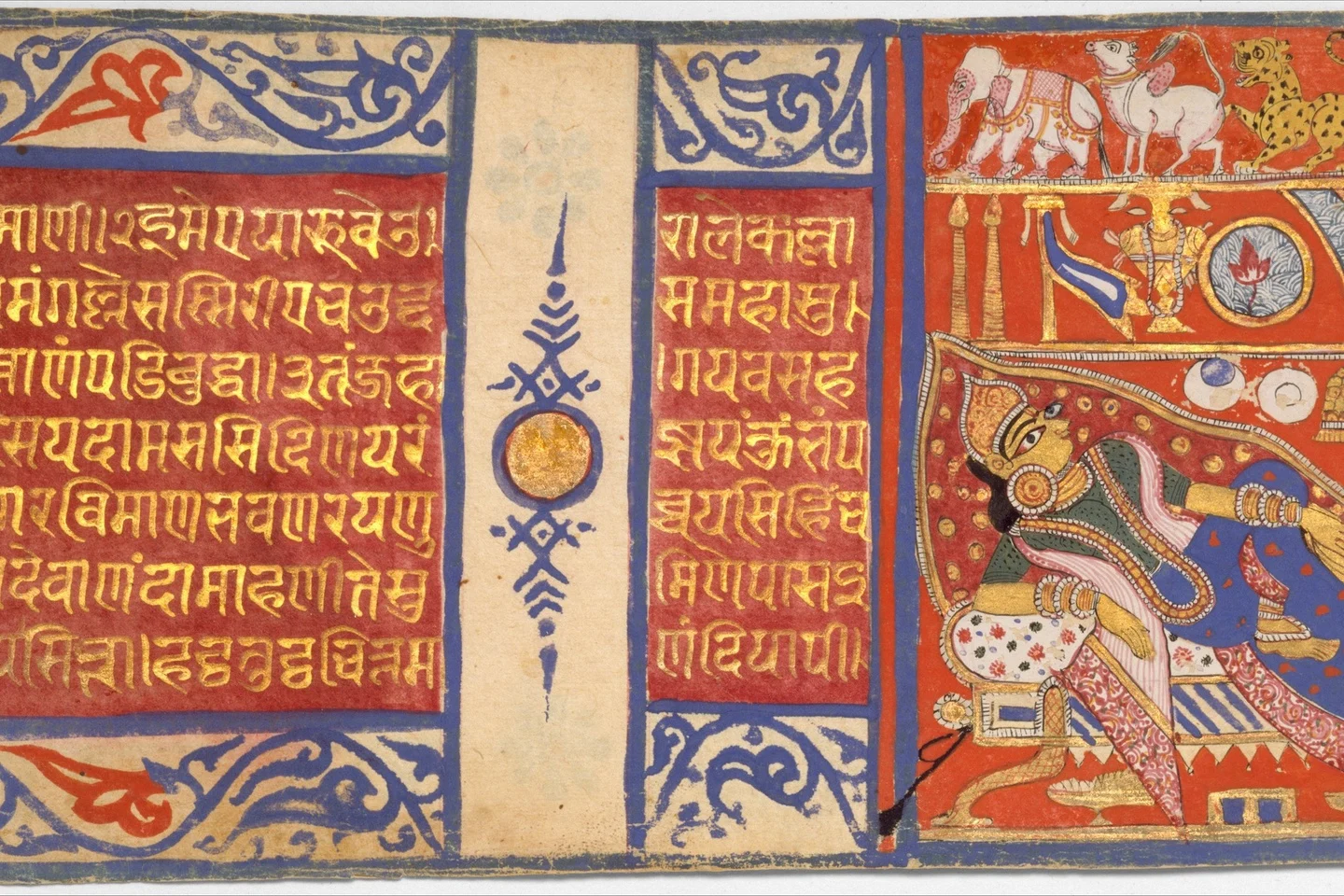 Master of the Jaunpur Kalpasutra
Devananda's Fourteen Auspicious Dreams Foretelling the Birth of Mahavira: Folio from a Kalpasutra Manuscript
ca. 1465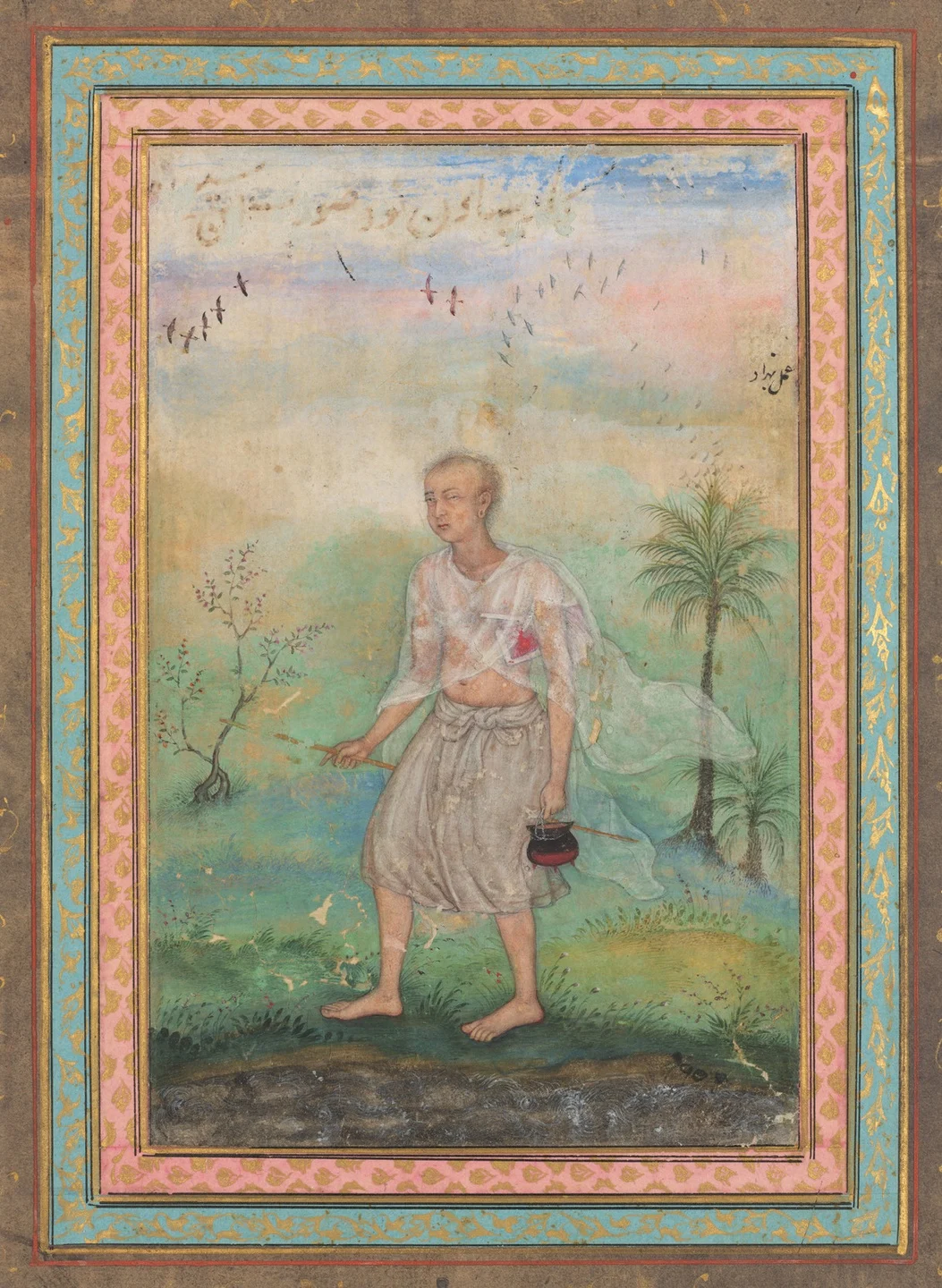 Basawan
Jain Ascetic Walking Along a Riverbank
c. 1600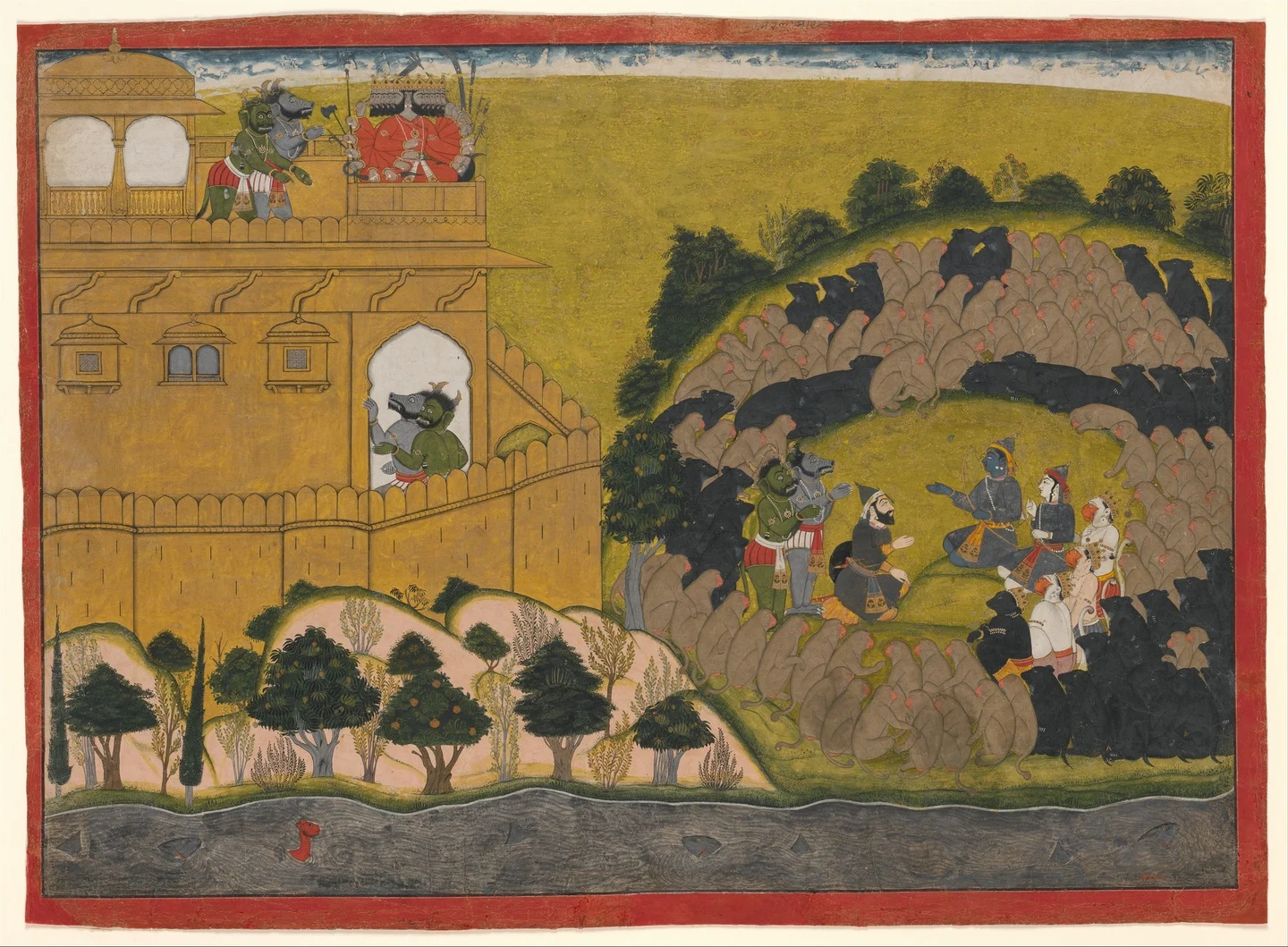 Attributed to Manaku
Rama Releases the Demon Spies Shuka and Sarana: Folio from the Siege of Lanka series
ca. 1725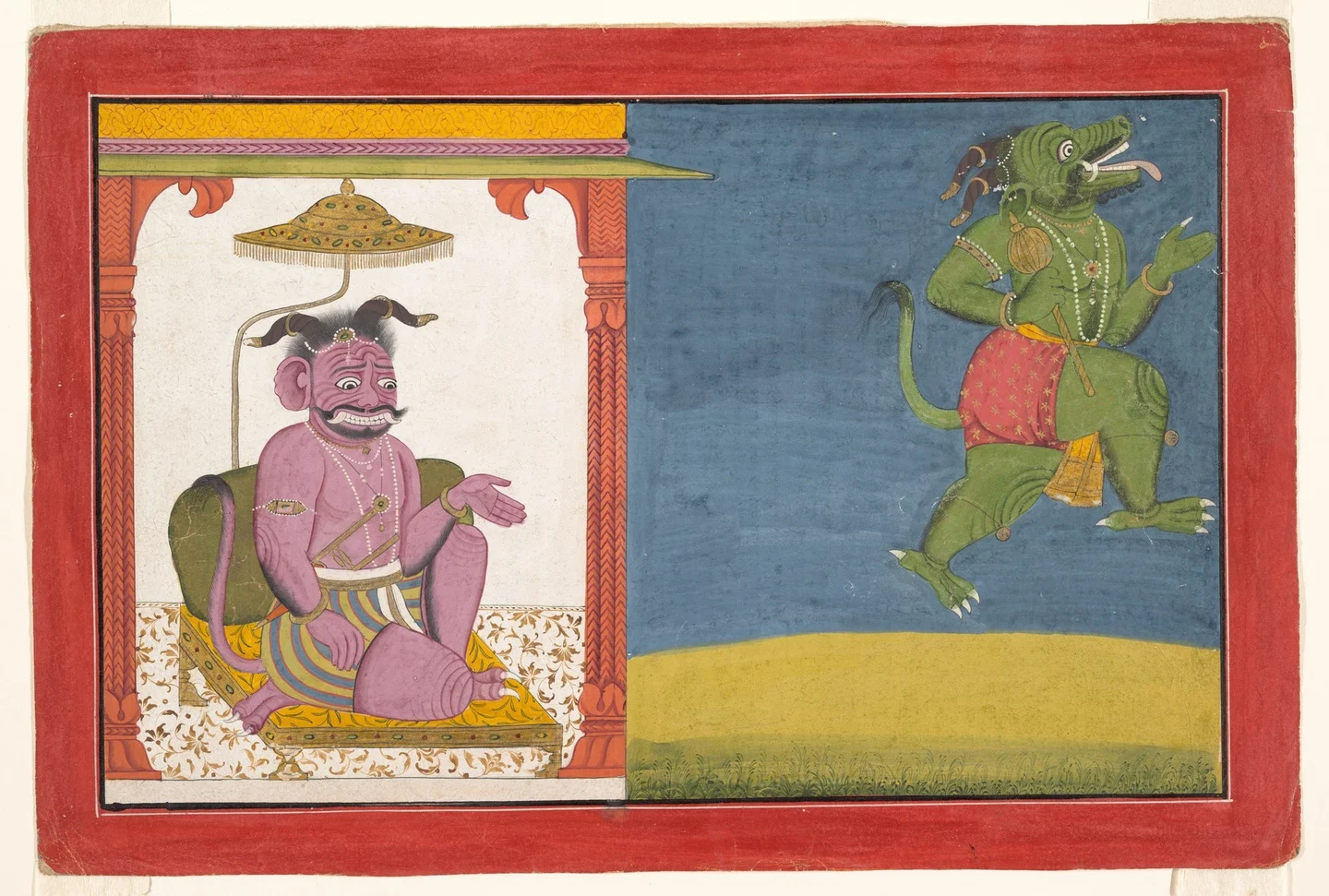 Unidentified Indian painters
The Demon Hiranyaksha Departs the Demon Palace: Folio from a Bhagavata Purana Series
ca. 1740Jain manuscripts, Hindu subjects and regional court life.
Viewers often recognised a scene from an attribute or gesture. Painters could assume familiarity with an epic, religious text or courtly poetry. We examine these clues while preserving distinctions between Jain and Hindu traditions, then turn to rulers’ portraits.
Manuscripts and religious narratives
Texts identify characters and the order of events. Different religions had their own figures and reading practices.
Devananda's Fourteen Auspicious Dreams Foretelling the Birth of Mahavira: Folio from a Kalpasutra Manuscript
Master of the Jaunpur Kalpasutra · ca. 1465
Dream emblems above Devananda’s bed foretell Mahavira’s birth. The long leaf preserves the format of earlier palm-leaf books. Gold and lapis-derived blue connect this Jain manuscript with Iranian artistic materials and approaches.
Jain Ascetic Walking Along a Riverbank
Basawan · c. 1600
A Jain monk carries a manuscript, staff, pot, and broom. The portrait was made for Akbar's collection during the emperor's interest in Jain teaching. Representatives of different religions joined court discussions, and he listened closely to Jain teachers. The monk's belongings explain his practice and connection with learning.
Rama Releases the Demon Spies Shuka and Sarana: Folio from the Siege of Lanka series
Attributed to Manaku · ca. 1725
Three episodes share one leaf: spies are captured, Rama releases them, and they report to Ravana. The unfinished Siege of Lanka series is attributed to Manaku. It bridges Basohli’s flat colour with developing Guler-Kangra naturalism.
The Demon Hiranyaksha Departs the Demon Palace: Folio from a Bhagavata Purana Series
Unidentified Indian painters · ca. 1740
Hiranyaksha leaves to attack Earth while Vishnu sleeps cosmically. The episode prepares Vishnu’s rescue of Earth as the boar Varaha. Within a Bhagavata Purana sequence, departure begins a familiar story of disrupted and restored cosmic order.
Gods, music and relationships
Scenes of play, music and encounters take part in religious and poetic narratives.
Shiva and Parvati Playing Chaupar: Folio from a Rasamanjari Series
Devidasa of Nurpur · dated 1694–95
Parvati protests after Shiva cheats at chaupar and wins her necklace. The leaf belongs to a Rasamanjari series describing lovers’ emotions. Gods take part in a recognisable domestic quarrel, expressed through vivid Basohli colour and gesture.
The Gopis Plead with Krishna to Return Their Clothing: Folio from "Isarda" Bhagavata Purana
Master of the "Isarda" Bhagavata Purana · ca. 1560–65
Krishna has hidden the bathing gopis’ clothes, and they ask for their return. Devotional poetry interprets their attraction to him as profound religious attachment. This important mid-sixteenth-century manuscript preserves North Indian traditions during the emergence of Mughal court art.
Krishna Revels with the Gopis: Page from a Dispersed Gita Govinda (Song of the Cowherds)
Unidentified Malwa painter · ca. 1630–40
This page illustrates the Gita Govinda, a poem about Krishna and Radha. Gopis gather around Krishna beside a river. Bright color and patterned clouds belong to the early Malwa painting tradition. Within a manuscript, the figures and their gestures accompanied a familiar poetic story.
A Lady Playing the Tanpura
Unidentified Kishangarh painter · ca. 1735
A courtly musician embodies the ideal heroine of devotional poetry. Tanpura, jewellery and fine clothing also suggest Radha, important to Kishangarh’s patrons. Music at court meets a language of religious love.
Royal lovers watching rain clouds: The month of Bhadon, from a Barahmasa
Unidentified Indian painters · c. 1790
The painting represents Bhadon, a month near the end of the monsoon. Rain hindered travel and warfare, keeping men at home. Monthly painting cycles therefore associated this time with lovers' meetings. A palace couple, musicians, and storm clouds turn the calendar theme into a particular scene.
Protector and ruler
Devotion to a deity and a ruler’s image could support the same dynastic history.
Mahadevi, the Great Goddess
Unidentified Bikaner painter · ca. 1725
Mahadevi’s twenty arms carry the gods’ weapons and connect her with Durga. The ruling family of Bikaner honoured this protective deity. Multiple arms allow several powers to be represented at once within one figure.
Maharana Sangram Singh Riding a Prize Stallion
Stipple Master · ca. 1712
A radiant halo asserts Sangram Singh’s solar ancestry. The unidentified artist is conventionally named for stippling. Tiny marks and restrained colour leave paper visible, creating an unusual Rajput approach with Mughal and Deccan parallels.
Maharana Bhim Singh in Procession
Attributed to Ghasi · c. 1820
Mewar’s ruler rides with jewels, a hookah, hunting animals and dynastic emblems. The procession projects wealth and authority. Yet in 1818 Bhim Singh had to accept British protection. The ceremonial image shows the status the ruler sought to sustain as his state’s independence weakened.
The House of Bijapur
Kamal Muhammad and Chand Muhammad · ca. 1680
Nine Adil Shahi sultans appear together in an assembly made for the young Sikandar. The painting dates shortly before Bijapur fell in 1686. An exchange of a key invokes dynastic legitimacy and links with Safavid Iran. A later inscription misidentifies the Iranian ruler and cannot be accepted at face value.
Prince and ascetics, from the Late Shah Jahan Album
Attributed to Painting by Govardhan · c. 1630
A Mughal prince visits a Sufi teacher. The finished painting was later removed from an earlier setting and inserted into Shah Jahan's new album. Its selection emphasized the religious side of court life. Additional ascetics in the margins connect the central encounter with the album page's decoration.
Familiar subjects allowed different solutions
Familiar subjects allowed different solutions. Artists varied scale, colour and the number of episodes on a sheet according to workshop and commission.
A region’s name helps locate an artistic setting without always identifying a painter. Inscriptions and manuscript histories can clarify what the image leaves unknown.
Artists in the tour
Sources
- Master of the Jaunpur Kalpasutra — Devananda's Fourteen Auspicious Dreams Foretelling the Birth of Mahavira: Folio from a Kalpasutra Manuscript
- Basawan — Jain Ascetic Walking Along a Riverbank
- Attributed to Manaku — Rama Releases the Demon Spies Shuka and Sarana: Folio from the Siege of Lanka series
- Unidentified Indian painters — The Demon Hiranyaksha Departs the Demon Palace: Folio from a Bhagavata Purana Series
- Devidasa of Nurpur — Shiva and Parvati Playing Chaupar: Folio from a Rasamanjari Series
- Master of the "Isarda" Bhagavata Purana — The Gopis Plead with Krishna to Return Their Clothing: Folio from "Isarda" Bhagavata Purana
- Unidentified Malwa painter — Krishna Revels with the Gopis: Page from a Dispersed Gita Govinda (Song of the Cowherds)
- Unidentified Kishangarh painter — A Lady Playing the Tanpura
- Unidentified Indian painters — Royal lovers watching rain clouds: The month of Bhadon, from a Barahmasa
- Unidentified Bikaner painter — Mahadevi, the Great Goddess
- Stipple Master — Maharana Sangram Singh Riding a Prize Stallion
- Attributed to Ghasi — Maharana Bhim Singh in Procession
- Kamal Muhammad and Chand Muhammad — The House of Bijapur
- Attributed to Painting by Govardhan — Prince and ascetics, from the Late Shah Jahan Album