The Love Song
Sir Edward Burne-Jones · 1868–77
Explore the painting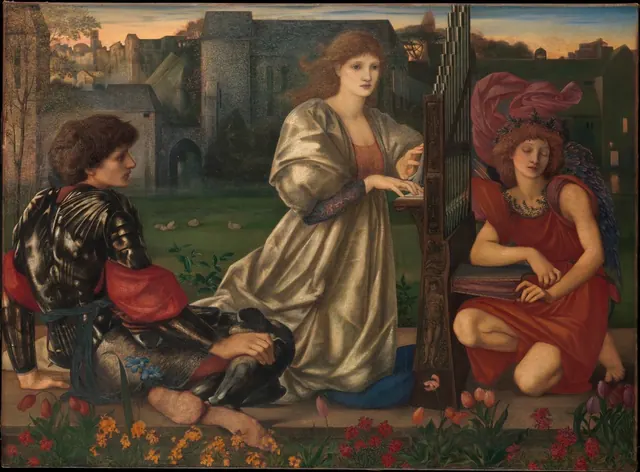
The painting’s story and details
A woman plays a small organ, a knight listens, and Cupid operates the instrument. Edward Burne-Jones worked on The Love Song from 1868 to 1877. When exhibited, it was accompanied by lines describing a song as alternately sad and happy. Music joins the three figures without turning the image into a sequence from a known legend.
The player looks ahead, her fingers resting on the keys. Her pale dress fills the centre against the knight’s dark armour. The woman and the knight do not exchange glances.
The knight sits beside a tree with his helmet removed. Pale reflections break across polished metal beside a red sleeve. Armor remains present without a battle. It establishes an imagined chivalric world in which music and love can occupy as prominent a place as heroic action.
Winged Cupid works the organ bellows at the right, identified by his quiver of arrows. He performs labor necessary for the sound. Music depends both on the keyboard and on supplied air. The allegory rests on a specific action rather than merely the presence of an attractive winged figure.
Tall organ pipes divide the player from Cupid. Carved wood and soft folds receive comparable attention. An actual mechanism inhabits an invented setting. Burne-Jones constructs a past from selected forms of dress and architecture rather than reconstructing a particular medieval town.
Stone buildings rise behind the figures, with tulips and other flowers in front and little urban activity. The first owner was businessman William Graham. This imagined past adorned nineteenth-century private collections. Commerce and business connections supported paintings in which life appeared unhurried and remote from the present.
Burne-Jones associated the scene with his affair with the artist and model Maria Zambaco. A modern experience took the form of an invented past. Player, listener, and bellows-working Cupid depend on one another for the song to sound. Love becomes a shared action even though the participants scarcely exchange glances.
Featured in tours
Love, marriage and encounters
Gods, lovers, spouses and people whose relationships remain unknown.
More paintings to compare
Period, style and subject
- Movement
- Pre-Raphaelites
- Genre
- Imagined worlds
- Medium
- Oil on canvas
- Collection
- The Metropolitan Museum of Art
- Dimensions
- 114.3 × 155.9 cm
- Accession number
- 47.26
Sources
Image provided under CC0. Image licence