The Trojan Women Setting Fire to Their Fleet
Claude Lorrain · ca. 1643
Explore the painting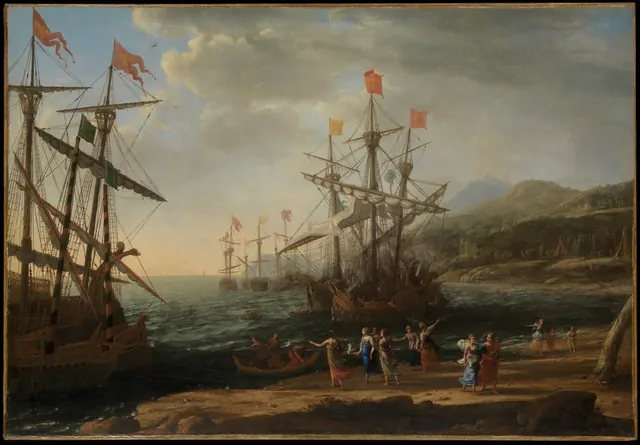
The painting’s story and details
After Troy’s destruction, Aeneas leads its survivors toward a new homeland. In Book V of the Aeneid, however, the women try to stop the journey by burning their own ships. Claude Lorrain chose this episode around 1643. The foreground belongs to people for whom the great expedition has meant years without a permanent home.
On the shore, women gesture and carry fire toward the water. In Virgil’s account, Juno sends Iris to prevent the Trojans from reaching Italy. The goddess exploits their existing desire to stay. Behind divine intervention lies a human exhaustion with the sea and uncertainty.
The ships occupy most of the painting. Their masts tower above the women, rigging forms intricate webs, and their hulls are richly decorated. This scale makes the stakes apparent. The vessels enabled escape from Troy and remain the means of continuing. Destroying them would remove the entire community’s ability to leave.
The fire is still small. Smoke appears beside the central vessel, but hull and sails retain their shapes. Claude does not turn the scene into an all-consuming blaze. A quiet, luminous distance remains open between the ships while events on the near shore determine whether another voyage will take place.
Clouds gather above the fleet, anticipating the story’s resolution. Aeneas appeals to Jupiter, whose rain extinguishes the fire. Four ships are lost in the poem; the rest survive. Some companions then remain in Sicily while Aeneas continues. Not everyone joins the next stage of the journey.
Tents stand on the slope at the right. This small camp provides a temporary human refuge beside the enormous vessels. The shore offers a place to stop; the ships exist to move onward. Claude places both possibilities within the same landscape, reflecting the division among the travelers.
The patron was Girolamo Farnese, a papal diplomat returning to Rome after service in Switzerland. His home could contain an ancient subject painted by a French artist working in Italy. Ecclesiastical patronage included such pictures. Pagan gods and Trojan exiles belonged within the educated culture of Catholic Rome.
More paintings to compare


Period, style and subject
- Movement
- Baroque
- Genre
- History painting
- Medium
- Oil on canvas
- Collection
- The Metropolitan Museum of Art
- Dimensions
- 105.1 × 152.1 cm
- Accession number
- 55.119
Sources
Image provided under CC0. Image licence