The Abduction of the Sabine Women
Nicolas Poussin · probably 1633–34
Explore the painting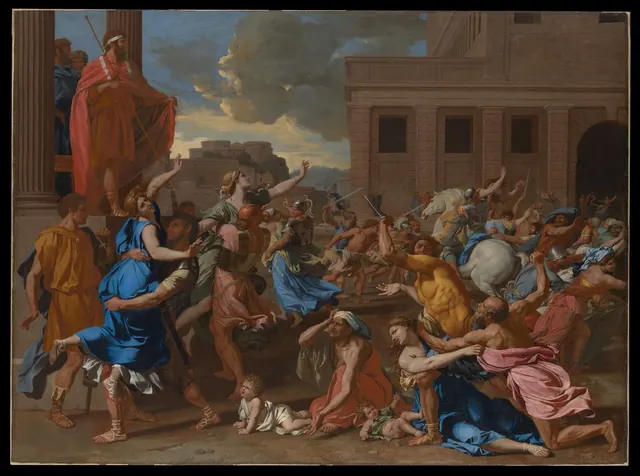
The painting’s story and details
According to Roman tradition, Romulus invited the neighbouring Sabines to a festival so that his men could seize their women as wives. Poussin shows the attack beginning. He painted the work in Rome, probably in 1633–34; it later belonged to Cardinal Richelieu. This account of a state’s foundation begins with deceiving and assaulting its guests.
Romulus stands between the columns on the left. He lifts the edge of his red cloak, the prearranged signal. His figure remains still above the crowd while everyone below moves in different directions. The cloak connects the ruler’s order with events in the square. The attack was planned before the festival began.
On the left a man lifts a woman dressed in blue. She leans backwards, reaching towards Romulus, with her feet clear of the ground. Another raised arm appears nearby. Poussin distributes these gestures at different heights, keeping individual appeals and attempts to resist distinguishable within the crowded group.
An older woman sits on the ground beside two young children. One crawls, the other lies down, while she raises a hand to her forehead. In the museum’s reading, following Plutarch, these are the nurse and children of a married woman taken along with the unmarried women. An existing family, torn apart by the attack, enters the story of Rome’s future.
On the right a kneeling man in pink holds a young woman. Behind them, a figure in yellow raises a sword. Beautiful folds connect the bodies in a complex group, but open mouths, grasping hands and weapons keep the event unmistakable. Pictorial elegance and depicted suffering coexist in this single passage.
A white horse separates the foreground struggle from the crowd beside the building. Its hindquarters create a pale shape among the many bodies. More raised arms and attempts to carry women away appear beyond it. The attack extends across the square, although the largest figures occupy only the portion closest to us.
Dark windows repeat at regular intervals across the building on the right. Upright columns and horizontal edges hold the space together. Against them, crossed arms, tilted heads and flying drapery become particularly prominent. Poussin studied ancient sculpture, and some of the groups draw closely on classical examples he knew.
Contemporaries described Poussin arranging wax figures inside a small theatre-like structure to work out poses and lighting. Such preparations helped organise crowded narratives. The story itself deserves equally close scrutiny. If founding a great state justifies abduction in the legend, what happens to that justification when a painter carefully displays the victims’ bodies and faces?
Featured in tours
History in painting. Events and memory
Who painted war, revolution and state power, and how long after the event.
More paintings to compare
 Nicolas Poussin
Landscape with Saint John on Patmos
1640 Nicolas Poussin
Blind Orion Searching for the Rising Sun
1658 Nicolas Poussin
The Holy Family on the Steps
1648 Nicolas Poussin
The Baptism of Christ
1641/1642 Nicolas Poussin
The Assumption of the Virgin
c. 1630/1632 Claude Lorrain
The Trojan Women Setting Fire to Their Fleet
ca. 1643Period, style and subject
- Movement
- Baroque
- Genre
- History painting
- Medium
- Oil on canvas
- Collection
- The Metropolitan Museum of Art
- Dimensions
- 154.6 × 209.9 cm
- Accession number
- 46.160
Sources
Image provided under CC0. Image licence