"The Elephant Clock", Folio from a Book of the Knowledge of Ingenious Mechanical Devices by al-Jazari
Unidentified painter, probably Syria or Iraq · dated 715 AH/1315 CE
Explore the painting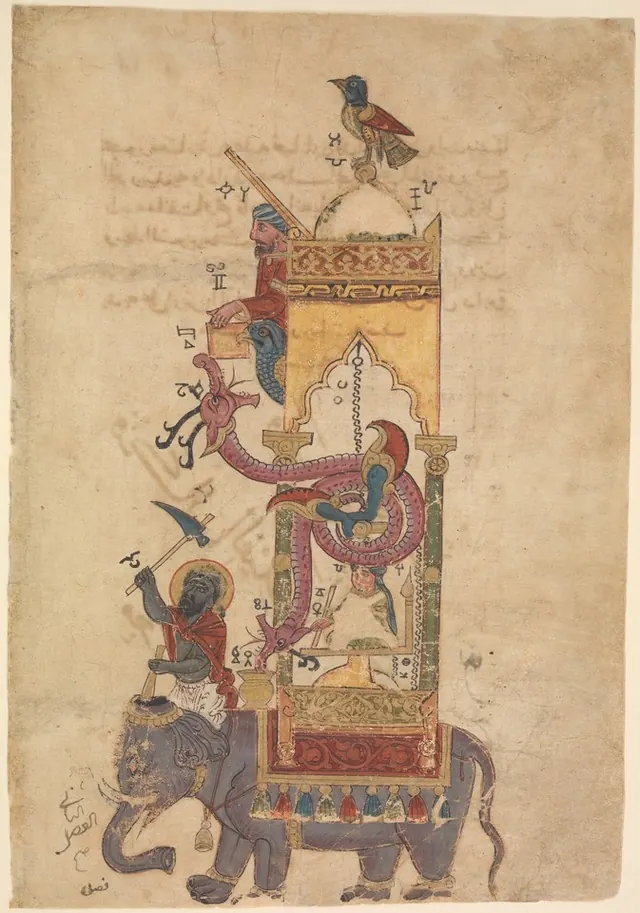
The painting’s story and details
An elephant carries a tower with people, a bird, and dragons. This illustrates a clock from the engineer al-Jazari’s treatise. The book explained mechanical devices, while its pictures helped readers connect descriptions to individual components. This surviving leaf was made in 1315, after the author’s lifetime, probably in Syria or Iraq.
A bird stands on the dome. According to the museum’s account of the mechanism, it whistled every half-hour. Time was announced through sound and movement. The figure at the top therefore has a particular technical role despite looking like an ordinary decorative ornament.
The upper man sits before a small platform. During the clock’s operation he released a ball into a dragon’s mouth. The painter shows him from the side, keeping the hand visible. His position connects the human gesture with the neighbouring part of the device.
The dragons have long curved necks and open mouths, occupying much of the centre of the leaf. Their bodies cross the tower’s supports, but fine outlines keep the shapes distinguishable. The illustration conveys the exterior of a complex device. Its inner mechanism must be reconstructed from the treatise rather than guessed from this image alone.
The driver sits above the elephant’s head with an implement raised in his hand. When the clock operated, this figure struck the elephant. Several automatic actions occurred in different parts of the structure, allowing viewers to follow them from the bird above to the driver below.
The tower rests above a decorated covering. Tassels, coloured bands, and equipment are visible. They make the device resemble a richly caparisoned elephant carrying passengers. The mechanical object also provides a spectacle, and the painter gives its appearance as much attention as the placement of the moving figures.
Small lettered labels stand beside individual components. They distinguish this leaf from an independent scene featuring an animal. The image was intended to be used with the book’s text. Detached from that sequence of explanation, not all its labels can be understood without consulting the treatise.
The unusual machine raises questions that appearance alone cannot settle. How far was the image intended for construction, explanation, or admiration? Its lettered labels establish a relationship with technical text, but operation must be checked against the treatise. The illustration’s visual plausibility cannot replace that investigation.
The museum record names the calligrapher Farrukh ibn Abd al-Latif, but the illustrator has not been identified. Those roles should not automatically be combined. The leaf records the preservation of engineering knowledge through manuscript copies: text, component labels, and a carefully executed illustration worked together to describe an unusual machine.
Period, style and subject
- Movement
- Islamic book arts
- Genre
- History painting
- Medium
- Ink, opaque watercolor, and gold on paper
- Collection
- The Metropolitan Museum of Art
- Dimensions
- 30 × 38.7 cm
- Accession number
- 57.51.23
Sources
Image provided under CC0. Image licence