Great Indian Fruit Bat
Attributed to Bhawani Das or a follower · ca. 1777–82
Explore the painting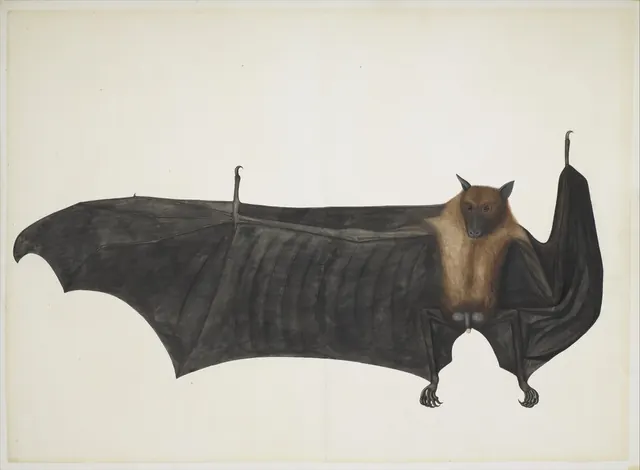
The painting’s story and details
One wing of the fruit bat opens across almost the entire sheet; the other is gathered beside the body. This view allows two states of the membrane to be compared immediately. Made in Calcutta around 1777–1782, the painting is 83 centimetres wide. It is attributed to Bhawani Das or a follower. Its maker worked in a setting where Indian miniature-painting skills were being adapted to large natural-history images for British patrons. The animal occupies the whole sheet without a landscape or accompanying figures.
Pale rims around the eyes, nostrils and short hairs are visible on the face. The fur on the shoulders is considerably lighter than the wings. Fine strokes distinguish its direction, scarcely allowing the hairs to merge into one patch. These small differences help make the animal recognizable. Close viewing reveals care comparable to that of a tiny court portrait. The skill of working with a very fine brush survives even on an unusually large format.
Long fingers form the wing’s framework. A dark membrane stretches between them, with curves and fine veins. The artist varies the density of the tone so that each fold remains distinct. The entire edge can also be traced from the body to its outermost point. The image makes it possible to study a structure that is difficult to observe for long in this position on a moving animal. The sheet does not establish how the specimen was arranged before the painter.
On the right the wing forms deep folds. It occupies much less space although its structure matches the extended wing. The difference between the two sides breaks the body’s symmetry and makes the sheet particularly useful for comparison. A curved claw projects at the upper edge. Pale paper surrounds it, keeping its thin shape clearly visible. The same precise brushwork distinguishes the claws of the lower feet against the nearly empty background.
The feet end in tightly curling claws. Such precision was expected of painters working for collectors of natural history. Bhawani Das worked for Mary Impey and her husband Elijah, Chief Justice of Bengal. Their Calcutta home contained an aviary and a menagerie. Mary commissioned detailed animal pictures from artists trained in Mughal painting. Shaikh Zain ud-Din and Ram Das worked alongside Das. The Ashmolean Museum records their use of large sheets of imported English paper. A commission from the Impeys for this particular bat has not been established; the Met relates it to another, closely comparable work by Das.
Works of this kind are called Company painting. East India Company employees and their families commissioned Indian artists to depict local nature, people and cities. The Company was expanding from trade into territorial administration. The wish to describe the country in detail developed within these unequal relations. This sheet lets us study an animal’s body closely, yet tells us little about its behaviour, surroundings or feeding. The chosen format provides some kinds of knowledge while leaving others outside the frame.
The category’s name associates these works with a British trading company, while the authorship of individual sheets has to be investigated afresh. The Wallace Collection’s 2019 exhibition Forgotten Masters deliberately shifted attention to Indian artists and their distinct styles. Bhawani Das remains a proposed attribution, but the work of a particular hand is clear in individual hairs, membrane folds and the precise curve of each claw. The natural-history image depended on a maker whose name survives with less certainty than the species represented.
Featured in tours
The courtly book. Iran and India
Poets, scribes, painters and rulers make an illustrated manuscript.
Period, style and subject
- Movement
- Mughal painting
- Genre
- Animals
- Medium
- Pencil, ink, and opaque watercolor on paper
- Collection
- The Metropolitan Museum of Art
- Dimensions
- Painting, 59.7 cm
- Accession number
- 2008.312
Sources
Image provided under CC0. Image licence