The Sixteen Luohans
Wu Bin · dated 1591
Explore the painting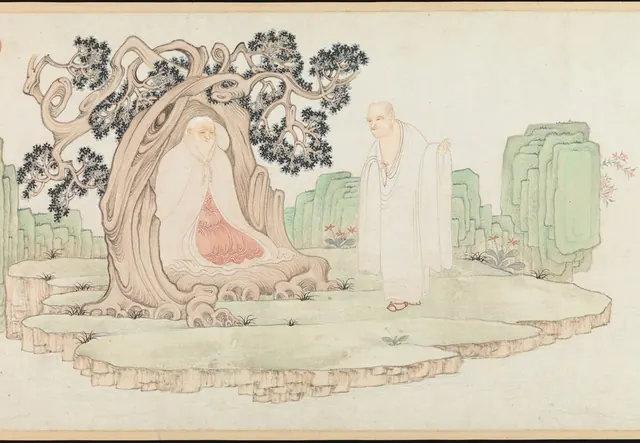
The painting’s story and details
This is the final section of Wu Bin’s handscroll of 1591. The complete scroll unfolds horizontally and contains many more figures. Its traditional title is The Sixteen Luohans, or arhats. In Buddhism, arhats have attained liberation; their images could take the form of elderly wanderers with deliberately unusual appearances.
On the left, a figure sits within a hollow trunk. White clothing conceals almost the entire body. His face and beard emerge from the dark cavity, surrounded by the tree’s folded forms like a close shelter. Here the tree provides a particular place of seclusion.
The standing figure turns towards the seated man and raises a hand. A dark loop of beads appears in the other hand. This small movement connects the two figures. Their identities and the precise meaning of the encounter require interpretation; the gesture alone cannot establish them.
Pale winding lines cover the trunk. Roots and branches curl, leaving scarcely any straight sections. Wu Bin’s tree looks as unusual as his human figures. Its individual curves can be followed across the surface, although it does not resemble a botanically exact specimen.
Green rocks on the right rise in abrupt vertical facets. Small red flowers appear between them. Stone, foliage and figures have different rhythms of line. These forms place the encounter in surroundings markedly different from an ordinary road or monastery courtyard.
Below, the edge of the land meets bands of water. The figures occupy a small island-like setting enclosed by tree and rocks. Stories of extraordinary monks and miracle workers were popular in late Ming culture. The museum connects Wu Bin’s fantastic figures with holiness concealed beneath an unconventional appearance.
The title Sixteen Arhats became established later, under the Qianlong emperor. In a 2024 study, Hui-chi Lo notes that the complete scroll contains more than sixteen possible arhats and proposes reconsidering its narrative. The familiar title therefore does not settle exactly whom Wu Bin depicted.
Featured in tours
Buddhist images. Gesture, mandala and journey
How images participated in teaching and ritual across Asia.
Period, style and subject
- Movement
- Chinese painting
- Genre
- Religious art
- Medium
- Handscroll; ink and color on paper
- Collection
- The Metropolitan Museum of Art
- Dimensions
- Image, 32.1 × 415.4 cm
- Accession number
- 1986.266.4
Sources
Image provided under CC0. A detail of the scroll. The complete work extends beyond this museum reproduction. Image licence