Justinian and his retinue
Unknown mosaic artists · About 547
Explore the painting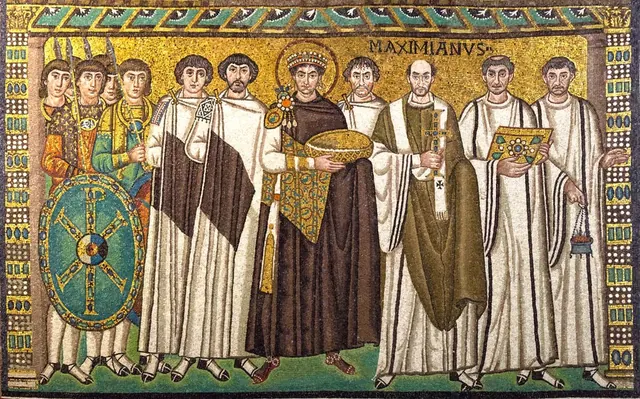
The painting’s story and details
Justinian appears in a church in a city he never visited. His mosaic portrait stands near the altar of San Vitale in Ravenna, consecrated in 547. Empress Theodora appears on the opposite wall. Worshippers saw their rulers far from the court in Constantinople. Images made distant authority a permanent participant in local religious life.
In 540 Belisarius’s forces took Ravenna from the Ostrogoths. Justinian sought to bring former western Roman territories under his rule, and war in Italy continued. The mosaic presents an established order — ruler, officials, soldiers and clergy standing together. In a city that had recently changed rulers, this appearance of agreement carried a specific political meaning.
A purple cloak, crown and jewelled fastening distinguish the emperor. A patterned panel on his clothing, the tablion, is clearly visible beneath the dish. Dress communicated court rank before a viewer recognised the face. A halo surrounds the living ruler’s head and lends his presence a sacred character. Costume’s splendour serves as a language of authority.
Justinian carries a paten for the Eucharistic bread. His offering is directed towards the altar and the adjacent image of Christ. He occupies the chief place in the earthly procession while venerating a higher authority. This gives his position a Christian justification — a ruler commands people while serving God.
Above the bishop is the inscription MAXIMIANVS — Maximian. His face, cross and white vestment band are distinct from the emperor’s purple. Regalia identify the ruler; words name the bishop. Different ways of establishing rank work together within the row. Among similar pale robes, the inscription secures Maximian a particular place.
The shield on the left combines chi and rho, the first Greek letters of Christ’s name. It connects the army with the faith defended by the emperor. Spears and shield remain military objects within a church procession. Armed men beside clergy show state force incorporated into an image of sacred order.
On the right, attendants carry an ornamented book and a censer on chains. Their hands turn to display the objects clearly. The group is almost motionless, yet the distribution of objects explains its activity. Each person’s role within the procession matters. Book, cross, paten and censer make that order legible to the eye.
At foot level the order becomes less certain. Art historian Allen Farber observes that overlaps advance Justinian, while Maximian’s lower feet bring the bishop closer to the viewer. He suggests a possible tension between ecclesiastical and imperial authority. This interpretation of spatial ambiguity invites another look at the agreement so confidently presented above.
Up close, the gold separates into numerous small pieces. Joints, shades and surface irregularities become visible. The face too is assembled from individual elements whose directions change around eyes, nose and mouth. From a distance they join into a ceremonial figure. An impression of inaccessible grandeur results from precise manual work.
Julianus Argentarius, generally described as a banker, funded San Vitale’s construction. Bishop Ecclesius began the building; Maximian consecrated it. Money, decisions and the work of many people in Ravenna stood behind the imperial image. The mosaic organises their world around an absent ruler, whose permanent presence in the city was supplied by art.
Featured in tours
Christian images. From mosaic to Caravaggio
Icons, manuscripts, domestic devotional pictures and church altarpieces.
Period, style and subject
- Movement
- Byzantine art
- Genre
- Religious art
- Medium
- Wall mosaic
- Collection
- Basilica of San Vitale, Ravenna
Sources
CC BY-SA 3.0. Resized previews and tiles prepared for display; no retouching or upscaling. Image licence