Hunters in the Snow (Winter)
Pieter Bruegel the Elder · 1565
Explore the painting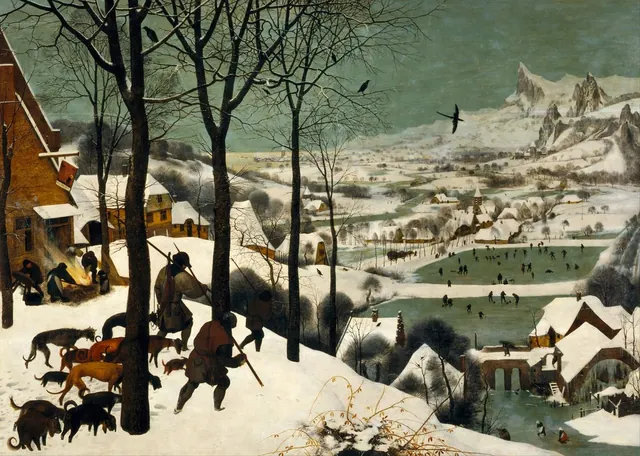
The painting’s story and details
Bruegel painted Hunters in the Snow in 1565 for a cycle of six seasonal pictures decorating the country house of the Antwerp merchant Nicolaes Jonghelinck. Winter here covers December and January. The large landscape combines obtaining food, household work and games. For the villa’s owner it offered nature as a setting for leisure; for the people shown, the same nature determined the conditions of daily existence.
Three hunters descend with their backs to us. Their long poles echo the direction of movement, while dark trees divide the foreground into passages. We enter behind the men, then gradually overlook the entire valley. A path becomes a broad prospect. Bruegel establishes human scale nearby before showing how small it is in relation to the landscape.
The dogs move in a close group, heads and tails lowered. There is little prey. We can read the return as a modest outcome of a lengthy activity, though the hunt itself is unseen. Animals occupy much of the lower edge. Different turns and sizes make their movement uneven. Winter life begins here with fatigue and the need to return home, rather than a festive success.
Below, people skate and play on frozen ponds. Their bodies become short dark movements, yet inclinations, turns and groups remain distinguishable. The frost that makes hunting and work harder also creates a surface for amusement. These aspects of winter coexist. The painting does not require a choice between hardship and pleasure. One environmental condition affects different activities differently.
The steep mountains beyond the village are unlike ordinary Flemish terrain. Bruegel combines familiar settlements with Alpine impressions. This constructed view offers more than one exact location could provide. The horizon recedes, houses shrink and the snowy valley extends far beyond the human route. The prospect feels comprehensive, although the artist assembled it from different observations.
At left several people work around a fire beside a house. Yellow flame differs sharply from the green-grey sky and white snow. Smoke rises as bodies bend towards a shared task. This small group restores the need for warmth and cooperation within the vast landscape. Games continue at a distance. The activities have no separate boundary, only distance within one village environment.
In 1594 Antwerp acquired the cycle and presented it to Archduke Ernest of Austria, the new governor of the Netherlands. The rural year became a diplomatic gift. That history adds another relationship: people within the painting depend on the season, while the image of their lives circulates among merchant and ruling elites. The artist gives daily labour a grand scale, but ownership of that view remains a privilege.
More paintings to compare
Period, style and subject
- Movement
- Northern Renaissance
- Genre
- Landscape
- Medium
- Oil on oak panel
- Collection
- Kunsthistorisches Museum, Vienna
- Dimensions
- 116.5 × 162 × 2.4 cm
- Accession number
- Gemäldegalerie, 1838
Sources
Reproduction of a public-domain artwork. Image licence