The Tempest
Giorgione · 1503–1509 (proposed dates; dating debated)
Explore the painting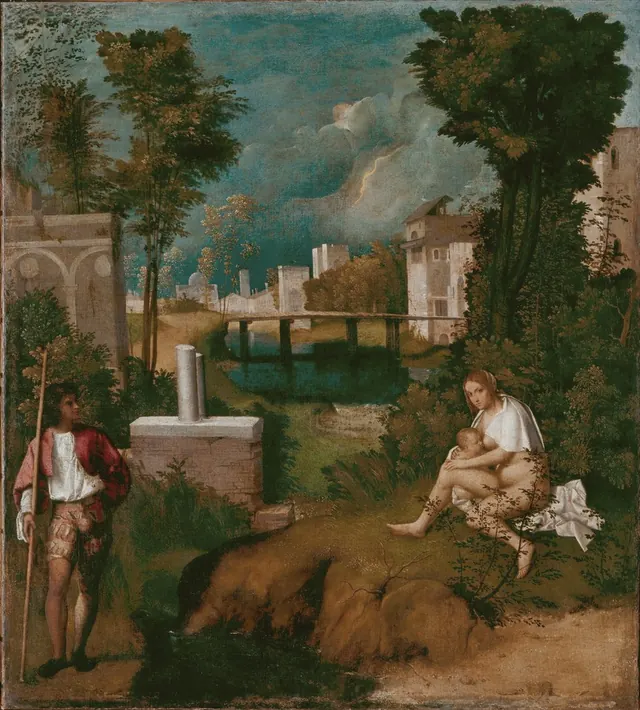
The painting’s story and details
Lightning above a town, a nursing woman and a young man form a scene without a generally accepted narrative explanation. In 1530 Marcantonio Michiel saw it in the Venetian Gabriele Vendramin’s collection. It belonged among objects available for close private viewing and conversation. Giorgione made nature so independent that the human figures no longer command the entire image.
The man at left stands with a long staff. His red clothing stands out against the greenery, yet the trees above occupy far more space. Examination revealed a seated nude woman beneath this figure. The change altered the scene’s cast. Imagining both versions is useful: a narrative interpretation that seems inevitable in the final painting may no longer work if the earlier figure is restored.
The woman feeds an infant while turning her face towards us. White fabric crosses her shoulders and lies on the ground without covering her whole body. Her pose combines an ordinary act of care with the unusual exposure of an outdoor setting. Water, earth and vegetation separate her from the man. We may see a pair, but the spatial interval also lets us consider each figure independently.
A short bright streak of lightning lies almost above the town’s centre. The sky around it grows dense and dark, while buildings remain illuminated. This relationship brings the possibility of sudden change into a quiet scene. Yet nobody runs for shelter. Weather becomes an event of its own, not enacted by the figures’ gestures. That is a significant feature of Giorgione’s thinking about landscape.
The bridge leads our eyes towards the buildings. Dark reflections lie on the water, more structures appear beyond walls, and trees screen parts of the town. These intermediate planes let the eye travel gradually into depth. The landscape offers more connections than a backdrop for two people would require. We can follow water and light while almost forgetting the demand to identify the figures.
Two broken columns stand beside the man. Their smooth pale surfaces differ from loose earth and foliage. Traces of human building continue in the inhabited town across the river. Ruin and living settlement coexist in one view. Against the approaching storm, that proximity lends the town vulnerability: it too belongs to the time that has already altered the foreground structure.
The Tempest allows two equally serious approaches. We can seek a source that connects figures and objects into a story, or examine how they coexist beneath a changing sky. The first requires documents and comparisons; the second is available within the painting. Their tension matters. Nature can sustain attention even when no human protagonist explains everything we see.
More paintings to compare
Period, style and subject
- Movement
- Renaissance
- Genre
- Landscape
- Medium
- Oil on canvas
- Collection
- Gallerie dell'Accademia, Venice
Sources
Reproduction of a public-domain artwork. Image licence