The Adoration of the Shepherds
Giorgione · 1505/1510
Explore the painting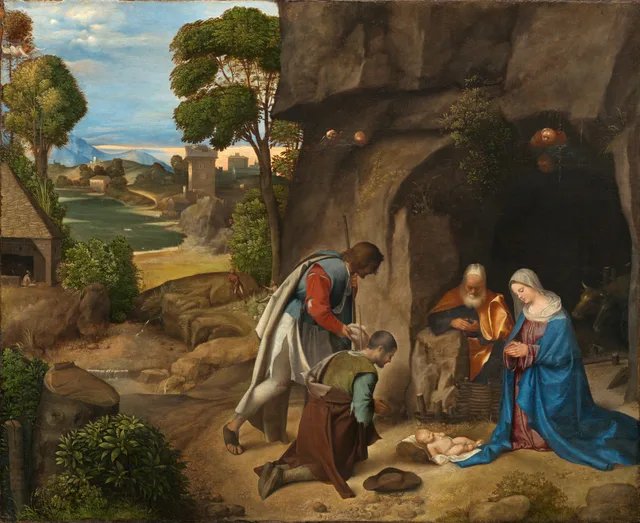
Shepherds approach a child lying on the ground outside a cave. Giorgione painted this scene around 1505–1510. The Gospel event occupies the right side of the panel while an extensive landscape opens on the left. Nature was gaining greater independence in Venetian painting. Here it places an extraordinary event within a world continuing its ordinary life.
The infant lies on white cloth close to the earth. His small size makes the surrounding figures bend and approach. Their bodies express adoration without elaborate ceremony. Humble circumstances are emphasized. The scene’s most important figure occupies the least physical space, so his significance emerges through everyone else’s attention.
Two shepherds stand between us and the Holy Family. Simply dressed, one already kneels while the other is still bending. Their positions suggest successive stages of approach. In the Gospel narrative shepherds first hear the angelic announcement, connecting the sacred birth with people whose work lay outside urban and courtly life.
Mary folds her hands beneath a blue mantle while Joseph sits farther back beside the dark rock. Bright garments distinguish the figures without disturbing the scene’s restraint. Small gaps preserve each gesture, and the group gathers around the child without any person obscuring the focus of adoration.
The cave’s dark entrance makes lit heads and fabrics more distinct. Rock occupies much of the right side, enclosing the group. The left opens into air and distance. This contrast combines concentrated action nearby with a slower exploration of the surrounding world.
Road, water, buildings, and hills extend into the distance rather than reconstructing ancient Judaea precisely. Giorgione’s viewers could recognize something of familiar Italian country. Early sixteenth-century pastoral literature also imagined rural places as settings of repose. The painting shares that interest in nature while retaining a specific Christian subject.
Giorgione died young, and little documentation survives for many commissions. This painting is also called the Allendale Nativity after a former owner. Its historical importance is visible in its construction. Landscape can hold attention beside the sacred scene. A viewer may begin with the road and trees before noticing whom the people at the cave are approaching.
More works by Giorgione
- Medium
- oil on panel
- Collection
- National Gallery of Art, Washington
- Dimensions
- 90.8 × 110.5 cm
- Accession number
- 1939.1.289
Sources
Museum reproduction. Public domain, NGA Open Access. Image licence