Portrait of the Artist's Sister
Georges Lemmen · 1891
Explore the painting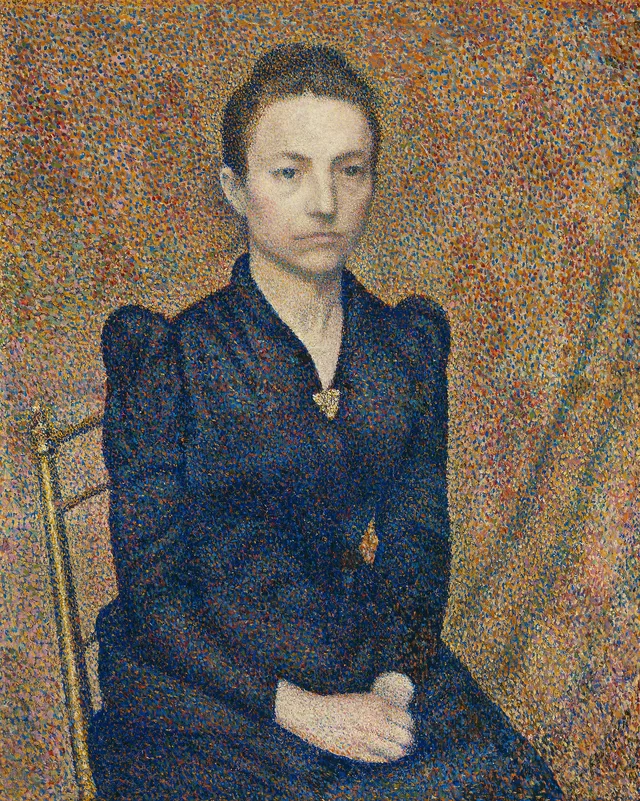
The Belgian painter Georges Lemmen portrayed his sister Julie Frédérique in 1891. A few years earlier he had seen Seurat’s Sunday on La Grande Jatte in Brussels and become interested in painting with separate dots of colour. The method was used less often for portraits than landscapes. Lemmen tests whether a systematic, nearly uniform mark can convey an individual presence without dissolving it into decoration.
The face turns almost directly towards us. Dark hair is gathered above, exposing a broad pale forehead. Close up, skin breaks into numerous small touches, yet eyes, nose and mouth remain distinct. Lemmen varies the density and hue of dots to produce volume. The method’s discipline permits the slight asymmetry that makes a face recognisable rather than ideally oval.
Brows and lips are restrained, with no clear smile. A direct gaze combines with a quiet seated position. She encounters the viewer while retaining distance. The slight angle of her eyes and head makes her attention to the viewer particularly noticeable.
Blue, red and greenish dots construct the dark dress. They merge into dense fabric from a distance but remain varied close up. A small ornament at the neckline becomes the brightest point in the clothing. It establishes the figure’s centre without overloading the portrait with accessories. Colour is active throughout the dress even though the garment appears almost monochrome.
Folded hands in her lap form the second pale area after the face. Their position makes the pose contained and stable. A long dark passage of dress separates head from hands, slowing the eye’s movement. Lemmen retains the familiar organisation of a seated portrait. The novelty lies in translating that arrangement into thousands of separate colour marks.
Orange, yellow and blue dots are especially evident in the background. They surround head and shoulders without describing a clearly defined room. The figure stands out through the overall darkness of its silhouette. Close viewing reveals a feature of the method: background and person consist of similar marks, but their different combinations let us distinguish a living sitter from surrounding surface.
Lemmen transferred a method associated with Seurat’s large public leisure scene into a small family portrait. Artistic influence changes with the task. Dots can investigate a crowd, a sunny shore or a particular face. Here a systematic technique did not remove the personal relationship between painter and sitter. It gave that relationship a form the viewer reassembles with each change of viewing distance.
Featured in tours
Domestic life. Leisure and care
Sixteen paintings about reading, music, children and the work that makes domestic comfort possible.
- Medium
- Oil on canvas
- Collection
- Art Institute of Chicago
- Accession number
- 1961.42
Sources
Wikimedia Commons reproduction. Public domain. Image licence