Jacques and Berthe Lipchitz
Amedeo Modigliani · 1916
Explore the painting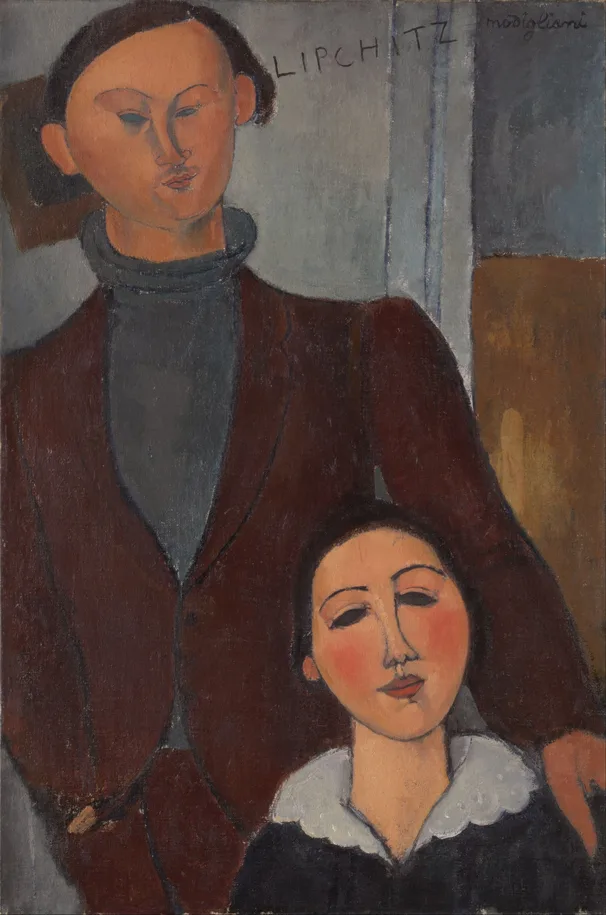
In 1916 the sculptor Jacques Lipchitz commissioned Modigliani to paint a double portrait on his marriage to the poet Berthe Kitrosser. The commission helped a friend in financial difficulty. Lipchitz recalled that the picture was substantially finished in two days, but he persuaded the painter to continue for another two weeks so that he could pay more. The portrait belongs to both a marriage and a network of friendship in Montparnasse.
Jacques stands behind his wife, occupying much of the vertical canvas. Dark clothing and a high collar emphasise his elongated figure. His head inclines slightly and the narrow eyes receive little detailed modelling. Modigliani retains individuality through the oval, hairstyle and facial features, using a restricted set of means. The likeness does not depend on smooth transitions of light.
Berthe sits in front, facing towards the viewer. A pale collar separates her face from her dark dress and her husband’s clothing. Red areas on the cheeks warm the skin. Her face shares Jacques’s basic construction but differs in outline and expression. A consistent style does not erase two individuals. Shared forms instead make small differences more noticeable.
Jacques’s hand appears at the right beside Berthe’s shoulder. It is a small but important connection between the figures. Much of his body surrounds his seated wife, joining their silhouettes. The arrangement can suggest intimacy, while also using a conventional family-portrait format of standing man and seated woman. Modern painting retains some older ways of presenting a couple.
His other hand enters a pocket, reinforcing the jacket’s line. Large brown and grey areas of clothing are almost flat. Compared with the faces they contain little incident, so attention returns to the heads. Modigliani achieves expression through reduced detail. A pocket, collar and a few lines suffice to make the clothes seem worn by a particular person.
The name Lipchitz appears above, beside Modigliani’s signature. Only a few rectangles and verticals remain in the background. The room contains almost no objects explaining the couple’s professions. Knowledge of a sculptor and poet comes from the commission’s history. The picture concentrates on their presence together, without displaying a studio or attributes of creative work.
Modigliani came to Paris from Italy in 1906. Artists from different countries became one another’s models, patrons and supporters. The Lipchitz portrait reveals the practical side of that milieu. Behind a recognisable style stood sittings, an agreement about payment and a wish to help a colleague. Art that later acquired great market value could begin with a modest private act of mutual support.
More works by Amedeo Modigliani
- Medium
- Oil on canvas
- Collection
- Art Institute of Chicago
- Accession number
- 1926.221
Sources
Wikimedia Commons reproduction. Public domain. Image licence