Mäda Primavesi (1903–2000)
Gustav Klimt · 1912–13
Explore the painting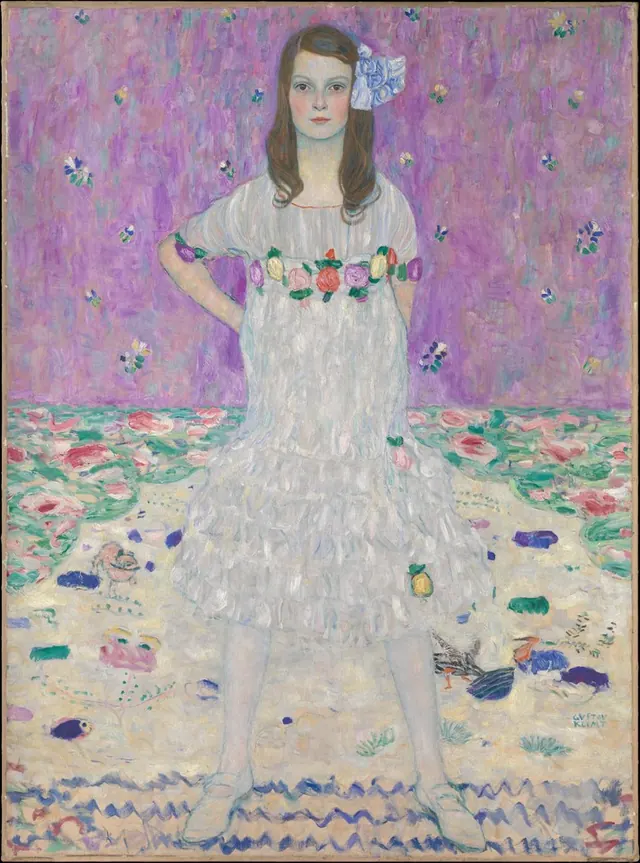
The painting’s story and details
Mäda stands full length before us, her feet apart and one elbow extended. She is about nine. Her father, Otto Primavesi, was a banker and industrialist; together with his wife Eugenia, he supported new art in Vienna. The family portrait formed part of that patronage. Klimt placed the child within a world of contemporary clothing and decorative patterns.
Small strokes of different colours construct the face. Pink appears on the cheeks, with a bluish shadow beneath the chin. Despite the vivid surroundings, the eyes and mouth remain distinct. Klimt preserves recognisable features within a composition in which almost every other surface becomes pattern.
Mäda holds one hand at her waist. The projecting elbow breaks the symmetry and broadens the upper figure. This pose emerged gradually. She later remembered numerous preparatory drawings in which Klimt varied her position, clothing, and surroundings. The portrait’s immediacy coexists with prolonged work on its arrangement.
The white dress with floral decoration was made by Emilie Flöge, a fashion designer and Klimt’s close companion. The flowers around the waist are painted with rounded curls of colour. Their pinks, yellows, and violets echo the background. Clothing helps the artist connect the actual child to the painting’s decorative space.
The bow beside the head is much larger than the individual flowers on the dress. It projects sideways, balancing the mass of hair. Blue curves within its pale shape suggest folds while also forming an independent design. The fabric remains a recognisable object, yet its surface approaches a small abstract composition.
Pale shoes stand near the lower edge. Above them, the long legs are only slightly darker than the dress and carpet. The eye first notices the firm placement of the feet and then reconstructs the complete figure. Head, elbow, and shoes become principal reference points among the scattered patches of colour.
Birds can be found on the carpet at the right. Elsewhere its design is so freely painted that individual forms are difficult to name. The carpet barely recedes into depth, occupying the lower canvas as a broad field of colour. The room’s perspective gives way to relationships among patterns surrounding the girl.
Small flowers cover the pink and lilac background. Vertical strokes remain visible between them, preventing the surface from becoming entirely flat. Few objects tell us about the family’s domestic life. The patrons appear indirectly through their choice of artist and the artistic world to which the portrait belongs.
The firm stance can suggest Mäda’s independence. Yet this was also her parents’ commission and the result of Klimt’s choices. A child’s portrait combines these different contributions. Her expression alone cannot determine what belongs to her own behaviour and what to the painter’s construction of a formal likeness.
The painting also has a history of loss. In 1938 the Nazis confiscated it from the Viennese collector Jenny Pulitzer Steiner. It was restituted to her in 1951 and later given to the museum by her family. Behind today’s museum image are particular people, their collections, and the violent disruption of private lives.
Featured in tours
How painting changed in the early twentieth century
Colour, the human figure and early experiments in abstraction.
Portraits. How people presented themselves
Rulers, merchants, artists and private patrons before a viewer.
More paintings to compare
Period, style and subject
- Movement
- Modernism
- Genre
- Portrait
- Medium
- Oil on canvas
- Collection
- The Metropolitan Museum of Art
- Dimensions
- 149.9 × 110.5 cm
- Accession number
- 64.148
Sources
Image provided under CC0. Image licence