Judith
Jan Sanders van Hemessen · c. 1540
Explore the painting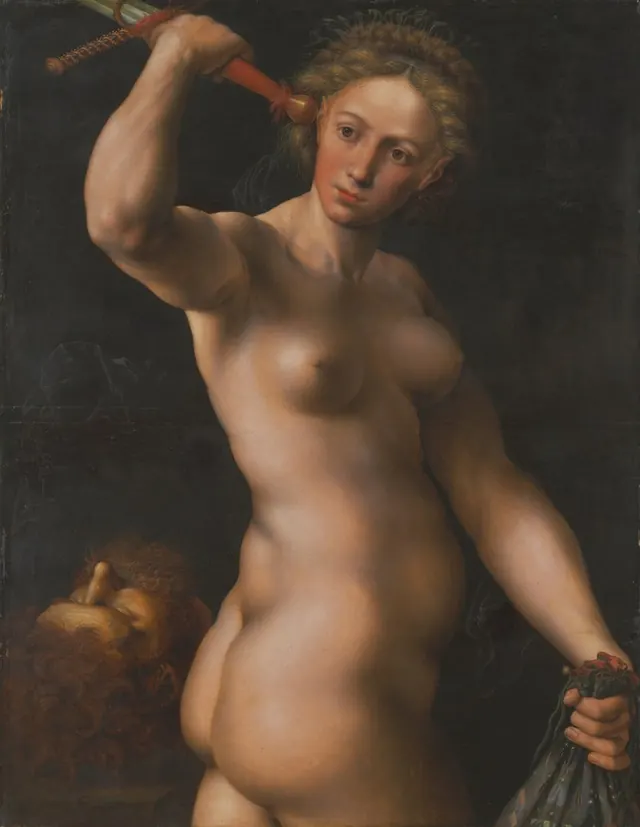
The painting’s story and details
Judith holds a sword beside Holofernes’s severed head. In the biblical account, the widow enters the enemy commander’s tent and kills him to save her people. Jan Sanders van Hemessen painted her around 1540 at nearly life size. A muscular nude combines moral achievement with the display of an attractive body.
Her head turns away from the raised arm. Open eyes and a relatively calm face contrast with bodily tension. Shoulders, neck and head twist in different directions. The killing is over, yet its physical effort remains present.
A hand grips the sword above her shoulder. Much of its blade extends beyond the edge, keeping weapon and body tightly connected. Strength becomes visible without a battle scene. One person and a few objects reveal the consequences of conflict.
The bent arm is emphatically muscular. Van Hemessen belonged to Netherlandish painters exploring monumental classical sculpture and Italian art. Physical power and elaborate turning recall approaches associated with Michelangelo and Raphael. Italian models changed the scale and character of Northern figure painting.
The lit torso projects from darkness. Its turn exposes an extensive nude surface. The museum relates this decision to period male ambivalence towards women’s agency. Judith invites admiration while possessing the power to destroy an adversary drawn to her beauty.
Holofernes’s hair and beard receive precise description. His head beside an attractive body transforms their relationship. The heroic act retains a violent, visible result. Minute hair detail continues Northern attention to surface within an Italianate monumental composition.
Judith’s other hand holds a patterned bag. Dense fabric and a gauzy headdress show different possibilities of painterly description. Belongings connect her with the episode while emphasising nakedness. Cloth, skin and dark background become strongly contrasting surfaces.
Judith belonged to Northern European themes concerning the power of women. This painting preserves their ambiguity particularly clearly. Her strength earns recognition while her appearance remains organised for visual pleasure. Power within the image therefore involves more than the sword: it emerges among the accomplished deed, the displayed body and the position of the person looking.
More paintings to compare
Period, style and subject
- Movement
- Northern Renaissance
- Genre
- Religious art
- Medium
- Oil on panel
- Collection
- Art Institute of Chicago
- Dimensions
- 99.1 × 77.2 cm
- Accession number
- 1956.1109
Sources
Image provided under CC0. Image licence
Adapted and translated from Art Institute of Chicago materials. · Text licence