The Penitence of Saint Jerome
Joachim Patinir · ca. 1515
Explore the painting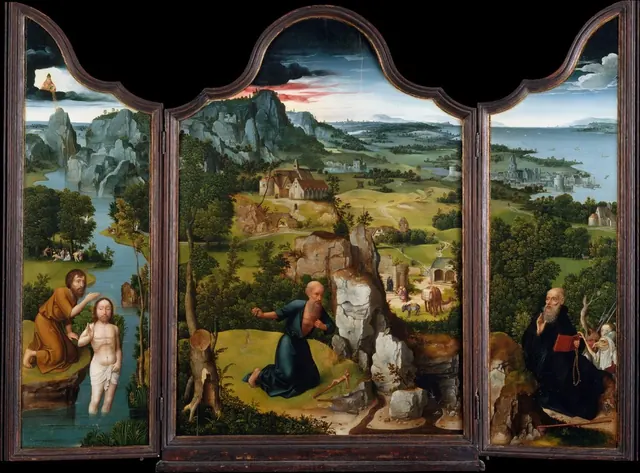
The painting’s story and details
Different events unfold across the three panels. On the left John baptises Christ, in the centre Jerome performs penance, and on the right demons surround Anthony. Patinir painted the altarpiece around 1515, joining its episodes through a continuous panorama. They belong to different centuries, making this a space for comparison rather than a single historical day. Baptism, penance and resistance to temptation offer different examples of spiritual life. Meanwhile, the landscape invites us to explore far beyond each scene.
Jerome kneels before a small crucifix set low against the ground. In his outstretched hand he holds the stone with which he beats his chest in penance. He is also known for translating the Bible into Latin. Here the emphasis shifts from scholarship to physical trial in solitude. His exposed chest and the uneven rock behind him convey the severity of his chosen life.
Christ stands in the water on the left wing while John leans towards him from the bank. God the Father appears high above, with a white dove below. The earthly action is thus connected to the presence of the Trinity. The winding river recedes between cliffs and draws the eye upwards. The structure of the landscape participates in the narrative. A long space opens between the figure in the river and the sky, carrying our attention through the scene.
Anthony sits with an open red book. Beside his shoulder are a pale female face and a bird-beaked creature wrapped in white cloth. Their proximity makes temptation unsettling and ambiguous. The saint raises a hand and turns his gaze away from this crowded group. The interruption to prayer is brought right up against him. The opposite shore may be distant and peaceful, but solitude alone does not remove the possibility of trial.
Beyond the green hills lie blue bands of land and water. The farther objects recede, the less their colours differ. This is atmospheric perspective, a way of suggesting distance through changes in colour and clarity. Patinir makes it especially effective by giving us an elevated viewpoint. Several river bends, settlements and a distant coast become visible at once. The frames interrupt the painted surface, while the continuing shoreline lets us join the space in our minds.
Behind Jerome are a church, a road and pack animals. His secluded spot adjoins settlements and human movement. These details give the landscape a life of its own that rewards exploration. This raises a question about the altarpiece itself. The viewer is asked to attend to the saint’s penance, yet the painter’s work draws the eye towards buildings, paths and shores. That might be experienced as a distraction from prayer or as a way to reflect on the world in which prayer takes place.
The wings could be closed. Their reverses show Saint Sebald and Saint Anne with Mary and Christ. Sebald’s association with Nuremberg has led scholars to suggest a Dominican monastery there as the original destination. This remains a hypothesis. The presence of two sides changes our usual museum perspective. The complete panorama was only one possible state of the object. Closed, the altarpiece offered a different group of images and a different scale of attention.
More paintings to compare
Period, style and subject
- Movement
- Northern Renaissance
- Genre
- Religious art
- Medium
- Oil on wood
- Collection
- The Metropolitan Museum of Art
- Dimensions
- Shaped top, 117.5 × 81.3 cm
- Accession number
- 36.14a–c
Sources
Image provided under CC0. Image licence