The Annunciation
Hans Memling · ca. 1465–70
Explore the painting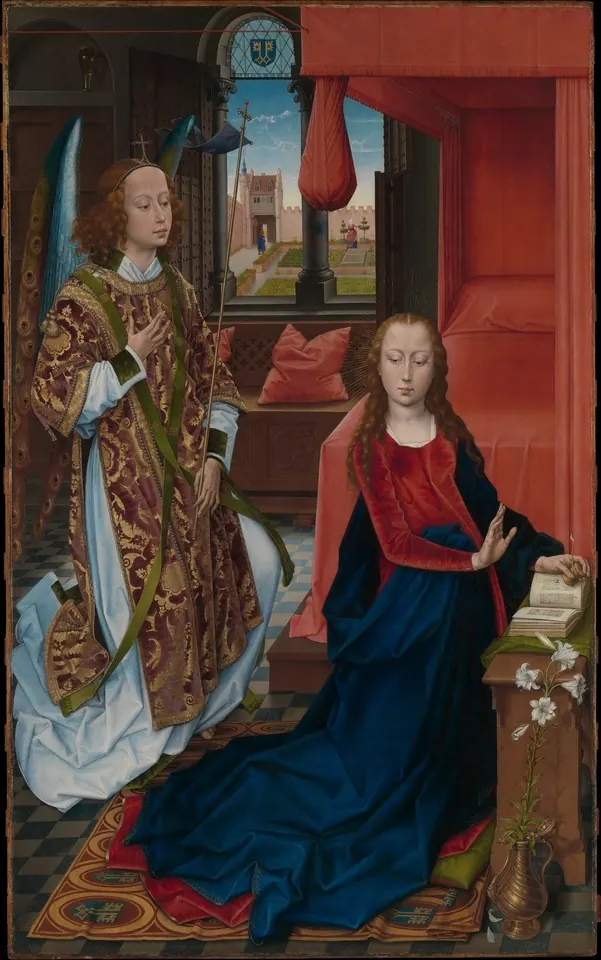
The painting’s story and details
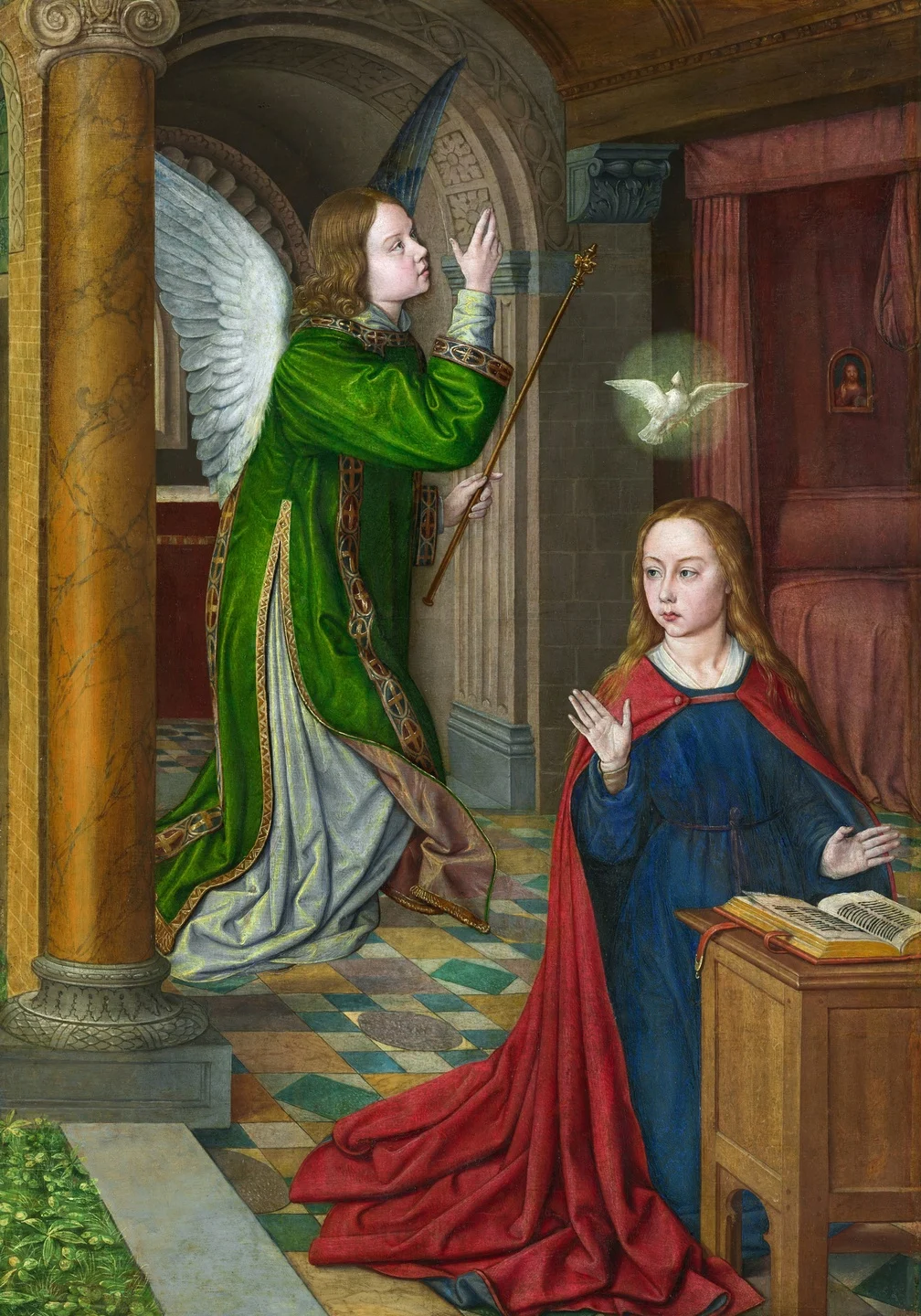
An angel tells Mary that she will become the mother of Christ. Memling sets the Annunciation in a spacious bedroom with carved furniture, a carpet and a red canopy. Almost two metres tall, the painting was probably intended for the burial chapel of the church dignitary Ferry de Clugny in Autun.
Mary turns from her book and raises a hand. Her blue cloak gathers in heavy folds on the floor. The sacred event takes place among familiar furnishings, interrupting her reading.
Gabriel’s clothing resembles liturgical vestments. A golden pattern runs across the heavy outer fabric, with white clothing visible underneath. He carries a staff topped by a cross. His appearance connects the bedroom encounter with worship, where precious fabrics and embroidery were familiar to fifteenth-century viewers.
White lilies stand in a metal pitcher below. In Annunciation scenes, lilies conventionally signify Mary’s purity. Here that symbol belongs to the room’s furnishings. The pitcher has a handle, a neck and highlights across its body, like an object that could actually be used.
The red canopy occupies much of the upper right corner. The colour returns in the cushion beside the window and in Mary’s clothing. These large areas connect the back of the room with the foreground. Luxury takes material form in the bedding’s folds and the carpet’s pattern.
Two joined keys appear in the stained glass and the carpet. They are Ferry de Clugny’s arms, the principal evidence connecting him with the commission. He founded his burial chapel in 1465. His heraldry places the memory of a particular person within a biblical event many centuries earlier.
The composition derives from Rogier van der Weyden. The commission may originally have been intended for him, but Rogier died in 1464. Technical evidence links the young Memling to his workshop. Designs and commissions could pass from teacher to pupil alongside painting techniques.
More paintings to compare
Period, style and subject
- Movement
- Northern Renaissance
- Genre
- Religious art
- Medium
- Oil on wood
- Collection
- The Metropolitan Museum of Art
- Dimensions
- 186.1 × 114.9 cm
- Accession number
- 17.190.7
Sources
Image provided under CC0. Image licence